Next week the Commission is expected to outline a plan in which governments will no longer have veto power over most EU trade deals. It could be a game-changer for the Brexit negotiations.
One year ago, as Canadian Prime Minister Justin Trudeau prepared to board a plane tp Brussels to sign a landmark free trade deal with the European Union, he had a bone to pick with some fellow Francophones 4km to the south of the EU capital.
The deal was done and all 28 EU national governments had agreed to it. But the tiny region of Wallonia, the French-speaking, politically far-left Southern part of Belgium, was threatening to wield a veto. A region of 3.5 million people was about to unilaterally kill the trade deal agreed by the other 509 million.
The premier of Wallonia asked Trudeau to cancel the visit, saying it would be a "provocation" to do so while Wallonia had not yet given its assent. The Canadian PM cancelled his flight, but he was not pleased. "If, in a week or two, we see that Europe is unable to sign a progressive trade agreement with a country like Canada, well then with whom will Europe do business in the years to come?" he asked.
Showing posts with label Canada. Show all posts
Saturday, 9 September 2017
Monday, 20 February 2017
A Canada-EU alliance is forming against a Russia-US-UK axis
Simultaneous visits to the EU by Justin Trudeau and Mike Pence reveal the ideological rift that is rapidly tearing the West apart.
If Mike Pence was expecting a warm welcome in Brussels today, he will have been unpleasantly surprised. The arrival of the US vice-president was greeted with protests from citizens on the streets and scowls from European Union lawmakers, in scenes reminiscent of the 2003 fallout from the Iraq War.
The hostility in the air was all the more palpable when compared to the reception of the Canadian prime minister Justin Trudeau just three days earlier. The European Parliament had Trudeau-mania, and some lawmakers were even seen being moved to tears by Trudeau's call for EU-Canadian unity, as detailed hilariously by Euractiv's James Crisp on Friday:
If Mike Pence was expecting a warm welcome in Brussels today, he will have been unpleasantly surprised. The arrival of the US vice-president was greeted with protests from citizens on the streets and scowls from European Union lawmakers, in scenes reminiscent of the 2003 fallout from the Iraq War.
The hostility in the air was all the more palpable when compared to the reception of the Canadian prime minister Justin Trudeau just three days earlier. The European Parliament had Trudeau-mania, and some lawmakers were even seen being moved to tears by Trudeau's call for EU-Canadian unity, as detailed hilariously by Euractiv's James Crisp on Friday:
Tuesday, 17 January 2017
May's Brexit vision depends on the goodwill of Australians
Brexit Britain will cut itself off from Europe and 'turn to the world'. But does the world want them? In Australia, feelings are ambivalent.
This morning in London, Theresa May will make what is probably the most important speech of her political career.
The British people "voted to leave the European Union and embrace the world" she will say, outlining a vision for the UK to completely cut itself off from the EU and instead focus on rebuilding a globally-focused maritime trading empire. The first focus will be on the countries which share a monarch with Britain - Australia, New Zealand and Canada.
I've been travelling through Australia for the past two weeks as part of a month-long visit, and I've been asking Australians how they feel about being part of Britain's glorious new trading vision. The reaction has largely been bemusement. But more on that later.
This morning in London, Theresa May will make what is probably the most important speech of her political career.
The British people "voted to leave the European Union and embrace the world" she will say, outlining a vision for the UK to completely cut itself off from the EU and instead focus on rebuilding a globally-focused maritime trading empire. The first focus will be on the countries which share a monarch with Britain - Australia, New Zealand and Canada.
I've been travelling through Australia for the past two weeks as part of a month-long visit, and I've been asking Australians how they feel about being part of Britain's glorious new trading vision. The reaction has largely been bemusement. But more on that later.
Friday, 14 October 2016
Soft Brexit or Hard Brexit? It's a false choice
Today's vote in Wallonia against an EU-Canada free trade deal makes it painfully clear - Europeans will not approve any arrangement that lets Britain have its cake and eat it too.
Over the past weeks, people in the UK have been engaged in a tortured debate - should we have a "hard Brexit" or a "soft Brexit"?
A hard Brexit, viewed by most people (even the Brexiteers) as the worst outcome, would mean that the UK cuts economic ties with Europe, and continues to trade with the EU only on WTO terms. In other words, the UK is left with the same relationship with the EU enjoyed by Morocco.
A 'soft Brexit' would mean the UK retains market access while formally leaving the EU. This would occur either by the UK joining the EEA (à la Norway and Iceland) or negotiating bilateral treaties (à la Switzerland). Either of the latter two options would involve compromise. Crucially, the EU has made clear that the UK can't have either of these "soft Brexit" scenarios without maintaining freedom of movement (the ability for EU citizens to live and work in any EU country).
Over the past weeks, people in the UK have been engaged in a tortured debate - should we have a "hard Brexit" or a "soft Brexit"?
A hard Brexit, viewed by most people (even the Brexiteers) as the worst outcome, would mean that the UK cuts economic ties with Europe, and continues to trade with the EU only on WTO terms. In other words, the UK is left with the same relationship with the EU enjoyed by Morocco.
A 'soft Brexit' would mean the UK retains market access while formally leaving the EU. This would occur either by the UK joining the EEA (à la Norway and Iceland) or negotiating bilateral treaties (à la Switzerland). Either of the latter two options would involve compromise. Crucially, the EU has made clear that the UK can't have either of these "soft Brexit" scenarios without maintaining freedom of movement (the ability for EU citizens to live and work in any EU country).
Tuesday, 19 November 2013
Quebec: no need for readmission
Given that it is the only significant independence movement in the developed world outside Europe, the cause of Quebec secession is often used as an example in discussions of separatism in the European context. And so it was perhaps not surprising that at an event at the European Parliament last week about independence movements within the EU, a Quebecer was on hand to share his experiences.
The European Free Alliance (EFA), a collection of seven separatist members of the European Parliament from Scotland, Wales, Corsica, Flanders, the Russian community in Latvia and the Basque Country, hosted the event on “the right to decide” last Wednesday (13 November). The group sits in a sometimes uncomfortable common group with the Greens, who notably had little by way of promotion of the event on the group’s website.
In addition to Quebec, the event looked at the independence referendum situations in Scotland, Catalonia, the Basque Country, Wales and Galicia.
Europe has long had a strange relationship with Quebecois separatism. The situation in Belgium is often compared to that of Canada. France has been a strong supporter of Quebecois separatism, while simultaneously suppressing separatist movement sin Corsica, Brittany and Savoy. But are there really lessons for Europe from Quebec’s experience?
Monday, 24 September 2012
Britain snubs Europe, goes to the dance with Canada
It shouldn’t be a surprise to anyone that UK foreign
secretary William Hague has found a new way to annoy his European counterparts.
But today he’s managed to bring a North American country into the fray, and for
once is isn’t the one with whom he believes he has a “special relationship”.
During a visit to Canada
today Hague announced that the UK
is going to close some British embassies across the world and merge them with Canadian
embassies. The two countries will establish joint diplomatic missions, sharing
embassy offices and consular services.
The move, an attempt to save money in these cost-cutting
times, might seem logical enough at first glance. But the more you delve into
it the more you realize it is diplomatically and logistically bizarre. While
the UK and Canada may have
similar foreign policy (something irrelevant to the consular services they are
merging), they are completely separate countries which share no unified visa
system. The only thing they share is a queen.
Wednesday, 3 December 2008
Guest Blogger: The Queen and Canada's Crisis
As I watched pomp and pageantry of the Queen's speech this morning, I couldn't help but reflect a bit on the role of the British monarchy in the modern world. Though the role is now mostly ceremonial, the British government still depends on it to function properly. For instance, parliament cannot open its new session without the Queen's blessing and speech. But the monarchy can have sudden importance outside Britain as well. And this is being born out in Canada at the moment.Domestic news in Canada usually gets short shrift both in the US and Europe, but at the moment some huge events are unfolding over there that could topple the current government and change the face of Canadian politics permanently. It's a bit complicated, but essentially all of the opposition parties are wishing to band together and form a coalition against the currently ruling Conservative party. A coalition government has never before been formed in Canada, and doing so would completely shape the political landscape there. The big question is whether the parties will be allowed to band together to oust the goverment and rule in tandem. And the person who will decide the answer to that question? None other than the Governor-General of Canada, who answers directly to Queen Elizabeth II. Canada is still, after all, technically under the rule of the British monarch. And it could be the British monarch that will decide this hugely important question for her dominion on the other side of the Atlantic.
I'm not very knowledgable about Canadian politics, so my friend Dan Berrier, a pollster in Washington DC was nice enough to explain the situation. Enjoy!
Canada in Crisis
By Guest Blogger Dan Berrier
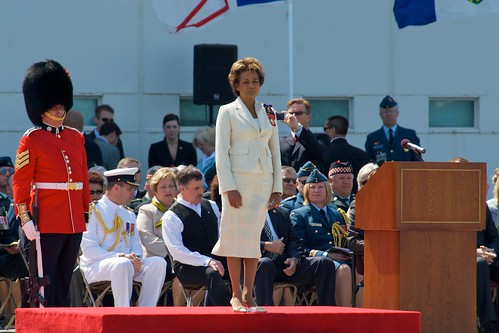
Standing in the center of it all is a woman named Michaëlle Jean, the 27th Governor-General of Canada, who will have to mediate with Conservative Prime Minister Stephen Harper and the Opposition leaders and come to a series of decisions that preserve the Canadian's people's faith in their government and in their constitutional processes. It is truly representative of 21st century multi-cultural Canada that this responsibility rests on the shoulders of a woman of African descent, born in Haiti, who moved to Montreal as a child and became a distinguished television journalist before being appointed to this largely ceremonial and symbolic post. For Americans, it would be as if Barbara Walters, with a lot of advice from lawyers and constitutional scholars, was entrusted with some unique and abstract role as the final arbiter on important constitutional matters. Technically speaking, Jean is the sovereign's representative, in this case, the Queen of England. But in reality, she serves the Canadian people and is supposed to make decisions that will stand the test of time, set precedent, and maintain the trust of the public.
The politics of Canada over the last 20 years have been defined in large part by two movements, Quebec separatism and Western regionalism, as well as the mainstream political reaction to these strains on national unity. For most of the post-war period, Canada's two leading political parties, the Liberals and the Conservatives (formerly the Progressive Conservatives), have held sway and ruled the country. Most of the time, one party or the other would win a majority of seats in the House of Commons, and thus form a majority government.Along with these two parties, the NDP (New Democratic Party) also gained support from trade unions and the left, but never garnered more than 20 or 30 seats in the House of Commons, though they did win some provincial elections. In 1988, they hit somewhat of a breakpoint and earned 20% nationally under the leadership of Ed Broadbent. This coincided with two strong showings by the Conservatives and a much weakened Liberal Party.
The 1993 election saw the emergence of Quebec separatism and Western regionalism as major forces in national politics. The Bloc Quebecois won 54 seats and became the second largest party after the Liberals, who won a landslide victory and decimated the Progressive Conservatives, who were down to just 2 seats. The Reform Party, a new conservative party that promised to advocate for a greater voice for Western Canada won 52 seats in Manitoba, Saskatchewan, Alberta and British Columbia.
Throughout the 1990s, Liberal Prime Minister Jean Chretien served the country, still winning some seats in Quebec, his home province. This limited the appeal of the Bloc and helped the Liberals stay in power. The Liberals went on to win two more impressive victories, in 1997 and 2000, assisted by the fragmentation on the political right, as Progressive Conservatives still won seats in Eastern Canada and Reform won seats in the West. In Ontario, both of these parties ran candidates, splitting the conservative vote and ensuring continued Liberal dominance in Canada’s most populous province.
With the end of the Chretien era, Liberal popularity waned, and the Conservatives finally put aside their differences, merging the eastern Progressive Conservatives with the western Canadian Alliance (formerly the Reform Party). This new Conservative Party would present a single slate of candidates and was anticipated to dramatically improve its performance in Ontario, where they had been dividing their vote.
The Liberals managed to hang on in 2004, Prime Minister Paul Martin, Chretien's successor, won a minority government by taking 135 out of 308 seats, falling short of the 155 needed to form a stable majority government. The NDP did well, winning 15% of the vote and 19 seats. Their strengthened position, along with the Bloc's continued dominance in Quebec seemed like it would make it very difficult for any national party to again win a majority government.
Without the support of a majority of parliament, a government in Canada must tread very carefully. They need to earn either the support of opposition parties to pass their budgets, or at least get them to agree to abstain. Because continual elections do not allow any of the parties to rebuild, they typically manage to cooperate and allow minority governments to last at least one or two years. This tenuous position gave even more power to the NDP and to the Bloc Quebecois, in effect allowing them to play kingmaker. In 2005, the then-Conservative leader Stephen Harper tried to make a deal with both the NDP and the Bloc to bring down the Liberals, but this failed.
Martin lasted until 2006, when he was forced to call another election. This time the Conservatives came out in front, but with a government even weaker (124 seats) than the Liberal one preceding him. They won by dramatically increasing the number of seats they won in Ontario, while strengthening their near monopoly of seats in the West, especially in Alberta.
After two and a half years in power, Prime Minister Harper thought that October 2008 would be the time that he could win his long sought majority. But again, his hopes were dashed in Quebec and Atlantic Canada, where the party lost seats in Newfoundland and made no gains in Quebec. Further gains in Ontario helped the party move from 124 to 143 seats, but he was still 12 votes short of his majority. Without a majority, the Conservatives knew they could get very little done.
What is happening now is the aftermath of that election, in which just 37% voted Conservative and still elected a government. The remaining 63% voted for another party. More voted Green than ever before, earning 7% of the vote but no seats in the House of Commons. The NDP won 18% and strengthened to 37 seats. The Liberal Party was badly bruised, winning only 26% of the vote and just 77 seats, a historic low. The Bloc Quebecois won the remaining 10%, entirely in Quebec, winning 49 seats.
Mr. Harper’s actions following the election, not agreeing to a major economic stimulus package, and threatening to cut off public funding for political parties infuriated members of the opposition. They realized that the time to fight the Conservatives was probably now or never. With their funding removed, they would be seriously hampered in competing in the next election or any kind of public relations battle with the much better funded Conservatives. That was the final trigger to make them decide they had to try to bring down Mr. Harper at the very start of this parliament.
The political fragmentation of the left is now seriously plaguing Canada and is what the leaders of "the Coalition" are trying to remedy. Their fundamental argument is that they represent the wishes of more of Canada's public than do the Conservatives, and that they should rule the country. This is perhaps true, but their many factions will make governing difficult. They may be able to cobble together a government, but it will not last through an election unless there is some kind of long-term agreement. What is needed is either a merging of the two main left-wing parties, the Liberals and the NDP, or at least some kind of agreement to not run candidates against in each other in parliamentary ridings where one candidate has a chance to win and the other does not.
The prominent role of the separatist and left-wing Bloc Quebecois in the coalition (though just in parliament, not in the Prime Minister's cabinet) will unnerve the rest of Canada. The provinces of the west, particularly Alberta that is almost entirely represented by Conservatives in parliament, will become more and more alienated. This will be even more of a problem for a new coalition government if the Conservatives are successful in painting it as illegitimate.
This is where the role of the Governor General becomes so important. It is likely that Prime Minister Harper will ask her to “prorogue” Parliament, essentially hitting the restart button, and dismissing them until late January when he will present a budget. This would prevent his government from falling after losing a no confidence motion on the floor. It is an open question whether the Governor General could turn down the request. Undoubtedly, she has the authority to do so, but it has never been done before in the history the country. But it is also true that a Prime Minister has never made such a request so soon after an election, and for the express purpose of avoiding a vote of no confidence. While undoubtedly provoking outrage, it is not inconceivable that Jean could simply tell Mr. Harper no and let his government fall on Monday, December 8th as is currently scheduled.
If she grants his request and institutes a prorogation, he would likely lose in January anyway, if the coalition managed to stick to their guns and vote him down. Giving the Conservatives six weeks to de-legitimize the incoming coalition government does not seem as though it would serve the interests of Canada very well. But it may serve to maintain the standing of her office, whose enormous powers are only respected because of the reverence people have for the office. These powers are only really exercised in the most rare circumstances. If she denies the Conservative request for a delay, she will likely be painted as a Liberal stooge, since she was chosen when a Liberal prime minister was in office. Her Quebec roots, and her husband’s alleged separatist sympathies would also be highlighted by a Conservative Party, mostly of Western Canadians, outraged at their sudden loss of political power. The damage to her office could be significant.Once the vote of no confidence takes place, either next week or in January, it seems likely the Conservative government will fall and the Governor General will face another choice, this one much easier. Prime Minister Harper will go to her and request the dissolution of the House of Commons, triggering another election, just six weeks after the last general election. With the country inclined against such a course of action, she will have much greater standing to deny this request and take up Liberal leader Stephane Dion’s offer to form a coalition government supported in the House by the three major opposition parties.
The reaction in Western Canada to this course of events will be interesting to watch. There are reports that the Separation Party of Alberta is already getting a flood of angry emails, phone calls and volunteers. This may just be bluster, but it is representative of very real and lasting divisions in the country between east and west, and over Quebec. The reaction of Conservative leaders to this loss of power will be critical. Will they turn further to the right and further west, with some prominent politicians joining the call for separation or more regional sovereignty? Or will it just be a temporary blip in Canada’s political history?
The future of the Liberal Party will be even more dramatic to watch. Having just lost an election, Stephane Dion has already announced his intention to step down as leader of the party. They will choose between Michael Ignatieff, Dominic LeBlanc and Bob Rae. Whoever wins this election would then immediately become Prime Minister, with Mr. Dion stepping aside.
Even more important than the future of the Liberal Party is the future of the entire Canadian left. Going into another election as they did the last three, with votes being divided between the Liberals, the NDP and the Greens, they will undoubtedly be much weaker than they would be if they were more united. Will the governing experience motivate these parties to come to some type of agreement to be able to unify? Will they at least be able to coordinate in some fashion so as to not defeat each other’s candidates in marginal seats? If they can manage to do this in some fashion, they may be able to govern in the next parliament without the support of the Bloc Quebecois. Without stronger numbers, Quebec will undoubtedly seek more concessions and money from the federal government, and a weak coalition will have no choice but to acquiesce to these demands.
Canada is facing more than just a political battle about economic stimulus and Stephen Harper. The very foundations of their parliamentary democracy and sense of national unity are being tested. What is needed is a fundamental re-consolidation of the political party structure on the left to again restore stability. This will present Canada with a true choice, between a Conservative Party that gains support from all across the country and a left wing party that is diverse and welcoming of different ideas, but is mature enough to cooperate and to govern. The worldwide economic crisis has now forced that coalition together and they will likely be given a chance to try. I hope that this is just a first step in a process that will again see political stability come to Canada. What will be needed in May is a Liberal leader that can step up to the plate and seize that mantle. Who will it be Mr. Ignatieff, Mr. LeBlanc and Mr. Rae?
Subscribe to:
Posts (Atom)