Showing posts with label British Empire. Show all posts

Tuesday, 17 January 2017

May's Brexit vision depends on the goodwill of Australians

Brexit Britain will cut itself off from Europe and 'turn to the world'. But does the world want them? In Australia, feelings are ambivalent.

This morning in London, Theresa May will make what is probably the most important speech of her political career.

The British people "voted to leave the European Union and embrace the world" she will say, outlining a vision for the UK to completely cut itself off from the EU and instead focus on rebuilding a globally-focused maritime trading empire. The first focus will be on the countries which share a monarch with Britain - Australia, New Zealand and Canada. 

I've been travelling through Australia for the past two weeks as part of a month-long visit, and I've been asking Australians how they feel about being part of Britain's glorious new trading vision. The reaction has largely been bemusement. But more on that later.

Thursday, 28 January 2010

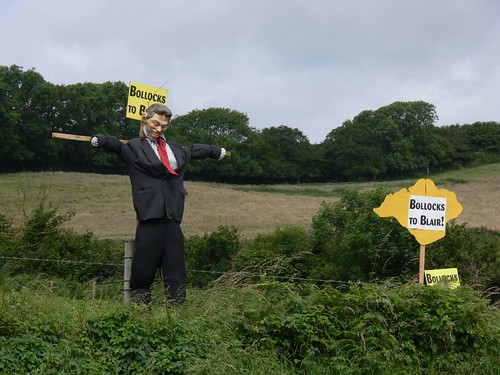
Tony Blair the scapegoat

The UK has been in frenetic anticipation this week of Tony Blair’s testimony Friday in front of the Iraq War show trial, er I mean, inquiry. The British media has been baying for a dramatic crescendo to the three week grilling of former cabinet officials who were involved in the decision to join the war. So far it's failed to deliver the “smoking gun” of conspiracy they’ve wanted. My inbox this week has been flooded with emails from activists and NGOs demanding this or that question be asked of Blair. Anticipation is so high that Channel 4 News actually spent 15 minutes last night doing a staged enactment of how the proceeding might go on Friday.

But despite the high theatre, the inquiry has failed to reveal anything too interesting. Given that the panel has focused so relentlessly on the accomplice rather than the perpetrator of the Iraq War, one could have expected similar results from an inquest of Austrian officials after World War II to “unearth the truth” about the invasion of Poland.

Tuesday, 4 August 2009

Ireland and its Various Dark Ages

I’ve just returned from a little weekend jaunt to Dublin, where I met my dad and my brother who flew over from Switzerland. It was actually my first time visiting Ireland, and it was great to finally visit a country that I’ve long focused on, both recently with the drama of the Lisbon Treaty ratification and in the past as a teenager when I looked to my Irish roots for a sense of identity and pride – something quite common in the US.

Ireland is a popular destination for American tourists, largely because so many Americans claim Irish heritage. Despite the fact that I’ve travelled all over Europe, the first question my relatives and friends back home always ask is if I’ve been to Ireland. It seems to have taken on the aura of a ‘holy land’ for the Irish diaspora, and for Americans the country has come to be more of a concept than an actual geographic place. To be fair, many Americans use their Irish ancestry to excuse bad behaviour like drunkenness or fighting, but many also feel a deep connection with Celtic traditions and the historical struggle of the Irish people.

I myself was not immune to this wistful gazing toward the emerald isle. I’m essentially only a quarter Irish (and Keating is an Anglo-Norman Irish surname rather than a Celtic one), yet as a teenager I went through a phase where I was fascinated by my Irish heritage, getting really into Celtic new age music and Druidic history. I dreamed of one day going to Dublin, the veritable Jerusalem of the Irish diaspora.

So I finally made it there, though by this point in my life Ireland no longer holds the same fascination for me. In fact coming from London I definitely arrived in Dublin with different expectations than I would have had coming from the US years ago. They say that many American tourists, arriving in Dublin expecting to find a gleaming Shangri-la, are struck by the issues of poverty the city still grapples with today. However living in the UK for the past three years I guess I’ve come to view Dublin as more of a regional city on the periphery of the British Isles, like Manchester or Birmingham – gritty, tough and far from London.

Actually Dublin reminded me of a smaller, grittier London. In fact it didn’t really feel like I had left the UK, not least because there is no passport check between the two countries. The Georgian and Victorian buildings, the loutish drinking culture, the use of British English and the endless array of British chain stores didn’t exactly seem foreign to me. Nor did the weather, as it was overcast and rainy most of the weekend!

Birth of a Nation: A Slow Start

In Dublin today you can really see the city existing between the three very different periods of its history: the intimidating Georgian splendour of its heyday as the second city of the British Empire, the drab and repressive first decades of the Irish republic, and the boom times of the IT and EU-fueled growth in the 1990’s.

Of course I imagine there are plenty of Irish people who would take issue with the above characterisation of recent Irish history, but listening to tour guides and locals it was impossible to ignore this distinct split. Almost every major landmark in Dublin was built by the English: Christchurch and St. Patrick’s cathedrals, Dublin Castle, the Bank of Ireland, the Four Courts, Custom house, St. Stephen’s Green, the list goes on (of course, there was a cruel tyranny these impressive monuments reflected). The guides will also proudly point to the shiny glass skyscrapers and monuments built in the years since the boom of the 1990’s: the redevelopment of the docklands, the financial centre, the new tramway, etc.

Yet as far as I could tell the only notable thing on the tourist map that was built by the Irish between the years of 1921 and 1990 is that ghastly spike in the middle of O’Connell street, which was put up after the IRA blew up a British-built mock Nelson’s Column in the 1970's. (the commenter below has alerted me to the fact that the spike was put up in 2003, so actually this wasn't built in the republic's first decades either!).

The more I read and talked to people, the more it seemed like now at the turn of the 21st century, those first decades of Irish Independence are starting to be seen as the proverbial ‘dark ages’. The country was hopelessly poor and saw its population fall throughout the period. Major literary figures, of whom the country has produced many, fled the country in reaction to the strict censorship laws imposed by the government, which was so closely aligned with the Catholic church it could almost have been considered a theocracy in all but name.

Incredibly, divorce was illegal in Ireland until 1995, and even then it only passed by a tiny margin. Homosexuality was a crime until 1993. Abortion is still illegal in the country, abut in the 1990’s rules were loosened to allow women to travel out of the country to get one.

How things have changed in 20 years. After Ireland joined the EU, it benefited from a huge wave of investment from Brussels. The government shrewdly used this money to position Ireland away from its history as an agrarian economy and toward a knowledge-based economy, instituting one of the lowest corporate tax rates in the world to entice US companies to set up shop there. The strategy paid off. Today Ireland has one of the highest GDPs per capita in the world, and in contrast to the decades after independence, it now has the highest population growth rate in Europe.

The evidence of this change can be seen in redeveloped pockets of Dublin, where a new, cosmopolitan vibe has taken hold. The boom times may have peaked off at the beginning of this decade, and Ireland may be suffering comparatively worse during the global recession, but it seems the attitude of the Irish, especially of Dubliners, has been irrevocably changed. These new Euro-Dubliners travel around the continent, sip cocktails in chic lounge bars by the river Liffey, and work in beautiful new office buildings in the redeveloped docklands by day. It doesn’t seem that anyone is in a big hurry to go back to the old days of an isolationist government under the foot of the Catholic Church (particularly after the church’s sex abuse revelations over the past two decades).

Nowhere is this more reflected than in a statistic I read in an Irish newspaper that 83% of the country favours enacting civil unions for same-sex partners (currently Italy and Ireland are the only two countries in Western Europe that don’t have a gay partnership framework).Last week the government published the civil unions law, and the gay community in Ireland right now is in the midst of a heated debate over whether to accept the proposed law (which stops far short of giving same-sex couples the same rights as heterosexual couples) or to refuse to accept anything but full marriage. It reminds me a bit of the debate that raged in Ireland after the Anglo-Irish treaty was drafted in 1920 offering Ireland conditional independence, with a civil war eventually erupting between those Irish who supported the treaty giving the lower counties autonomy under the British monarch, or those who said the country should refuse to accept anything but full independence for the entire island. I guess the age-old battle between idealists and pragmatists never changes.

EuroIreland

One thing I was really surprised by was how many tourists from continental Europe I saw in Dublin. I was expecting the vast majority of tourists to be American, with Brits, Canadians and Australians making up the rest. I figured without the mystique that Americans attach to it, rainy, quiet Ireland might not be the top destination for continentals. Yet throughout the weekend I was hearing Spanish, French Italian and German all over the place. I was especially hearing a lot of French – which I found really surprising. Even the bus tour we took of the Wicklow mountains on Saturday – which I thought would surely be all Americans – was mostly populated by continental Europeans. Colour me surprised!

Perhaps it just goes to show how much more European Ireland is these days. Despite the oft-used adage that “Dublin is closer to Boston than to Berlin” (geographically inaccurate but probably culturally true), there was plenty of evidence that Dublin, at least, is becoming Europeanised.

So where does this leave the Lisbon Treaty? Popular wisdom says that the Irish public will vote to approve the EU’s reform treaty, which it rejected last June, at the re-vote in October because the country’s financial situation has deteriorated so much since the first vote.

By this line of reasoning the Irish seem to only wanted to engage with Europe when it was going to give them money, and didn’t seem too keen to give something back once Ireland was doing well and the new entrants of Eastern Europe needed a helping hand. This is perhaps a rather cynical explanation, but given the morass the EU helped pull the country out of, it’s hard for me to understand the ‘no’ vote last year. Despite all its progress, are there still isolationist urges embedded in Ireland’s very DNA?

It seems to me that all evidence points to the fact that Ireland works best when it works in cooperation with others, not when it tries to go it alone. One need only look at the agenda for any tour of Dublin to see that.

Sunday, 18 November 2007

Farewell, crown jewel

My India visit is drawing to a close, I'm now just trying to kill time while I wait for my very long journey home. Overall it was an interesting and enjoyable trip but I'm eager to get home and be in my own bed. Interestingly, when I lived in New York I would dread going back after a trip, but now each time I go away reinforces how much I love living in London. It's funny, I moved there feeling fairly neutral about the city and have ended up - dare I say it - falling in love with London.

Bombay has been interesting, I definitely enjoyed it more than Delhi. It's so much easier to get a handle on, being as centralized and compact as it is. I’d say Bombay is like New York and Delhi is like DC, both in terms of their layout and their vibes.

Exploring all of the Victorian architecture here in Bombay is a real trip. It’s also nice the way it’s laid out all along the Arabian Sea. The air quality is still horribly bad, but at least in Bombay you get a breeze off the ocean, unlike in Delhi where the dirty air just seems to hang there. Either way I’m eager to get a gasp of fresh air once I get back to London.