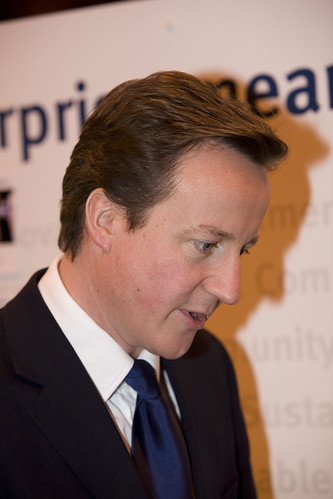
It’s unusual for an EU commission president to serve more than one term, and many in the parliament and member states opposed him. So how exactly did the former Portuguese prime minister squeak by on re-appointment to the EU’s highest office today?
The short answer is, there wasn’t really any alternative.
Barroso is from the centre-right European People’s Party (EPP), which currently has a majority in the European Parliament and the leadership of most EU member states (including Germany, France and Italy – and though the current British government is not technically centre-right, Brown strongly supported Barroso’s re-appointment). Still, there was great concern about his re-appointment resulting in a “lame duck” commission presidency for the next five years.
Barroso’s first term as president of the EU’s executive body has been fairly lacklustre, having overseen the defeat of both the EU Constitution and the Lisbon Treaty (although the latter will likely soon pass in the Irish re-vote next month). Many have accused him of not having a “grand vision” for Europe, or even a cohesive idea of where the union should go. His tenure has been marked by a drift into Euro-stasis, a paralysation over the past five years that stands in marked contrast to the gung-ho attitude in Brussels before his tenure at the turn of the millennium.
But the fact that he was re-appointed handily despite all these misgivings (he was even able to obtain an absolute majority of 389 votes today – a big triumph for him) shows just how severe the Brussels leadership crisis is. Despite their intense opposition to Borroso’s re-appointment, the Socialists failed to come up with any candidate to oppose him. No candidate emerged from those who had misgivings on the right either, though France’s prime minister did seem to be toying with the idea for a bit earlier this month.
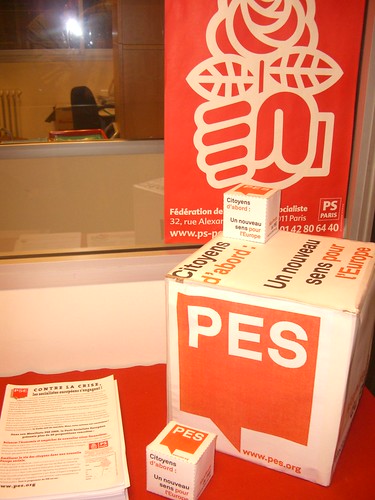 Immediately after the vote the Party of European Socialists (PES) issued this press release saying that as the second largest block in the parliament, they will insist on being given one of the “three key EU posts”. By that they appear to mean the Commission President, the High Representative (which will be empowered by the Lisbon Treaty) and the Council President (a post that will be created by the Lisbon Treaty).
But considering that they weren’t even able to field an opposition candidate for the commission presidency, who exactly are they thinking they could field for the first “president of Europe”? Tony Blair has been floated as an idea, and as a Labourite he is technically in the PES. But considering his support for the Iraq War and his role as a champion of free-market Anglo-Saxon economics, its doubtful continental PES members would be too pleased with this choice.
If Barroso’s second term does indeed turn out to be a “lame duck presidency” it will be interesting to see how this affects the development of the two new positions created by the Lisbon Treaty. Both of them have been really vaguely defined, and their remit and power will be largely shaped by their first holders. If the offices are held by two socialists in opposition to a weak or irrelevant Barroso, it could have the effect of strengthening the Council at the expense of the Commission. This could go some way in satisfying those who complain about Europe’s “democratic deficit”, as the Commission is an unelected institution.