Showing posts with label Moscow. Show all posts

Tuesday, 19 May 2009

The West is Back

One of the big flaws of this blog is that I have a tendancy to forget to write updates after I write about an upcoming event, so I thought I’d just give a quick update on the Eurovision results. Yes it is a little silly that this is my third entry about Eurovision in a week, but indulge me for a moment! I admit I’m unjustifiably fascinated by it.

As expected Norway came away the winner, but what was perhaps not expected was the huge margin by which they won (the largest in Eurovision history). In a distant second came fellow Scandinavian country Iceland with a lovely slow song called “Is it True,” and in third place was, inexplicably, Azerbaijan (huh??).

Western Europe can be pleased that it’s once again in the running, but lest people start to object that it seems to be only the Nordics that still have a shot from the West, take a look at the next few rankings. The UK came in an impressive 5th place, a far cry from the low scores it had the last few years. With Andrew Lloyd Webber penning this year's entry, it shows that a little effort can pay off. And France came in 8th, pretty good considering its entry was one of the only songs not in English and was decidedly Gallic and un-Eurovisiony in nature (Patricia Kaas definitely brought a touch of class to the proceedings!)


Some of the contest’s lowest scorers did much to show that the new voting system has ended the Eastern Europe dominance. Much to my dismay, Ukraine came in a dismal 12th (I favoured it because I met Svetlana in London awhile back but if I’m honest it wasn’t of the highest musical calibre – but what a show!). The Czech Republic was the only country to score the dreaded nul points, proving that even their Slavic heritage and Eastern geography couldn’t save them from the discerning eye of the new judging panels. Latvia, which had decidedly the worst entry in the whole competition, somehow managed to get 7 points.

So it would appear the new voting system worked. Norway should certainly put on a good show next year. Hell, maybe I’ll even see if I can get tickets. I’ve still never been to Norway. As for how the show was for the UK without broadcasting legend Terry Wogan, I couldn’t tell you. I was watching the show at a party and couldn’t hear any of Graham Norton’s narration, anyone catch it?

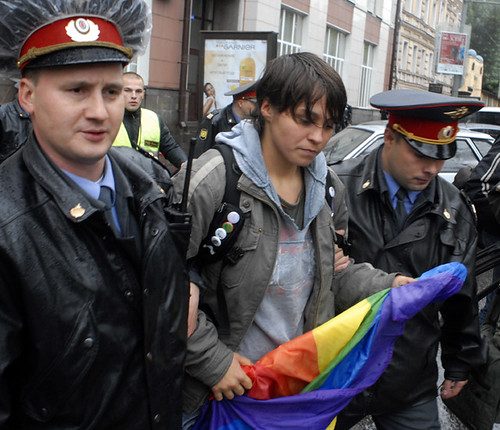
As regards the fears of violence on the Moscow streets over a gay rights protest, it appears nothing got out of hand, though the police were predictably heavy-handed. It appears they also made arrests of the Orthodox and skinhead counter-demonstraters as well though.

Friday, 15 May 2009

Eurovision Riot in Moscow?

Moscow is alive with excitement for tomorrow night’s Eurovision final, but the real drama could unfold tomorrow afternoon if violence breaks out at an illegal gay rights march in the city. With Western cameras thronging the city for the yearly song contest, Russian authorities seem astonishingly blasé about the very real possibility of some embarrassing scenes on the day of the final.

The notoriously kitsch song contest has for years been a favourite of gays and lesbians, in fact it’s often been said that the only people left in the UK who still watch Eurovision are gays (an exaggeration I’m sure). Wherever the contest is held, gays usually flock to the city to see it live. Moscow has been no different, with local hotels reporting a large number of European male couples booking rooms. But Russia is without a doubt the most gay-unfriendly place to have hosted a Eurovision Song Contest since gay rights came to the forefront of public consciousness.

Russia has ranked up there with the nations of the Caucasus and Poland for being one of the worst countries to be gay in Europe. The post-Soviet legacy has left Russian gays attacked from many sides. During the communist period homosexuality was demonized as a “Western capitalist decadence,” and many Russians see gay rights advocates as foreign intruders into Russian society (even if the activists are Russian themselves). Homosexuality was an actively prosecuted crime in Russia until 1993. At the same time the Russian Orthodox Church, which has grown increasingly powerful since the fall of Communism, considers homosexuality to be one of the worst sins imaginable. Add to that a sizable neo-Nazi presence in Russia and you have three groups ready to disrupt any gay pride march tomorrow with violence. Even the police have said they will get tough with any protest, and stories were rife three years ago of police beating marchers during an attempted pride march. Gay rights activists have an enemy in the Russian media as well, which frequently equates homosexuality with paedophilia and refers to gays as dangerous people. The Pew Research Centre has found that only 20% of Russians believe that homosexuality should be accepted by society. Gay activists are still actively prosecuted in Russia for, “homosexual propaganda towards minors” in one instance merely for holding a sign that said “homosexuality is normal”.

Gay rights activists have applied to have a march in Moscow on Saturday but their request was denied by the city’s mayor, who has described gay pride parades as "satanic”. But the activists say they will go ahead with their March tomorrow, sensing a once-in-a-lifetime opportunity with Eurovision bringing the world’s eyes (many of them Western gay eyes) to the capital. The march is set to be the largest gay mobilisation in Russia’s history, prompting the mayor to legally authorize several counter demonstrations by the Orthodox Church and neo-Nazis. The roughly 1,000 estimated gay rights activists who will march tomorrow (many of whom will be Western foreigners) will be met by 1,000 members of United Orthodox Youth. Bizarely, the counter-demonstration by the Orthodox Youth is legal, the gay march is not. The leader of the Orthodox Youth is openly saying that violence is likely.

And if the past is any indication, the result could be very embarrassing for Russia, or at least the elements in Russian government that want good relations with the West (a demographic that seems to be quickly dwindling). Two years ago the UK media reported on the story of British gay rights activist Peter Tatchell, who was badly beaten by skinheads at the first attempted gay rights parade in Moscow in 2007. After being beaten he was arrested by the police who allegedly taunted him with homophobic jokes while letting his assailants go free.

The top levels of Russian government have appeared to be completely ambivalent to the potential for violence tomorrow, but if the images are bad it would certainly be a blow for the country’s relations with the West and it could possibly even cause the expulsion of Russia from Eurovision. After Russia has poured money into this year’s contest (the most expensive in Eurovision’s history), this is probably not the outcome they were looking for. Then again, lately Russian leaders don’t seem too bothered about offending the West.