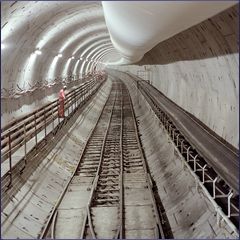
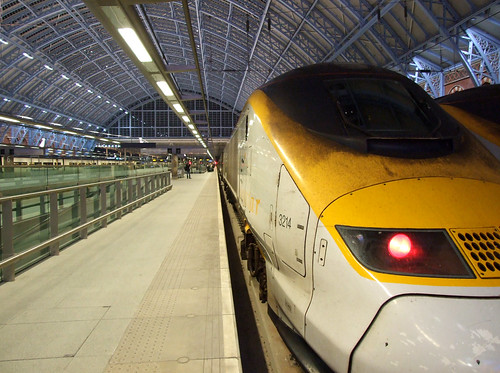
 I’m on the Eurostar at the moment heading back from a few days working in Brussels, so I thought it would be appropriate to write about this news item I just saw come across my RSS feed. While airlines still struggle to find any way to reduce their carbon emissions, it seems Eurostar is achieving reductions at a remarkable rate. Last week it announced it has achieved its target of a 35% per passenger reduction in emissions (from a 2007 baseline) two years early, and has now lowered its 2012 target for emissions reductions.
The train company, which carries passengers under the English Channel between London, Paris and Brussels, credited increased passenger numbers, a switch to nuclear energy supply for the Channel Tunnel and a series of on-train energy efficiency measures with the early success of its Tread Lightly initiative.
The results were released in a new sustainability report which also featured the results of a survey of over 1,500 travellers in the UK, France and Belgium showing that demand for high-speed rail continues to rise sharply. More than 40% of respondents said they regard the environment as a priority when making travel decisions.
 A journey on the Eurostar train generates just one-tenth of the carbon dioxide emissions of an equivalent flight, with a return journey between London and Paris generates 6.6kg of CO2 per passenger compared with 102.8kg per passenger by air. In fact Eurostar estimates that since the advent of the Chunnel Eurostar travellers have emitted an estimated 40,000 tonnes of carbon less than they would have if they had gone by plane.
Of course none of this takes into account the enormous convenience of taking a train rather than a plane. When I take the Eurostar I breeze into the station a cool 15 minutes before my train departs, and since I can leave and arrive in city centres there’s no time loss getting out to distant airports. Add to that avoiding the hassle of checking luggage and the low occurrence of delays, and I think it’s clear why I always prefer to take a train even if it will end up being longer than the air journey.
How do you say ‘high-speed’ in English?
Despite these enormous advantages, the fact remains that once I cruise into London at super velocity, that is where my high-speed journey ends. The UK has no true high-speed rail lines apart from the one coming from the continent, and even those high-speed compatible tracks south of London were just completed in 2006 (before then the Eurostar trains could only go at true high speed once they crossed into France). If I needed to continue on from London to cities as close as Manchester or Edinburgh the most efficient thing to do might be to take a plane. The fact that people are flying from Manchester to London is pretty absurd, but with the British rail system in a dilapidated and neglected state, there really isn’t any good alternative.
Even so, the trains across the pond in North America make the British trains look like marvels of modern technology. The rail network in the US has been largely abandoned, left to rot over decades as the government made a conscious decision to subsidize gas prices rather than invest in public transportation. There isn’t any proper high-speed rail line in the US - Acela in the northeast certainly doesn’t count, slower than a car at 60mph because of track limitations, costing about twice the price of a normal train just to save about 20 minutes.
 Last month President Obama unveiled a plan for developing high-speed rail lines in ten travel corridors in the US as part of the stimulus package, a plan that would both create jobs and update the nation’s crumbling rail network. Republicans mocked the inclusion of high-speed rail plans in the stimulus, deriding it as a waste of taxpayer money. I don’t know how to explain that logic, but I do know that the reality is it will be many, many years before any of these project are ready and functioning. In fact it’s been estimated that it would take 20 years for the US to get to where continental Europe is today in the area of high speed rail. It would take less time in the UK, but it would still be a long wait. In fact just about anywhere where the population speaks English, trains are creaking along quite inefficiently. Yet whether it’s on a TGV, ICE, AVE or Thalys, You can go from Holland to Germany to France to Spain all at ground speeds of up to 200mph/321kph.
The fact is that air travel is a necessity in a globalized world, and it can’t be limited without a viable alternative. Such an alternative may not exist for long-haul flights, but one certainly does for short-haul flights, particularly for those in densely populated areas like Western Europe or the Northeast US. High speed rail may be expensive (around $20 million per mile), but as the Eurostar and other lines has shown, the project can easily make the money back, and saving thousands of tons in carbon emissions in the process.