Showing posts with label eurostar. Show all posts

Wednesday, 24 February 2010

Moving to Brussels, Part 2

Well it’s official – I signed the lease for a studio apartment in the St. Catherine area of Brussels yesterday. Flat-hunting turned out to be relatively painless. I looked at some really nice places. It’s insane how cheap rent is in Brussels, if I had gone with an unfurnished apartment I could have gotten a really nice place that I could never afford in London or New York. But I decided to go with a furnished smaller place with a cheaper rent. There’s really no reason I need a big one-bedroom apartment, and I’d rather use that saved money to get out of Brussels frequently! And I was really not looking forward to the prospect of having to furnish a place, especially when I don’t know how long this little Brussels adventure will last.

This is, after all, essentially a trial. I’ll still be a UK employee on a temporary (one year) secondment in Brussels. Once that year is up (or possibly sooner) it will be time to decide how I like living in Brussels. I gave it a little test last year for a month, but spending the full year there will really let me see if it’s somewhere I can live comfortably.

Thursday, 7 May 2009

The Greenest Way to Travel

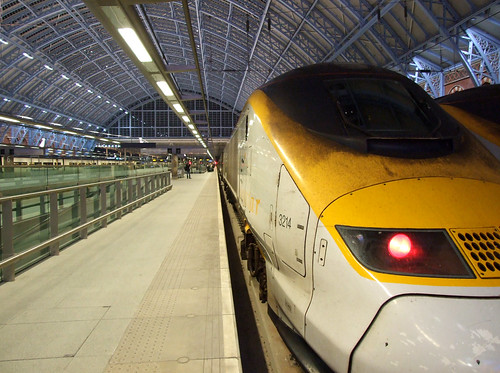
I’m on the Eurostar at the moment heading back from a few days working in Brussels, so I thought it would be appropriate to write about this news item I just saw come across my RSS feed. While airlines still struggle to find any way to reduce their carbon emissions, it seems Eurostar is achieving reductions at a remarkable rate. Last week it announced it has achieved its target of a 35% per passenger reduction in emissions (from a 2007 baseline) two years early, and has now lowered its 2012 target for emissions reductions.

The train company, which carries passengers under the English Channel between London, Paris and Brussels, credited increased passenger numbers, a switch to nuclear energy supply for the Channel Tunnel and a series of on-train energy efficiency measures with the early success of its Tread Lightly initiative.

The results were released in a new sustainability report which also featured the results of a survey of over 1,500 travellers in the UK, France and Belgium showing that demand for high-speed rail continues to rise sharply. More than 40% of respondents said they regard the environment as a priority when making travel decisions.

A journey on the Eurostar train generates just one-tenth of the carbon dioxide emissions of an equivalent flight, with a return journey between London and Paris generates 6.6kg of CO2 per passenger compared with 102.8kg per passenger by air. In fact Eurostar estimates that since the advent of the Chunnel Eurostar travellers have emitted an estimated 40,000 tonnes of carbon less than they would have if they had gone by plane.

Of course none of this takes into account the enormous convenience of taking a train rather than a plane. When I take the Eurostar I breeze into the station a cool 15 minutes before my train departs, and since I can leave and arrive in city centres there’s no time loss getting out to distant airports. Add to that avoiding the hassle of checking luggage and the low occurrence of delays, and I think it’s clear why I always prefer to take a train even if it will end up being longer than the air journey.

How do you say ‘high-speed’ in English?

Despite these enormous advantages, the fact remains that once I cruise into London at super velocity, that is where my high-speed journey ends. The UK has no true high-speed rail lines apart from the one coming from the continent, and even those high-speed compatible tracks south of London were just completed in 2006 (before then the Eurostar trains could only go at true high speed once they crossed into France). If I needed to continue on from London to cities as close as Manchester or Edinburgh the most efficient thing to do might be to take a plane. The fact that people are flying from Manchester to London is pretty absurd, but with the British rail system in a dilapidated and neglected state, there really isn’t any good alternative.

Even so, the trains across the pond in North America make the British trains look like marvels of modern technology. The rail network in the US has been largely abandoned, left to rot over decades as the government made a conscious decision to subsidize gas prices rather than invest in public transportation. There isn’t any proper high-speed rail line in the US - Acela in the northeast certainly doesn’t count, slower than a car at 60mph because of track limitations, costing about twice the price of a normal train just to save about 20 minutes.

Last month President Obama unveiled a plan for developing high-speed rail lines in ten travel corridors in the US as part of the stimulus package, a plan that would both create jobs and update the nation’s crumbling rail network. Republicans mocked the inclusion of high-speed rail plans in the stimulus, deriding it as a waste of taxpayer money. I don’t know how to explain that logic, but I do know that the reality is it will be many, many years before any of these project are ready and functioning. In fact it’s been estimated that it would take 20 years for the US to get to where continental Europe is today in the area of high speed rail. It would take less time in the UK, but it would still be a long wait. In fact just about anywhere where the population speaks English, trains are creaking along quite inefficiently. Yet whether it’s on a TGV, ICE, AVE or Thalys, You can go from Holland to Germany to France to Spain all at ground speeds of up to 200mph/321kph.

The fact is that air travel is a necessity in a globalized world, and it can’t be limited without a viable alternative. Such an alternative may not exist for long-haul flights, but one certainly does for short-haul flights, particularly for those in densely populated areas like Western Europe or the Northeast US. High speed rail may be expensive (around $20 million per mile), but as the Eurostar and other lines has shown, the project can easily make the money back, and saving thousands of tons in carbon emissions in the process.

Friday, 12 September 2008

Eurotunnel Still Ablaze

I don't think it can be exagerated what a nightmare this fire in the Eurotunnel is causing for traffic, commerce and travel in the UK and France. Though when I went to bed yesterday the tunnel's operator was saying the fire had been extinguised, when I got up this morning I hear the fire is still burning. This does not look good for the long-term impact of the blaze.

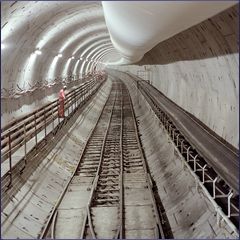
The fire in the rail tunnel, which since 1994 has connected the UK and France running under the English Channel, was apparently caused by a truck/lorry overturning on one of the vehicle transport trains. Some injuries have been reported and hundreds of passengers have been left stranded. By some miracle, there were no passenger trains in the tunnel at the time of the blaze, amazing considering that 100 trains pass through the tunnel each day. The injured people were evacuated through the central service tunnel (the BBC has a cool diagram of how the chunnel works here).

1996, it took months to fix the structural damage to the tunnel. That caused enough cahos then, but since then the traffic through the tunnel has increased dramatically. If such a closure were to happen again for so long it would cause massive long-term chaos and an economic blow to Britain, the UK and Belgium.

Even more worrying, the overturned truck/lorry reportedly contained phenol, a deadly chemical that isn't allowed to be transported through the tunnel. The people who are reportedly in the hospital for smoke inhalation could have inhaled this chemical as it burned.

According to Wikipedia, the toxic chemical was used in the Second World War at
Auschwitz as a means of rapid execution. Seeing as the fire happened on September 11th, there are some obvious concerned about whether this was truly an accident.

As someone who was planning to take the Eurostar train many times over the next several months, this is quite worrying. But for the economies of England and France in general, a shutdown of the tunnel for several months could be devastating. The majority of freight traffic between the UK and continental Europe now goes through the chunnel. In addition, the Eurotunnel just recently turned a profit for the first time, and there were big plans for expansion of the passenger services through it.

Just hours before the fire broke out yesterday, Air France announced it was launching its own high-speed train company through the tunnel which would take less than 2 hours, breaking the Eurostar monopoly. The journey currently takes a minimum of 2h 15m. Clearly there's a lot riding on the tunnel and its activity is only increasing. If anything were to go wrong with the tunnel at this crucial time it would have huge reverberations through France and Britain's economy.

Wednesday, 9 April 2008

Finally, the chunnel turns a profit

Here’s an interesting item from Euronews today. It seems that at long last the chunnel has turned a profit! Eurotunnel, the operator of the underwater train tunnel linking Britain to continental Europe, has made a profit for the first time since it opened in 1994.

Back then the cost of building the tunnel ran so over budget that the company has been paying off the massive debt ever since. And of course they were not helped by the fact that at the same time there was an explosion of budget airlines taking people from London to the continent for next to nothing. Ridership didn’t meet expectations, and over the past few years it looked like the company was headed for bankruptcy. It lost €204 million in 2006 and €2.8 billion in 2005.

It was a daunting task to turn it around but somehow they seem to have done it. Chief executive Jacques Gounon has managed to strictly cut operating costs and complete a financial restructuring that has lowered the company’s level of debt and therefore its interest payments.

Tuesday, 5 February 2008

Brussels: first impressions

This weekend my friend Lori and I took a pleasant little mini-trip to Belgium. It was, believe it or not, my first visit to Brussels. Beyond being a little getaway, it was also a chance for me to check out the city and see if I could imagine myself living there.

If you're a regular reader of this blog you of course know that I have a keen interest in European politics, particularly those of the European Union. And given that I'm a journalist, I would very much like to translate this interest into a career. At the moment here in London I'm actually covering real estate investment in Asia, which is about as far away from European politics as you can get. But I'm currently in the process of getting Italian citizenship (through my grandparents), which would give me an EU passport and enable me to work anywhere in the EU. When and if that comes through, it will be time to evaluate my career options. Given that I have a big interest in the EU and am knowledgeable about the subject given my educational background, covering it seems a natural choice.

Of course such a transition would require a move to Brussels. So I figured it would be a good idea to check the city out to see if I could do it. We even got a hotel in the European Quarter to get the full experience.

Tuesday, 1 May 2007

Paris

I went to Paris this weekend with Josh and Lori, who are both also recent transplants to London from New York City. As you can imagine it was a weekend of esoteric New York references. We took the train there which was really nice, I loved not having to fly. I was a bit annoyed that we had to go through this extensive passport and immigration check on both ends though, because you don’t have to do that on most inter-country train routes elsewhere in the EU.

It was a great time to be in France because they are gearing up for round two of their presidential election, which I’ve been writing about in this blog. The atmosphere is quite heated and everyone is abuzz about it. France had an 86 percent turnout for the first round of elections, so really everyone you meet has some kind of opinion on it. The contest for the second round is for Socialist candidate Segolene Royal, who would be the first female president of France, and conservative Nicholas Sarkozy, who was the interior minister under conservative president Jacques Chirac, who is now retiring.

There were posters and flyers everywhere, and tons of people running around handing out campaign literature (all for Segolene, Paris is solidly Socialist). Actually the whole time we were there I only saw one poster for Sarkozy, and someone had drawn a little Hitler mustache on him. The rest were all for Royal. Actually it was funny, the two friends I was with didn’t know anything about the French election, and Lori thought the posters were ads for some kind of beauty product. “Easy breezy beautiful cover girl!” Because, as you can see in the photo, Segolene is hot!

I used every opportunity to chat up people we met about the election. It seemed most people, especially people we met at gay bars, were Segolene supporters. But we did make a new friend Mattieu, who took us to this spot under a bridge on the Seine where all these university students hang out to drink beer. Here’s a photo (ah the joys of having a camera phone). Mattieu is a Sarkozy supporter, and the reasons he gave for this support I thought sounded totally rational and reflect my own opinions on the race. If France is looking for change, Sarkozy inspires a lot more confidence that he is the candidate who can bring that change, whereas Segolene seems more like the status quo. Ironic when you consider that Sarkozy was actually a part of the conservative government that has done basically nothing for the past five years. In fact the last five years of conservative rule have seen nothing but social tension and economic struggles. But Sarkozy has billed himself as an “outsider,” and for the most part the characterization has worked. And considering he seems to not be a big fan of Chirac and was actually working behind the scenes to overthrow him while he was interior minister, this may not be an audacious claim to make. But in the debate coming up in a few days, Segolene really needs to emphasize that Sarkozy is part of the ruling party of the last five years and shoot down this "outsider" label.

In general I was very impressed with how excited and engaged everyone was with the election. In the US what I mostly hear in the runup to an election is how sick everyone is of it, as if they’re angry that this democratic exercise would take time away from their nightly Friends reruns. Coming from a country which struggles to get a 40 percent turnout for elections, I was certainly impressed with French civic participation.

Actually, funny story. Me and Lori were sitting outside of a bar in The Marais, and this group of college-age boys came down the street getting people's attention and giving them pieces of paper. “Ugh,” Lori exclaimed, “here come the twinks with their flyers!” I confess I thought the same thing, as they resembled the army of pre-pubescent looking boys who accost people with flyers on Old Compton Street in London.

But then the boys started shouting “Segolene! Segolene!” and gave Lori a flyer. “What is this Segolene place?” Lori demanded. I burst out laughing when I saw the flyer, a promotional brochure outlining Segolene’s policies and platform. Of course the cynical New Yorkers assume a group of young gay boys are doing something stupid and frivolous. In fact they were young campaign volunteers working for change. For the rest of the weekend every time we saw campaign flyers we would say, “damn twinks with their flyers” and share a good laugh at ourselves.

This trip to Paris was much better than my last one, which was in the winter with awful weather. I went for a week by myself on my way back to New York after living in Prague, and I was depressed because I didn’t want to be leaving, so I spent the whole time moping. This time was much more fun, and the weather was great.

Some observations about Paris. The Paris metro is 1,000 times better than the London tube, although still not as good as New York’s I don’t think. It’s just below the surface like New York’s so getting down to the tracks is easier, and switching trains is a breeze. They also have the RSS trains which run on the same metro system, which are big trains that make only a few stops in the city so they’re sort of like express trains.

We all speak French but out of the three of us Lori’s was the best. She also hasn’t taken French since high school and I was surprised by how good hers was, and it made me realize that mine is really bad! I think also when you’re with a person who’s a better French speaker than you, you tend to kind of tune out and let them handle all the talking, because I was much better with the French last time I was there.

I’m making the final preparations for my big Germany-Denmark-Sweden trip in 2 weeks. It will be about half working and half pleasure, so in total it should be pretty exhausting. But the nice thing is since I’m working I can actually stay in hotels rather than hostels. I made some sort of public map on google, I’m not sure how it works but here’s a link to it. I’m not exactly sure why you would want to share maps, but I guess this is an instance where you might want to do it.