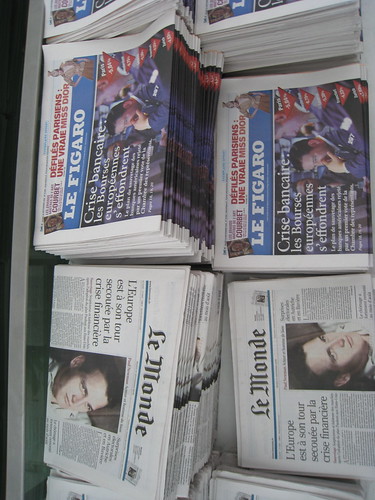
French President Nicolas Sarkozy is riding to the rescue on his white horse again, this time the damsel in distress is the struggling French newspaper industry. Considering that newspapers are struggling across the world, particularly in the United States,
Sarko's plan to give free daily newspapers to all French 18-year-olds will certainly be watched closely by media analysts around the globe. But in this latest quest, in hindsight is the gallant Sir. Sarko going to more closely resemble Prince Valiant, or Don Quijote?
After a
three-month investigation of the problems facing the French press, Sarko promised the following: tax breaks for delivery services, a doubling of the advertising it does in print and online newspapers, an increase in the public subsidies to newspapers to around €500 million, and giving all 18-year-olds a free subscription of the newspaper of their choice for a year.
Across the pond in the US much ink has been spilled about the imminent demise of the American newspaper. Paper after paper across the country has been folding, and big media conglomerates such as
Tribune Corp. are going bankrupt. Even the New York Times, the most respected paper in the US, has been forced to take out a
mortgage on its new Manhattan headquarters and start advertising on its front page. As far as I know the newpaper industry in the US doesn't receive any government assistance of any kind. So is the French social model of bailing out newspapers something that the US should consider?
It seems there is plenty of evidence to suggest no, but only hindsight will say for sure. In 30 years we may look back on the French decision to give 18-year-olds free newspapers as being akin to the government giving people free telegraphs in the 1920's after the invention of the phone.
 There is increasing concern that the French newspaper bail-outs will discourage the industry from making any meaningful reform. The websites of French newspapers are notoriously bad, and if the papers don't start feeling the pain they might not have any motivation to improve them (although some of the aid is contingent on the papers investing in their online departments). The bail-out also doesn't address some of the fundamental cost problems in the French newspaper industry, including the high cost of producing the papers as a result of powerful labor unions in printing and distribution. Sarko will also not change the existing regulations that make cross-ownership across media nearly impossible, which has discouraged foreign media companies from investing in French papers.
Obviously I'm not an 18-year-old, but I would have little use for a free daily paper from my government. I'll freely admit that I have only subscribed to a newspaper once in my life, and that was in Chicago during journalism grad school when we were made to do so. The reason has never been economic, as subscription prices are very low. Rather, the idea of getting all my news from one source, that I would sit down and pour over at the kitchen table, is about as foreign to me as the eight-track. I get my news from different sources all over the world online, with RSS feeds, Google News, etc. During a commute I listen to podcasts on my ipod or read the latest headlines on my phone. And really, I move around too much to make a newspaper subscription very practical!
But on the other hand one need only look at the countries that are not having a problem in the newspaper industry to think that perhaps governments shouldn't just toss newspapers to the wolves. One thing France and the US have in common is a high respect for the printed press, and a comparatively low number of tabloid papers. On the other hand, in the UK and Germany there is considerably less respect for the printed press and an extremely high proportion of newspapers are tabloids. And guess which countries have the most newspaper sales? According to the World Association of Newspapers, circulation of paid-for dailies in France is only about half the level in Germany or the UK.
Clearly, the only clear commercial way that companies have found to make newspapers profitable in this day and age is to go the tabloid direction. Without government help, this is what newspapers in France and the US will likely have to do. Government bail-outs for the newspaper industry may be an uncomfortable proposition, but it may be better than the alternative: a nation with a collapsed fourth estate and no reliable source from which the public can get information.