Showing posts with label American media. Show all posts

Tuesday, 3 April 2012

Are we entering the fact-free century?

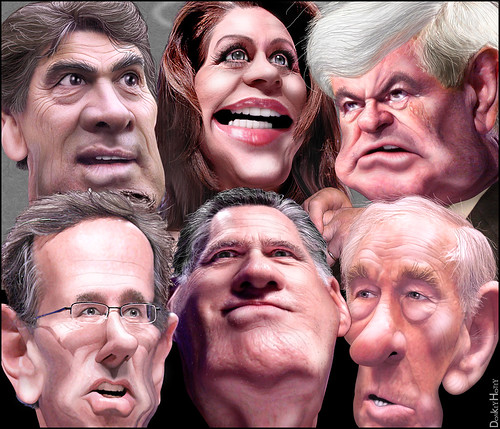
America appears to have a lying problem. It’s hard to come to any other conclusion when looking at the string of easily disprovable untruths that have come out of the mouths of mainstream politicians during this season's Republican presidential primary.

The fact that these untruths have mostly gone unchallenged is an alarming reflection on American society. When you look at both the amount and the sheer audacity of the lies told on the campaign trail, and the fact that little to none of it has been challenged, it's truly bewildering. It would appear some kind of pseudo-reality is gaining an increasing foothold in the United States. And it leads to a disturbing question - is this a phenomenon that is unavoidable for the world at large in the internet age?

This week US presidential candidate Rick Santorum, polling second in the race to become the Republican nominee, told an audience, “I was just reading something last night from the state of California. The California universities – I think it’s seven or eight of the California system of universities - don’t even teach an American history course. It’s not even available to be taught. Just to tell you how bad it’s gotten in this country, that we’re trying to disconnect the American people from the routes of who we are.”

Just a five minute search on the University of California website reveals that this is completely untrue. It’s not even a little bit true. Not only does every university in the California system offer American history courses, but all UC bachelors programs actually require students to take one.

Dutch killing machines

Thursday, 14 July 2011

Why the NewsCorp scandal won't resonate with Americans

The News of the World hacking scandal has progressed with shocking speed in the UK. Yesterday it seemed to reach a fevered climax when Rupert Murdoch withdrew his bid for satellite operator BSkyB after he was ceremoniously denounced by the entire British Parliament in an unprecedented session. It marks an incredible end of an era. Murdoch is effectively being banished from Britain after having held sway over the island's media, government and even police for decades.

Now commentators are speculating that the trouble for Murdoch's media empire News Corp, which also own many papers and Fox News in the US, is spreading across the Atlantic. The shares in News Corp on the New York Stock Exchange came crashing down even before Murdoch's BSkyB bid was withdrawn, and the billionaire himself had to buy up the shares to keep the price from collapsing.

Now there are concerns that the bribery allegations in the UK could get the company into legal trouble in the US, because it is illegal for a company publicly traded in America to pay bribes to foreign officials – which includes police officers. That, combined with new allegations that Murdoch's British papers also hacked into the phones of American 9/11 victims has prompted some Democrats in congress to call for an investigation into the matter. But will the public at large share their outrage?

Thursday, 19 May 2011

US focus on French sex attitudes echoes Lewinsky saga

Something is very wrong with France, if we are to believe the Anglophone media commentary this week. The arrest of Dominique Strauss-Kahn, the head of the International Monetary Fund and contender for the French presidency, has provoked some soul-searching in France about whether the media was right to have kept quiet about his history of unwanted sexual advances toward women. This soul-searching has been reported on with fascination by the American and British media. But for many in France, the Anglo-Saxon attention to their national trauma is bordering on smugness.

Back in the late 1990's, the French were quite vocal in their confusion and disgust with the impeachment proceedings against US President Bill Clinton. France has long had an expectation that politician's private lives are just that – private – and should have no relevance to their office. 'What kind of a society would impeach their president because he had an affair?' they asked. In fact the period during the Monica Lewinsky saga was probably the only one in which the French openly talked about their history of philandering presidents – from Mitterand to Chirac – if only to demonstrate how different their society was to America. If their politicians were oversexed "séducteurs" it was none of their business. Indeed, sometimes it was celebrated as a good thing, a sign of a healthy libido.

But what goes around comes around, and it seems that now it’s the Americans' turn to look derisively across the Atlantic, shake their heads and say, 'if only they were more like us.'

Sunday, 7 November 2010

Daily Show 'sanity' rally: more harm to the left than good?

I thought I'd post a video from this weekend's Real Time with Bill Maher show on the subject of Jon Stewart's "Rally to Restore Sanity" because I remember last weekend a lot of Europeans were asking me about it and whether I was going to watch. "No," I told them, "I'm not going to watch it, and if I was in the US this weekend I wouldn't be attending it either." At the time I don't think I was articulating my annoyance with Stewart and the rally all that clearly, but I told my friends I thought the rally was going to be almost depressingly irrelevant. Of course in the end it was. Though the rally had a huge turnout, the youth vote in last Tuesday's election was the lowest in years. On Friday night, Bill Maher delivered a monologue that I think will resonate with a lot of American Daily Show viewers who were uncomfortable with Stewart's rally but couldn't articulate why.

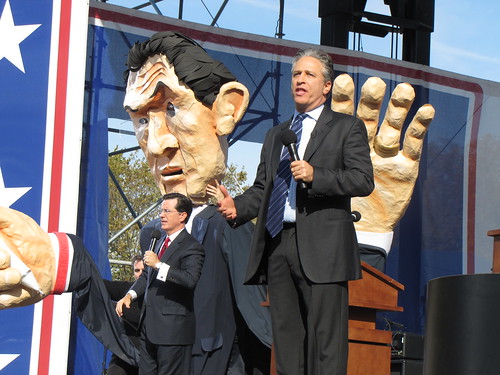
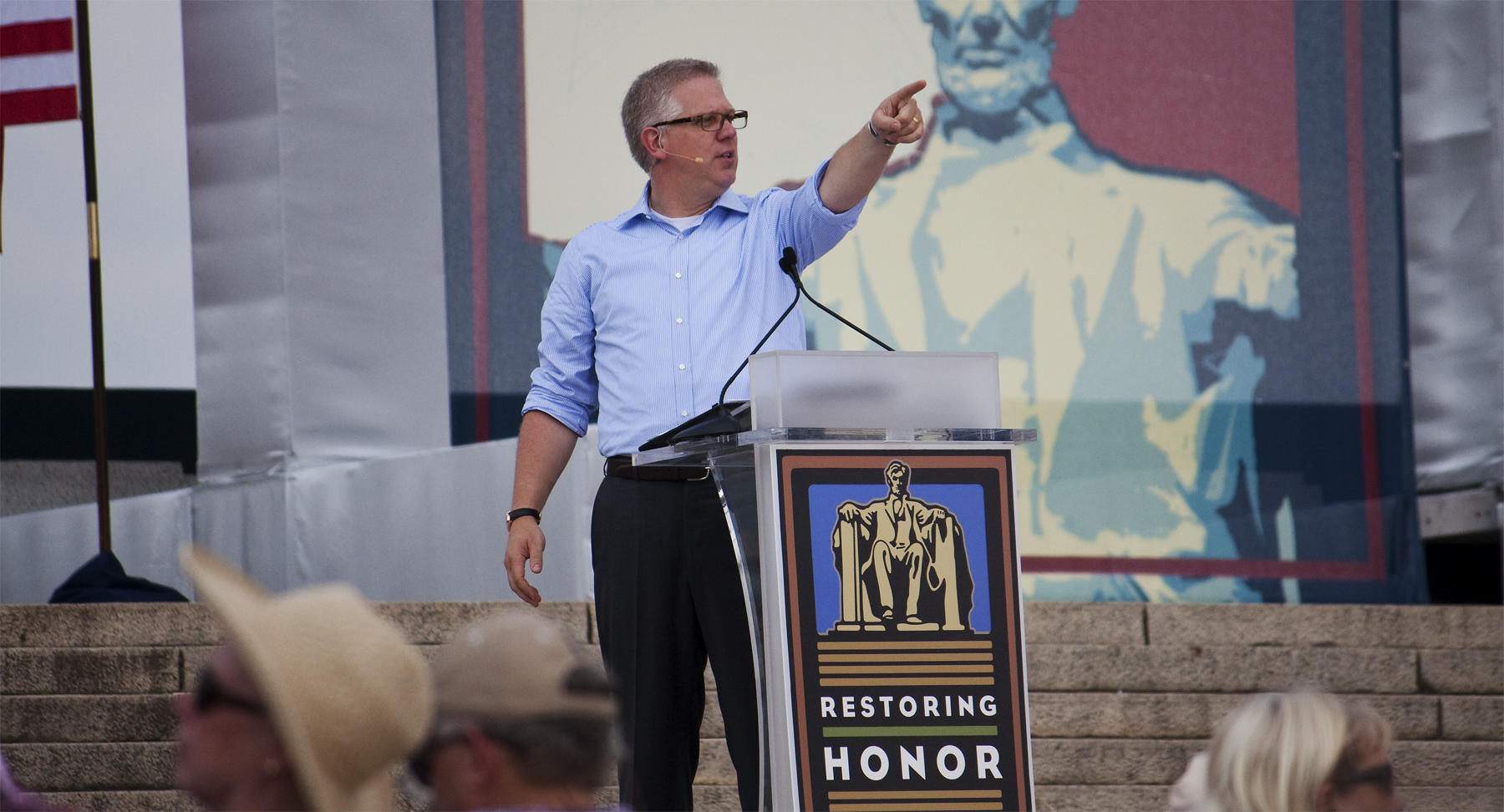
Yes, the Daily Show rally, held on the national mall in Washington, may have attracted twice as many people as tea party pied piper and Fox News host Glenn Beck's "Rally to Restore American Honor" which it was meant to lampoon. But that was cold comfort to some in the dwindling ranks of the politically active American left, who saw the rally more as a depressing reminder of the current state of things than anything they could be proud of. The Daily Show's writers and producers have an undeniable liberal viewpoint, and the show spends most of its time making fun of Fox News and Republican politicians. But the show also likes to present itself as being "non-political." After showing outrageous clips from politicians on the right, host Jon Stewart frequently insists that the same level of craziness exists on the left. But he rarely provides any actual examples of this phantom American left.

Monday, 12 July 2010

Libel migrates across the pond

Many of my fellow ex-pat friends have joked about the ‘reverse migration’ we see of Americans moving to Europe in search of a better, more comfortable life. But according to a recent article by the New York Observer, we may not be alone in this trans-Atlantic migration – libel lawsuits may be coming with us.

For decades it’s been a well-known fact that media lawyers in the US will frequently file lawsuits in the UK using a satellite office of the offending publication rather than suing in a US court. They are far more likely to win their case in Britain than in the US. The UK has arguably the strictest libel laws in the western world, and many media companies here keep a hefty fund on hand to make regular pay-outs to libel victims. When I first started reporting in the UK I had to attend seminars familiarising me with UK libel law, and in many ways I had to unlearn what I had learnt about libel in journalism school in the US. It’s a wholly different animal here.

Reforming UK libel law has been a priority for the Liberal Democrats, who are now a junior partner in the British government. Last week they announced that the government will bring forward a Defamation Bill next year that will aim to end the abuse of British libel law once and for all.

Tuesday, 8 June 2010

Israel: in concept and in reality

As Israel’s raid of a protest ship trying to break the blockade of Gaza unfolded last week, it was interesting to watch how the coverage differed between the United States and Europe. Monday morning I watched as the European headlines scrolled across my RSS feed reader, and then starting at about 13:00 I saw the headlines come in from the main US media outlets. It was as if they were reporting on two different events. The difference in media coverage has been particularly interesting to watch as I am about to head to Israel tomorrow to see the situation for myself.

It wasn’t so much surprising as it was illustrative. During my four years living in Europe I’ve seen firsthand how different the European media’s coverage of the Israeli-Palestinian conflict is from the American media’s portrayal. They’re two sides of a coin, and the truth is probably somewhere in the middle. It’s rare to see any criticism of Israel in American media or from American politicians, whether from the left or from the right. The main emphasis is usually on the Israeli need for security. In Europe, the main emphasis tends to be on the occupation, and the security concerns of Israel aren’t addressed as frequently.

Thursday, 5 March 2009

The Reports of Their Death are Greatly Exagerated

Is the established media dead, or are they stronger than ever? This is the question we've been grappling with over the past two days here at the Digital News Affairs conference in Brussels. The conference is a yearly cross-media, cross-platform look at the technologies shaping the media industry, and I've been here covering the event for CafeBabel. As with most conferences focusing on the media these days, the conversation has tended to be dominated by the big question: what is going to happen to the 'established media' now that the Internet has completely changed the game?

Such conversations took place just about every day back in journalism school at Medill in Chicago, and the level of chatter hasn't abated. But something significant has changed since then, and that is that the vast majority of the established media has caught up to the technological advances, and where they've entered they've entered in a big way. But will this be enough to keep them relevant? Various panelists over the past two days have staked their position on either side of the debate, and I've noticed that their position tends to reflect which side of the aisle they're coming from, established or start-up.

The conference opened with a panel of a few start-ups taking a look at how the economic downturn combined with the current technological revolution has turned the traditional media business upside down. Unsurprisingly this panel, composed of representatives from Google, Rue 89 and Demotix, seemed to conclude that traditional media models were dinosaurs and would be quickly eclipsed by young start-ups. In short, the web 2.0 revolution has created an equal playing field where news can be provided by anyone, anywhere over the web. The brands of the established media would not, some panelists concluded, protect them from being eclipsed by younger, more flexible start-ups. Users don't care who's providing the news any more, they argued, they just care how quickly and creatively they get it.

Contrast that with the the afternoon panel, appropriately titled "The Established Media React." Chaired by Ben Hammersley of Wired magazine, the panel was composed of folks from Deutsche Welte, Sky News, De Standaard, the Wall Street Journal and the BBC, who all vociferously defended their position. I have to say, between the representatives of the "new media" and the representatives of the "old media," I've found the established players to be far more convincing. Peter Vandermeersch of Der Standaard, the largest daily paper in Flanders, pointed out that despite all the predictions of the death of the traditional media his paper has actually been doing increasingly well over the past several years. "Newspapers are alive and kicking," he insisted. "Are we good enough now? No. But who is best equipped to deliver content, three geeks in their garage with no brands, no funds, and no customers, or us, the established media?"

Just to show how much things have changed, the established media panel opened with this amusing video from a local San Francisco news broadcast in 1981.

Although it sounds quite funny to us now, this reporter definitely gets points for being prescient!

As each panelist spoke, their company's web site was displayed behind them. Two things particularly stood out about them: For one thing, as Livestation's Matteo Berlucchi pointed out, you couldn't tell from any of them whether they were coming from a broadcaster or a publisher, suggesting that to users the original function of the company is irrelevant. And two, they were all highly sophisticated and aesthetically impressive. As much as the established media are lambasted by the new media as being old dinosaurs that haven't caught up with modern ways of presenting information, a quick look at the main players' web sites shows that to not be the case. The New York Times, BBC, CNN, The Guardian; they all have an impressive and extensive web presence. So clearly the established media, in the Anglo-Saxon world at least, has adapted and entered the new media space in a big way.

I spoke with Ben Hammersley after the panel, and he seemed to have reached much the same conclusion. While there is still a lot of cluelessness on the part of the established media, he said, the fact is that when they did set up an Internet presence they went all in. And with the extensive resources, audience and branding that they have, no-name start-ups can't hope to compete. Essentially, according to this line of thinking, what we've been looking at over the past five years was simply a lag. The established media is made up of big companies, and big companies move slow. But though giants may move slowly, when they make a move it has a big impact. And when an institution like the BBC masterfully sets up a great web site, 5 geeks in their garage aren't going to be able to touch them.

It was interesting timing for me to be hearing this line of argument, as earlier this week I learned that the start-up news web site I was contracting for in the fall has folded. I won't name the site but it was a user-generated news site, where anybody could post stories they had either observed themselves or read. The idea was that after witnessing news events first-hand, regular citizens could take photos and rush to this particular start-up web site to report what they had seen. When it did work, such as during the Mumbai terrorist attacks, it worked well and attracted a good deal of mainstream media attention. But the honest fact was that 95 percent of the time it didn't work. Most of the user-generated content was either crazy rambling or pure cut-and-paste jobs that added no unique content to a news story that was already out there. Trust me I know, my job was to read the posts as they came in all morning! The experience of contracting for them engendered in me a pretty strong scepticism about all this talk of an egalitarian Internet and valuable user-generated content. The fact is that most user-generated amateur news content is going to be just that: amateur.

I'm now listening to the final panel of the day, a question-and-answer session for people in the media business, and Michael Rosenblum is getting the crowd all fired-up with a rant about how all news outlets should fire half their staff and give everyone remaining a laptop and tell them to do everything on their own. I'm told he does this every year, and while he does have a point that the established media could stand to get rid of a lot of their infrastructure, I fundamentally disagree with his conclusion that newsrooms should get rid of edit bays, reporters, and any kind of specialized professional and instead pay people on an individual basis to produce content on their laptops. His implication, for broadcast at least, seems to be that producing good broadcast journalism is so easy a monkey could do it. Having worked as a broadcast journalist and as a video editor I can assert that this is absolute nonsense. Producing quality broadcast journalism (and in particular editing broadcast journalism) is a specific skill that not everyone can do well, and requires specific training.

So is the established media dying a slow death? Opinion at this conference seems to be divided on the subject. But I'm finding myself far more convinced by those that think that the extensive wealth, reputation and reach of the established players cannot be underestimated.

Monday, 26 January 2009

Sarko to Save Newspapers

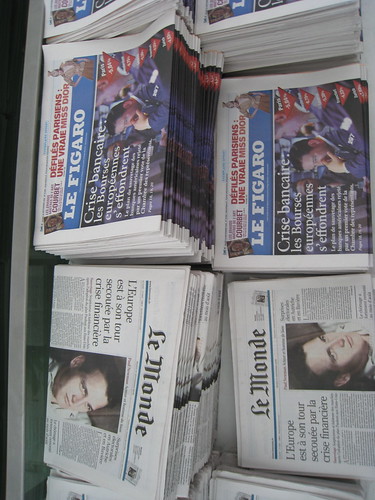
French President Nicolas Sarkozy is riding to the rescue on his white horse again, this time the damsel in distress is the struggling French newspaper industry. Considering that newspapers are struggling across the world, particularly in the United States, Sarko's plan to give free daily newspapers to all French 18-year-olds will certainly be watched closely by media analysts around the globe. But in this latest quest, in hindsight is the gallant Sir. Sarko going to more closely resemble Prince Valiant, or Don Quijote?

After a three-month investigation of the problems facing the French press, Sarko promised the following: tax breaks for delivery services, a doubling of the advertising it does in print and online newspapers, an increase in the public subsidies to newspapers to around €500 million, and giving all 18-year-olds a free subscription of the newspaper of their choice for a year.

Across the pond in the US much ink has been spilled about the imminent demise of the American newspaper. Paper after paper across the country has been folding, and big media conglomerates such as Tribune Corp. are going bankrupt. Even the New York Times, the most respected paper in the US, has been forced to take out a mortgage on its new Manhattan headquarters and start advertising on its front page. As far as I know the newpaper industry in the US doesn't receive any government assistance of any kind. So is the French social model of bailing out newspapers something that the US should consider?

It seems there is plenty of evidence to suggest no, but only hindsight will say for sure. In 30 years we may look back on the French decision to give 18-year-olds free newspapers as being akin to the government giving people free telegraphs in the 1920's after the invention of the phone.

There is increasing concern that the French newspaper bail-outs will discourage the industry from making any meaningful reform. The websites of French newspapers are notoriously bad, and if the papers don't start feeling the pain they might not have any motivation to improve them (although some of the aid is contingent on the papers investing in their online departments). The bail-out also doesn't address some of the fundamental cost problems in the French newspaper industry, including the high cost of producing the papers as a result of powerful labor unions in printing and distribution. Sarko will also not change the existing regulations that make cross-ownership across media nearly impossible, which has discouraged foreign media companies from investing in French papers.

Obviously I'm not an 18-year-old, but I would have little use for a free daily paper from my government. I'll freely admit that I have only subscribed to a newspaper once in my life, and that was in Chicago during journalism grad school when we were made to do so. The reason has never been economic, as subscription prices are very low. Rather, the idea of getting all my news from one source, that I would sit down and pour over at the kitchen table, is about as foreign to me as the eight-track. I get my news from different sources all over the world online, with RSS feeds, Google News, etc. During a commute I listen to podcasts on my ipod or read the latest headlines on my phone. And really, I move around too much to make a newspaper subscription very practical!

But on the other hand one need only look at the countries that are not having a problem in the newspaper industry to think that perhaps governments shouldn't just toss newspapers to the wolves. One thing France and the US have in common is a high respect for the printed press, and a comparatively low number of tabloid papers. On the other hand, in the UK and Germany there is considerably less respect for the printed press and an extremely high proportion of newspapers are tabloids. And guess which countries have the most newspaper sales? According to the World Association of Newspapers, circulation of paid-for dailies in France is only about half the level in Germany or the UK.

Clearly, the only clear commercial way that companies have found to make newspapers profitable in this day and age is to go the tabloid direction. Without government help, this is what newspapers in France and the US will likely have to do. Government bail-outs for the newspaper industry may be an uncomfortable proposition, but it may be better than the alternative: a nation with a collapsed fourth estate and no reliable source from which the public can get information.

Monday, 8 September 2008

US media still on the defensive

This piece of news from the US caught my eye today. It seems that Keith Olbermann and Chris Matthews, two of cable news network MSNBC's most popular personalities, have been demoted after the McCain campaign complained of a "liberal bias" in their coverage of the Democratic and Republican national conventions. For those in Europe who often find themselves perplexed by US broadcast media, this is probably an excellent lesson for understanding it.

There's been speculation over the past two years that MSNBC, which consistently ranks third among the cable news networks (behind Fox News and CNN) and has had trouble finding its voice since its inception, is going to veer to the left to try to become the "Fox News of the left." Fox News, which was launched in the late 90's promising to deliver news free of "liberal bias," is reviled by the left for its strongly conservative slant. All of Fox News' main personalities are right-wing, and its news coverage is often blatantly (and hillariously - as often featured on the Daily Show) enamoured with the Bush Administration and the Republican party. Tapping into the widely held American belief that there is a "liberal bias" in the US media, the network has been remarkably sucessful and consistently ranks above CNN.

So the thought was, MSNBC might try to emulate that success by becoming a network that favors the democrats. They began featuring Olbermann, who is a frequent critic of the Bush Administration and the GOP, more and more prominently. And Chris Matthews, who has been with the network since the begining, has been increasingly critical of the Bush Administration.

Tuesday, 11 December 2007

'Permalancers' walk out in US

There was an interesting article in the New York Times today about the "permalancing" concept so popular in the US which I wrote about in my blog entry last week about the new EU protections for temp workers. "Permalancers" are people who work regular full-time hours, but are classified as "freelancers" by their company so they don't have to give them benefits.

Yesterday a large number of freelancers at MTV networks walked off the job to protest the company's cuts to healthcare benefits for the 'permalancers.' The permalancers already have an extreemly low level of healthcare coverage and the new cuts whittle them down to almost nothing.

I have a number of friends who work for MTV as 'freelancers,' one friend has worked there full time under thsi status for 4 years. But they're all tucked away with visions of sugar plums dancing in their head right now so I can't ask if they took part in the walkout. But what's really interesting about this is that it seems to be the first instance of people working udner this status undertaking collective action.

Incidentally, no MTV office in Europe has anything even resembling the "permalancers" system, I'm told.

Tuesday, 8 May 2007

Welcome to the new France

As predicted, Nicolas Sarkozy became the new president of France on Sunday, ushering in what most observers are predicting will be a new era for France. The outcome of this new era, however, is far from certain, and the apprehension in the country is palpable.

The rioting Sunday night in response to Sarkozy’s win was underwhelming by French standards (really, I expect better from the Gauls!). The margin wasn’t razor thin but it definitely wasn’t a landslide either, the 53-47 split being wider than what the polls had showed just after the first round election.

The reaction to the outcome has been interesting. UK press coverage has been more thoughtful, examining the complexities of the election and what it means for Europe as a whole. US coverage has been, on the whole, misleading and inaccurate. A sampling of some of the US headlines for the result on Google News includes, “Pro-US Sarkozy wins French Presidency” But the idea that this election result had anything to do with the US is a stretch. Though the US media has painted Sarkozy as “pro-US” because of a visit he made to the Bush White House a few years ago, Sarkozy’s win was only made possible because he barely mentioned the US throughout his campaign. In fact it was his supposed friendliness toward the US that was considered one of his biggest vulnerabilities. The little bit that he did mention the US was only to affirm that he would not be a “US poodle,” a reference to the nickname given to Tony Blair by the Brits because of his sycophancy in the Iraq war.

Actually the US coverage in general (especially in evidence in that first link to the Fredericksburg article) really demonstrates the complete lack of understanding of European politics in the US media. For the US to refer to Sarkozy as “right-wing,” without context is pretty misleading to a US reader considering the European political scale is drastically to the left of its American counterpart and Sarkozy would be a Democrat if he were in the US. But the biggest area in which US media is getting this wrong is in their obsessive naval-gazing. This election had nothing to do with France’s ties to the US, it was about European socialism’s failure to adjust to a changing world in the era of globalization.

The biggest thing one needs to keep in mind with this election result is that the French people wanted to vote for Socialist candidate Royal but felt they needed to vote for conservative candidate Sarkozy. People generally don’t like him as a man, but came to the conclusion that France needed to drastically change course and he was the only candidate offering that change. In fact most French people I’ve talked to about Sarkozy said they would never vote for him for a second term, even if the first term was quite a success. Perhaps it’s a bit like Thatcher in the UK. They need someone tough to break the unions and change the country’s direction toward economic reforms, but once you’re done, get out.

One also needs to keep in mind that the French election didn’t happen in a vacuum and is actually the latest in a series of centre-right victories in Europe. Just last Thursday the Labour Party lost control of the Scottish Parliament to the Scottish National Party in local elections there, which wants Scotland to secede from the UK. It’s the first time Labour hasn’t dominated Scotland in fifty years. Last September, Sweden's Social Democrats were voted out of power by a young dynamo promising economic reforms and curbs to the traditionally cherished Scandinavian welfare system. And in 2005 Angela Merkel led the centre-right party of Germany to victory over the Social Democrats in Germany.

The election results in Southern Europe have been the opposite, but they’ve been real squeekers. Zapatero narrowly won a bid to become Prime Minister directly after the Madrid train bombing. Romano Prodi barely won election last year in Italy and his government nearly collapsed last month because of its razor-thin grip on power.

So what does all this mean? It comes down to idealism versus practicality. Europe is proud of its unique social model and the guarantees European countries can offer each one of their citizens. Europe’s Democratic Socialist triumph over the last 50 years has led to universal healthcare in all countries, generous unemployment benefits, and a quality of life unrivaled in the entire world. In fact in the quality of life rankings that come out every year, the top ten are always European cities, and you don’t start seeing American cities until you get into the 20’s.

All of this progress was made possible by the combination of peace, security and rebuilding that Europe enjoyed following World War II. Strong labour unions were able to negotiate decent wage agreements for workers and protectionist policies ensured that all people were guaranteed a basic standard of living. Because Europe could rely on NATO (aka the United States) for military protection, it was able to spend virtually nothing on its defence budgets, using that money instead to support generous social programs for its citizens.

But two key things have changed. The end of the Cold War means that the US no longer has a vested interest in protecting Europe, and the Iraq War has led many to conclude that the military goals of the US and Europe may no longer be compatible in the future. This means Europe is going to have to come up with the money to develop a viable standing force capable of self defense. At the same time, the forces of globalisation have dealt a shock blow to the continent’s traditional social system. Heightened competition has meant French workers, for instance, now have to compete with workers all over the world. And why would an employer hire in France, where they have to guarantee workers employment for life and can’t make them work more than 35 hours a week, when they can hire workers in India and China with virtually no restrictions. The basic premise of Democratic Socialism, to produce economic growth that lifts up the poor and the middle class as well as the rich, has now been challenged. And the European left hasn’t found a convincing strategy to address that challenge yet. So Europeans, uneasy about what the future holds for them and wishing to stay competitive in a modern world, are turning to the centre-right for answers.

And the centre-right is providing answers, although it remains to be seen whether they will work. Sarkozy promised that by deregulating the labour market, he could create more growth and more jobs. Royal, on the other hand, seemed to just be advocating the status quo, the maintenance and even expansion of France’s generous social protections.

So what lessons can be drawn from this for American progressives? In a great editorial in the Washington Post today, E.J. Dionne Jr. says that the American left should think about the frustrations that are making Europeans turn to the right for answers, but not to get carried away trying to draw analogies. He writes:
It would be a mistake to draw too many American lessons from the troubles of European social democrats. For one thing, the social insurance system is much weaker in the United States than in Europe, where even conservatives support substantial government provision for health care and child care. If European voters seem willing to gamble on a bit less security because they have a lot of it, American voters now seem inclined to ask for more because they have so little.
I think this observation is dead on. Sure, in the US there’s still widespread “welfare-bashing,” but it’s mostly stemming from ignorance and sometimes racism. The biggest complaint you hear from the US working class is not that they’re receiving too many social benefits. Some of the biggest complaints of US voters today are about the terrible state of US healthcare, the outsourcing of US jobs and the steady increase in the number of Americans living in poverty. All of these things are the result of the weak (now defunct really) US labor movement and the lack of social protections. So as globalization makes Europe reexamine the generosity of its social system, it may make Americans reexamine the stinginess of theirs. This could create an interesting scenario where the two blocks each move away from their extremes and meet in the center.

Of course, this would be the logical way for people to vote and if Democracy has taught us anything its that people (especially in the US) often don't cast their votes based on well-thought-out logic. But regardless of what happens in the US, one thing is certain. Sunday’s vote is going to drastically reshape the direction of not only France, but of the EU as a whole. And as much as I don’t like Sarkozy, he may be the only one who can revive the stalled EU-building process and move it firmly in the direction of being a viable political union.
Thursday, 22 March 2007

It's tough being a cultural behemouth

Someone just reminded me that I owe you all, gentle readers, an entry about British television. What with the hustle and bustle of many visitors at once (Joel just arrived today) it’s plum slipped my mind. It’s downright peach, apricot and boysenberry slipped my mind was well.

I do enjoy opining about the differences I’ve noticed between British and American culture, mostly because Brits don’t seem all that interested in my insights. It’s not that they’re not interested, it’s just that they already know whatever I’ve told them. If I say, “Oh is that how you do it here? Like that? We do it like this,” I get a, “right, I know.” Not in a rude way, but they know all about American culture and customs already.

After all, we export our culture and customs throughout the world. Here in the UK they see how things are in the US daily. On TV, in movies, in music, and on web sites. What’s more, most of them have visited the US at least once. In fact I don’t think I’ve met a single person here yet who hasn’t.

Thursday, 16 November 2006

Muslims in European parliaments

On Tuesday CNN Headline News host Glenn Beck did an interview with newly-elected congressman Keith Ellison (D-MN), the first Muslim ever elected to the US Congress. A lot of people have reacted with outrage to the first part of this segment, where Beck demands that Ellison “prove” that he’s not working with terrorists. It was truly a ludicrous, outrageous thing to say, assuming that Ellison could be in league with terrorists simply because he’s Muslim.

But it was the second part of this clip that interested me, the part where Beck is seemingly beaming with pride that a Muslim can be elected to office in America. Here’s the transcript:
BECK: With that being said, you are a Democrat. You are saying, "Let's cut and run." And I have to tell you, I have been nervous about this interview with you, because what I feel like saying is, "Sir, prove to me that you are not working with our enemies."

And I know you're not. I'm not accusing you of being an enemy, but that's the way I feel, and I think a lot of Americans will feel that way.

ELLISON: Well, let me tell you, the people of the Fifth Congressional District know that I have a deep love and affection for my country. There's no one who is more patriotic than I am. And so, you know, I don't need to -- need to prove my patriotic stripes.

BECK: I understand that. And I'm not asking you to. I'm wondering if you see that. You come from a district that is heavily immigrant with Somalians. And I think it's wonderful, honestly, I think it is really a good sign that you are a -- you could be an icon to show Europe, this is the way you integrate into a country. I think the Somalians coming out and voting is a very good thing.
This last part is probably the least offensive, but to me it is the most idiotic. Nearly every country in Western Europe has Muslim members of parliament. For Beck to hold out the first election of a Muslim to congress in the United States as some sort of example for Europe, which has had Muslim members in its parliaments for over a decade, is just silly.

Friday, 28 July 2006

Another human rights condemnation? yawn

During my sometimes tedious days at work I frequently check Google news to get up-to-the-minute breaking news on everything that’s going on. The great thing about the site is it goes through publications all over the world and shows you what has been statistically written about the most in various categories. In that way, there’s no editorial filter and you get to see the raw news, with no one deciding what is important and what is not except the pure law of numbers, which thankfully also tends to show what is most important. Fortunately the pool only includes reputable news organizations (aside from the entertainment section) so you’re not getting literally what is most popular but rather what is most published.

One of the most interesting aspects of the site is that you can monitor how different areas of the world are covering the same news event. And one of the more frequent occurrences is that a story will get high-level play everywhere in the world except in the US.

Such was the case today when the UN human rights committee issued its most scathing critique yet on the human rights violations of the United States After a two-day hearing in Geneva last week into US compliance with the 1966 International Covenant on Civil and Political Rights, the committee concluded that the United States is in serious violation of the treaty through its extensive secret interrogation and detention program for terror suspects. The document is probably the most critical and serious human rights report ever concluded by the UN about a Western nation.