Wednesday, 28 March 2012

EU internet roaming charges to be slashed

From 1 July this year using a mobile phone to surf the web in another EU country will be about 70% cheaper, following an agreement on rate caps reached today by European Parliament and member state negotiators.

For the first time, the EU roaming caps will limit the rates phone companies can charge you for using the internet in a different EU country. The cost per downloaded megabyte will be capped at 70 cents as of 1 July 2012, 45 cents in 2013 and 20 cents as of 1 July 2014. The current average cost of roaming within the EU is €2.23 per megabyte.

The EU first started limiting the rates EU carriers could charge for roaming within the EU back in 2009, limiting the charge for making calls to 45 cents a minute. That cap has steadily decreased over the past three years, and today's agreement will lower them a further 20% from the current 35 cents to 29 cents, dropping to 19 cents in 2014. Before then, it used to cost an average of €1.50 per minute to make a call elsewhere in the EU. Now, for the first time, internet usage will be capped as well.

Of course this only applies to people with an EU phone carrier. So if you're travelling to Europe from the United States, you'll still pay the high fees.

Friday, 23 March 2012

Don’t mention the Gaza

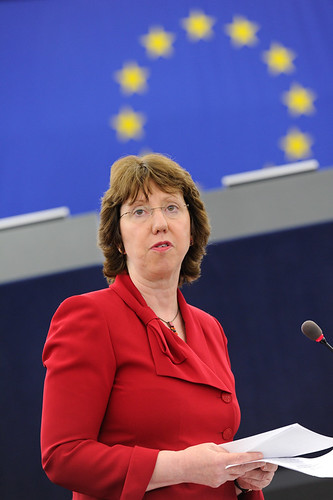
EU foreign policy chief Catherine Ashton was the object of fury in Israel this week - with the press, the pundits and even the prime minister all calling for her immediate sacking. Her crime? Mentioning the fact that children have been killed in Gaza.

Ashton was attending a Brussels conference on the subject of Palestinian children refugees on Monday when news came that three children had been shot and killed at a Jewish school in Toulouse, France. When she took to the podium to address the conference, Ashton broke the news. She then talked about how sad it is when a child loses a life, bringing up last week’s bus accident in Switzerland where 22 Belgian children were killed.
“The Belgian children have lost their lives in a terrible tragedy. And when we think of what happened in Toulouse today, when we remember what happened in Norway a year ago, when we know what is happening in Syria, when we see what is happening in Gaza and Sderot [Israel], in different parts of the world — we remember young people and children who lose their lives,” she told the audience (video here).
 When news of her comments reached Israel, the reactions were swift and furious. Israeli papers said her comparison of the shooting of innocent Jewish children with the deaths of Palestinian children during Israeli shelling of Gaza was “grotesque”. They labelled Ashton as anti-Semitic, people compared her to a Nazi, and the papers demanded her immediate removal from office.

Thursday, 8 March 2012

Eurovision controversy starts early as Armenia pulls out

As predicted, this is going to be one tumultuous year for Eurovision, the yearly singing competition where European countries compete with original songs (for Americans, it's a bit like American Idol and Miss America combined). News this week that Armenia has pulled out of the competition after Azerbaijan's president described Armenians as the country's "main enemies" has noticably rattled the competition's organisers.

The song contest, which has been held since 1956, is hosted each year by the country which one the previous year. Last year the contest was won by Azerbaijan, the Muslim former Soviet republic in the Caucasus on the border with Iran. The definition of 'Europe' has been stretched over the past decades to encorporate new countries such as Turkey, Israel and even one year Morocco.

But this year's contest in Baku is going to be an awkward one, given that Azerbaijan is still in an active conflict with its neighbor Armenia, which also participates in Eurovision and takes it very seriously. Having the warring countries both participating in Eurovision has caused problems in the past. In 2009 a number of Azerbaijanis who had voted for Armenia's entry Anush and Inga (pictured below) during the contest that year were reportedly summoned for questioning by the Ministry of National Security.

Wednesday, 22 February 2012

Carnivals around the world

Today is Ash Wednesday, a day when Roman Catholic areas can witness in equal number people with ashes on their forehead and those with bags under their eyes. It is the first day of lent – the 40-day fasting period leading up to Easter. But it is also the day after Mardi Gras and the carnival week, a period of revelry which can lead to some serious hangovers at the finish.

This year I went to the carnival celebrations in Cologne, Germany – the largest street festival in Europe (pictured above). I think I’m going for a record at this point – I’ve now been to carnivals in six cities on three continents (I’m not sure if that’s a brag or an embarrassing confession). The carnivals that I’ve seen in Rio de Janeiro, Salvador, New Orleans, Venice, Binche, Maastricht and Cologne have all been remarkably different – reflecting the diversity of the global Catholic community.

An American asked me yesterday if Europeans celebrate the “American holiday of Mardi Gras.” In fact it’s Americans who are celebrating the European tradition of carnival, with Mardi Gras just being a local New Orleans variant. Carnivals have been celebrated in Europe in the days before Lent begins for 1,000 years. The term comes from the Latin carne vale, which means “goodbye to meat”. Traditionally during Lent Catholics were supposed to refrain from drinking or eating rich foods such as meat, dairy, fats and sugar. They were also not to engage in any partying or celebrations, to mark the 40 days that Jesus spent in the wilderness. So in the days before Lent, all rich food and drink had to be disposed of.

Friday, 10 February 2012

UK court ends prayer in town councils - but on technicality

A UK court issued an interesting ruling today – finding that it is not lawful for town councils to say prayers before meetings. What makes it an interesting case is that the UK, unlike the US, does not have a legal separation between church and state.

In fact England has an official state religion – the Church of England. So having local government say Anglican prayers before a government meeting might not seem so unusual. But an atheist counsellor in a town called Bideford in Southwest England decided to challenge his council’s practice of saying a prayer before meetings. The legal challenge, brought by the National Secular Society, said that prayers have no place in "a secular environment concerned with civic business".

Because the UK has no formal constitution, and no domestic legal guarantee of religious freedom, the NSS cited the European Convention on Human Rights - which protects an individual's right to “freedom of conscience” and protects against discrimination. The ECHR (transposed into British law through the 1998 Human Rights Act)  is often cited in British cases involving human rights because there is no British constitution to appeal to. This lack of a legal code for human rights often means that Britain is more subject to the non-binding verdicts of the European Court of Human Rights (which guarantees the convention) than other countries.

Friday, 3 February 2012

UK gets ready for ‘American’ mayors

In three months, on 3 May, citizens of some of England’s largest cities will hold a referendum on whether or not they want their cities to be run by mayors. Though it may not seem like a revolution-in-the-making, it would represent a big change. American-style ‘mayors’ are an new concept in the UK.

London was the first British city to adopt the concept, creating an elected mayor position for the first time in 2000, a position now held by Boris Johnson. Before a devolution referendum was approved by Londoners in 1998 the city was ruled by 32 local boroughs with drastically less power than the current mayor enjoys. The referendum essentially created ‘London’ as an entity that had never existed before – a ‘Greater London Authority’ with its own government controlling the entire London area.

The ‘City of London’, the historic city where the financial centre now is, has had, and still has, a ceremonial ‘Lord Mayor” – a position which has existed since 1189. But actual elected mayors with powers have been unknown, largely because the UK is such a unitary state. It's one of the reasons some posit the British are so hostile to federalism at the European level. Given they have one of the lowest levels of local government in the western world, the concept of federal entitites sharing power rather than having it "dictated" to them from Brussels might be hard for them to understand.

As opposed to a federal state like the US, most decisions in the UK are taken centrally by the British Parliament – even painfully local things like new building authorisations or roads. But atr the turn of the century the government of Tony Blair made a huge decision - devolving powers to four regions through a process called devolution. Scotland and Wales were ‘devolved’ and given their own parliaments to make local decisions in 1999 (Northern Ireland has had a devolved government off and on since 1921, but a new one was established in 1999). London – which could be considered a ‘region’ in its own respect considering it has a larger population than Scotland and Wales put together – was also given devolved powers at the same time.