I'm here in Sofia, taking a break at a coffee house in between interviews. So far the trip has been really interesting. My article on vote-buying is shaping up nicely. The political culture here is fascinating. There are something like 400 political parties, which has created a real mess of the government. It would seem they've gone from having too few parties (really only one, the Communist Party) to too many. This has led to widespread dissatisfaction with the political process, so much so that now three times as many Bulgarians say they have faith in EU institutions as say they have faith in their own national government. That's pretty much the reverse of Western European countries. In fact according to the people I've interviewed it's gotten to the point where Bulgarians now see the EU as the real leader of the country, and when NGOs or businesses want something done they bypass the Bulgarian government and go straight to Brussels. But more on that next week.
 Sofia itself does remind me a bit of Prague, at least in terms of its eery quietness and the gloomy expressions on everyone's faces. It's interesting how much 50 years of Communism seemed to leave the same effect on such a huge and diverse swath of Europe. Before World War II, the Czechs had little in common with the Bulgarians in terms of their history, other than their shared Slavic ancestry, one being part of the Austrian Empire and the other the Ottoman Empire. Yet now you can observe so much similarity between their behavior and way of life. In my observation the same goes for Hungarians, Romanians, and Lithuanians; it's this sort of post-Warsaw Pact malaise. But you definitely notice it more with the older generation than the younger.
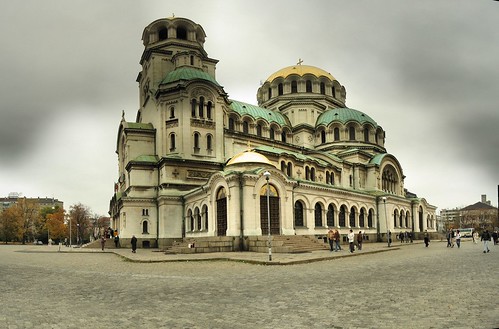
 There aren't many tourist attractions in Sofia, really there's only one: The Alexander Nevsky Cathedral. And even that, when I went to visit, didn't have any non-religious visitors inside except me (in fact it was nearly empty). I spent a few hours walking around the city yesterday taking photos, and people seemed to be looking at me with bemusement, with my map and my camera in tow.
 It's a shame really, because the city is actually thousands of years old. It was one of the first cities in the Roman Empire to adopt Christianity and was an early stronghold for the spreading religion. It was also an important centre for the Byzantine Empire. But the city centre was almost entirely destroyed during World War II, and over it was built a giant grid of characterless straight streets. There's actually nothing here that's much older than 150 years. And as it only became the capital of Bulgaria about a century ago, the government buildings have a rather rushed, characterless quality.
 At the same time, the city is a lot of fun. The seven strangers have been having a great time, our Bulgarian hosts have been showing us some amazingly cool bars and restaurants. A bar we went to last night was down in a deep cellar, lit only by candles. Intense!
I'm actually the only Anglophone in the group, but naturally we've been speaking English as the common language between us all. A large portion of us speak French, but not everyone, so we're not using it. Take a note, France. It's a shame though because it takes away so much of the motivation for us Anglophones to learn foreign languages, when our native language allows us to communicate with most everyone we would need to. Still, I've had to remember to switch over to speaking Continental English instead of my normal way of speaking. Ironically, it's easier for everyone else in the group to understand each other speaking English than it is for them to understand me, since I have a tendency to speak too quickly. I need some Continental English lessons.
 I'm about to head to the Parliament Building to interview an MP, she seems like she'll be an interesting character. I found some YouTube clips of her kicking up a fuss and yelling in the Parliament chamber. so she should be quite quotable! Then tomorrow we have our EU Debate on the Ground and the launch of CafeBabel Bulgaria. If you're in Sofia, come join us!