Saturday, 31 January 2009

Life In the Dark

If you've never tried eating in the dark, I highly recommend it. Last night I went to a blind restaurant here in Zurich called Blindekuh. It's an establishment where all the waiters are blind, and all the patrons eat completely in the dark, without being able to see a thing. Considering I had just been made redundant/laid off from my only steady freelancing gig an hour before we went to eat, it was hard not to see the experience as a metaphor for the state of the world right now.

I wasn't quite sure what to expect from the blind dining experience. I went with my father and some of his friends, apparently they had to make reservations for it four months ago. It's pretty wild. When you go to the table you are guided in by your waiter into a large dining room that is completely pitch black. You go through the entire meal and then are led out without ever having seen the room you were in. It's interesting how being in the dark heightens all your other senses. You suddenly become aware of the tone of people's voices, the feel of the objects around you and the taste of the food. Eating is a bit of an adventure. You have to move your hands very slowly around the table to make sure you don't knock anything over. You have no idea what it is you're putting in your mouth, so you just have to guess from the texture. Sometimes I would bring the fork to my mouth to find there was nothing on it! I speculated that it would be hilarious if there was a night-vision camera trained on us and at the end of the evening we could all watch ourselves hanging our heads over our plates, dragging our food into our wide open mouths and eating like infants. Actually, maybe that wouldn't be so pleasant to watch!

Of course I was a little distracted throughout the evening because just before we left I got a call from the web company I do my regular writing shift for saying they're having money problems and could no longer have a Europe correspondent. It's not a huge big deal as it's just one of my sources of income, but it was the only one that came with a regular daily schedule and a regular paycheck. But times are tough and I can understand why they can't afford to have foreign contractors any more. I was going to stop doing it in the next few months anyway, assuming I can find a full-time job soon. But it was a rather startling reminder of the state the world is in right now.

By my count 15 of my friends in the US and UK have been laid off in the past month (judging from Facebook status updates). They're not alone. US unemployment rose 159,000 to a record 4.78 million Americans this week. The Eurozone unemployment rate has risen to 8 percent. The predictions and analysis coming from the World Economic Forum in Davos this week have been truly frightening. And nobody seems to be quite certain of what's coming next, all they seem to agree on is that it's going to be bad.

Sitting there helpless in the dark last night, at first I felt quite anxious. But soon I realized I wasn't alone, we were all in this together. Me, my table, and all the other diners were also trying to navigate their way through this new uncertain world. But by working together, advising each other on where the obstacles in the dark lie, we made it through. By the end of the meal it almost felt normal to be eating in the dark. As we all feel blindly around the table in 2009, perhaps it will be good to keep in mind that we're all in the same boat.

It's going to be an interesting year in the dark.

Friday, 30 January 2009

'Black Thursday'

The one-day strike in France has come to an end, and despite some predictions, it didn't shut down the country. Yet for anyone who wanted to dismiss this simply as the French being French, there were signs today that this wasn't your average French protest.

The nation-wide industrial action severely disrupted air, rail and commuter service across the country. Air France stopped its flights, and hospitals had to operate at reduced capacity. Even journalists didn't show up for work today.

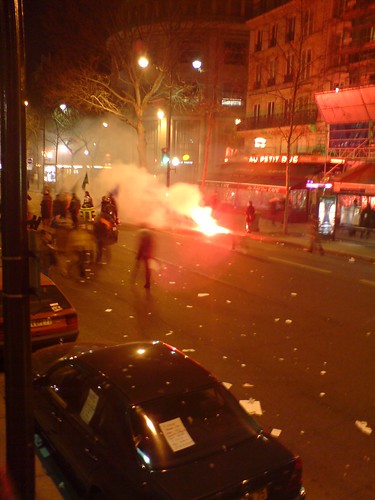
Industrial action is hardly unusual in France, but one thing was significantly different about today's strike: the protest wasn't against a specific issue, but rather at the government's handling of the entire global economic crisis. The French public is furious at the perceived unfairness of government bailouts going to the bankers and investors who caused the crisis in the first place. The protests turned violent this evening, with riots and fires erupting throughout the city and clashes with riot police.

Sarkozy recently said that a country like France will be hard to govern during this global economic crisis. He seemed today to be quite rattled by the strike. And with the dismal views coming out of Davos this week, things clearly are only going to get worse. As these protests keep occurring with increasing frequency in Europe, it's looking more and more likely that 2009 will be a year of discontent on the streets of Europe's capitals.

Wednesday, 28 January 2009

Moving to Brussels

Well this is it, I'm finally doing it. In four days I'll be moving on from Zurich and hopping a train up to Brussels, trying to make it as an EU journalist. I'll still be doing my work-at-home job in the mornings, but now in the afternoons I'll be able to go to events, press conferences and interviews for freelance articles.

For the past few months I've been writing freelance articles on EU politics for a few different publications, but I've found I could only do so much while not being in Brussels itself (I can only write so many articles on Switzerland joining the Schengen Zone and Obama's relations with Europe!). I'm in the process of getting credentialed for the press centre, so it's all very exciting. I'll be continuing to work on my French at the same time with another course three days a week.

Of course my long-term goal is to find a full-time job in Brussels covering the EU, but I know it's going to be a challenge, especially in this job market. Careers in Europe tend to be very stratified into tracks, and journalism is no exception. From what I've seen most of the young EU reporters in Brussels writing for policy-focused publications all started as interns for MEPs or for the Commission, and most of them tend to have the same kind of background. Of course, I've never worked for the EU in any capacity, and I haven't been on a track for working within the EU like they have. My knowledge of the EU comes from my education, but not from being part of it. So I've got work to do in expanding my list of contacts, but I'm ready to dive into it. My general experience with government has always been from the outside looking in, having covered the US government, Chicago politicians, and European regulatory bodies. Being an outsider can make generating contacts a challenge. But I've been thrown into strange reporting beats before and picked them up quickly, so I'm pretty confident I can do it again here.

I'll be very interested to see what living in Brussels is like. I've heard...well...mixed reviews! I've been there many times, but never lived there. I think I'm going to love it, but I'm a peculiar breed I suppose. I've taken a room in an apartment I'll be sharing with a girl from Iceland, she works in Brussels in food lobbying. My Brussels life is already so international!

Monday, 26 January 2009

Sarko to Save Newspapers

French President Nicolas Sarkozy is riding to the rescue on his white horse again, this time the damsel in distress is the struggling French newspaper industry. Considering that newspapers are struggling across the world, particularly in the United States, Sarko's plan to give free daily newspapers to all French 18-year-olds will certainly be watched closely by media analysts around the globe. But in this latest quest, in hindsight is the gallant Sir. Sarko going to more closely resemble Prince Valiant, or Don Quijote?

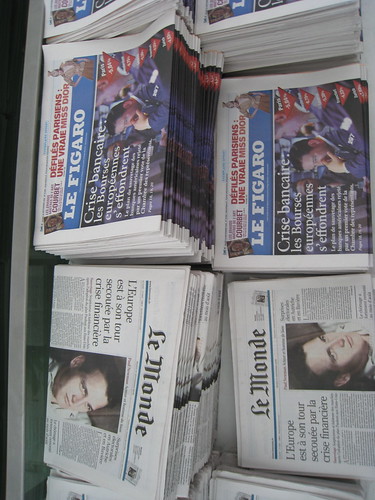
After a three-month investigation of the problems facing the French press, Sarko promised the following: tax breaks for delivery services, a doubling of the advertising it does in print and online newspapers, an increase in the public subsidies to newspapers to around €500 million, and giving all 18-year-olds a free subscription of the newspaper of their choice for a year.

Across the pond in the US much ink has been spilled about the imminent demise of the American newspaper. Paper after paper across the country has been folding, and big media conglomerates such as Tribune Corp. are going bankrupt. Even the New York Times, the most respected paper in the US, has been forced to take out a mortgage on its new Manhattan headquarters and start advertising on its front page. As far as I know the newpaper industry in the US doesn't receive any government assistance of any kind. So is the French social model of bailing out newspapers something that the US should consider?

It seems there is plenty of evidence to suggest no, but only hindsight will say for sure. In 30 years we may look back on the French decision to give 18-year-olds free newspapers as being akin to the government giving people free telegraphs in the 1920's after the invention of the phone.

There is increasing concern that the French newspaper bail-outs will discourage the industry from making any meaningful reform. The websites of French newspapers are notoriously bad, and if the papers don't start feeling the pain they might not have any motivation to improve them (although some of the aid is contingent on the papers investing in their online departments). The bail-out also doesn't address some of the fundamental cost problems in the French newspaper industry, including the high cost of producing the papers as a result of powerful labor unions in printing and distribution. Sarko will also not change the existing regulations that make cross-ownership across media nearly impossible, which has discouraged foreign media companies from investing in French papers.

Obviously I'm not an 18-year-old, but I would have little use for a free daily paper from my government. I'll freely admit that I have only subscribed to a newspaper once in my life, and that was in Chicago during journalism grad school when we were made to do so. The reason has never been economic, as subscription prices are very low. Rather, the idea of getting all my news from one source, that I would sit down and pour over at the kitchen table, is about as foreign to me as the eight-track. I get my news from different sources all over the world online, with RSS feeds, Google News, etc. During a commute I listen to podcasts on my ipod or read the latest headlines on my phone. And really, I move around too much to make a newspaper subscription very practical!

But on the other hand one need only look at the countries that are not having a problem in the newspaper industry to think that perhaps governments shouldn't just toss newspapers to the wolves. One thing France and the US have in common is a high respect for the printed press, and a comparatively low number of tabloid papers. On the other hand, in the UK and Germany there is considerably less respect for the printed press and an extremely high proportion of newspapers are tabloids. And guess which countries have the most newspaper sales? According to the World Association of Newspapers, circulation of paid-for dailies in France is only about half the level in Germany or the UK.

Clearly, the only clear commercial way that companies have found to make newspapers profitable in this day and age is to go the tabloid direction. Without government help, this is what newspapers in France and the US will likely have to do. Government bail-outs for the newspaper industry may be an uncomfortable proposition, but it may be better than the alternative: a nation with a collapsed fourth estate and no reliable source from which the public can get information.

Friday, 23 January 2009

One Letter and Six Months

Following the rioting in Iceland this week resulting from the country's economic collapse, the cruel joke making the rounds in Europe right now is that Ireland, its Atlantic island neighbor, is just one letter and six months away from being Iceland itself.

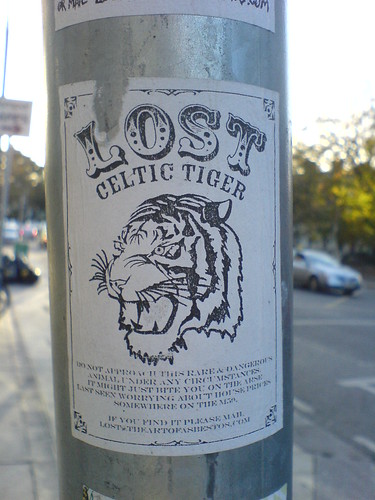
Once hailed as the "Celtic Tiger" for its economic power performance after joining the EU, Ireland today finds itself in bad economic straights. Yesterday the government announced that it would nationalize Anglo Irish Bank, the country's third largest lender. The government is also considering reducing the pay of public sector workers as it scrambles to find money anywhere, a decision which could lead to massive and possibly violent demonstrations in Dublin. In six months, Ireland could be in the same situation as Iceland.

Of course there is one key difference between the two: Ireland is on the Euro, Iceland is not. Many economists are saying that the fact that Ireland is in the euro zone is the only thing that has enabled the country's economy to stay afloat during these trying times. Though the economy is in big trouble, investors still consider the country safe because it is part of the euro zone, and its credit rating has not been downgraded.

This fact has seemed to make a few Euroskeptics across the Irish sea more than a little defensive. The British pound has virtually collapsed over the past six months, dropping today to its lowest level against the dollar in 23 years. It's fallen from $2.00 to one pound in July to $1.34 to one pound today. And the pound has lost 20 percent of its value against the euro in the same time, with the two currencies now almost equal in value. Today the UK also officially entered a recession, with commentators noting that the fact that 3/4 of the UK's economy is dependent on the services industry (the most harshly affected industry in the current global crisis) means that the country will likely be the hardest hit of any during the global downturn. And without the stability of being part of a larger currency block, it is thought the UK may have to go crawling to the International Monetary Fund begging for money, because it won't be able to finance the massive level of debt it is taking on with its currency so devalued.

This might explain the peculiarly hostile questioning the Irish finance minister received on the UK program Newsnight last night about whether it had been "too early" for the country to join the euro zone. The presenter insisted that the country's "hands are tied" by the Eurozone since it will be unable to set its own interest rates in response to the crisis (interest rates for the euro zone are set centrally by the European Central Bank in Frankfurt). The minister, Brian Lenihan, seemed hardly able to disguise his bemusement at the absurd question, pointing out that before Ireland joined the Euro its currency was pegged to the pound, and since the country has never freely floated its currency it has never been able control its own currency measures anyway. That shut the presenter up. But Lenihan must have taken a bit of satisfaction in then being able to tell the lecturing presenter that the Euro, "is the currency of our trade with many of our European partners. With the United Kingdom of course, we are at some disadvantage now because we're far stronger than sterling." Oh snap! "Small countries which have their own currencies tend to be speculated against," he continued. "We don't want to put our country in that position, so we linked to a stronger currency." Lenihan had cause for the comparison. Although the Irish economy is hurting, in the long run it may be in better shape than the UK ecnomy.

A New UK Euro Debate?

The prospect of the UK joining the Euro has long been dead in the water, but the current situation might revive the idea, particularly now that the pro-Europe Tory politician Ken Clarke has been brought back to the front benches. Rather than defending the British pound, however, British Euroskeptics seem to have fired an opening salvo by attacking the decisions of other countries to join. An opinion piece by Ruth Lea in today's Telegraph calls the euro zone "dysfunctional" and says the 'one size fits all' interest rate policy has been a disaster for smaller economies like Spain, Italy and Greece. She even blames the recent downgrading of Spain's credit rating on the Euro, seeming to suggest the Southern European economies will imminently drop out of the zone in order to devalue their own currencies out of the crisis.

But in reality, the Fitch ratings agency has kept Spain's credit rating as triple A because it's on the Euro. As the Wall Street Journal Europe pointed out today, Fitch affirmed Madrid's triple-A rating partly because "Spain's membership of the euro area supports its rating, as it eliminates the risk of a currency crisis." The Journal also points out that being part of the euro zone has kept these Southern European economies' budget deficits lower than 3 percent of GDP (or at least made them try to do so), making many euro zone countries now in a better position to absorb their rising deficits. Futher, the idea that these countries would suddenly leave the zone doesn't make sense. Aside from the enormous cost involved in converting the bills and the national debts back to the old currency, such a move would lead to massive wage inflation. And the concerns about national defaults would still exist to the same degree, only now the counties wouldn't have the security of being in thre euro zone to protect their credit rating. Perhaps it is just euroskeptic wishful thinking to think the euro zone is about to fall apart.

Celtic Tiger Laid Low

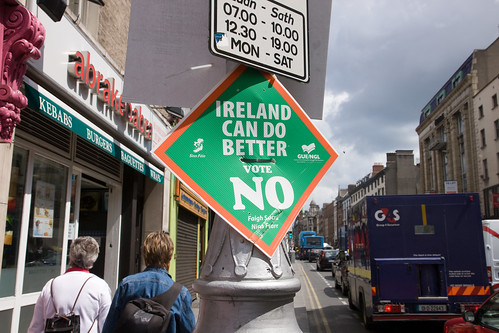
Many have been speculating on what effect the new economic reality in Ireland will have on the re-vote to be held in the country on the ratification of the EU Reform Treaty. Last night Lenihan seemed pretty confident that the crisis has made the Irish realize how much they have benefited from membership in the EU and adoption of the Euro. One of the explanations analysts had given for the no vote last year was that, although Ireland had historically been very pro-Europe, its economic success over the past decade had given the Irish the confidence to spurn the EU, thinking they could go it alone if they needed to. The recent months have certainly been humbling for the tiny country, and perhaps they will be thinking differently this time around when they enter the voting booths. That's the hope in Brussels at least.

Thursday, 22 January 2009

What's Going on at Switzerlands Borders??

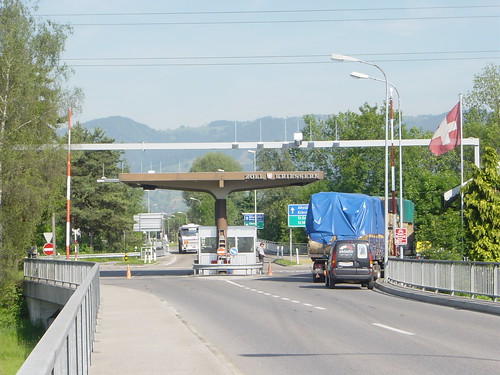
Something very strange is going on here. Back on 12 December, Switzerland joined the passport-free Schengen Zone, which enables travel between it and all of its EU neighbors without a passport check. Yet from stories I've been hearing it seems that Switzerland's borders have actually become harder to cross since it entered Schengen.

In the past two weeks two friends of mine have come to visit from Paris, both taking the direct high-speed TGV train. Both of their trains were stopped at Basel for 30 minutes while authorities came on board and checked people's passports. On the first visitor's train into Switzerland two weeks ago, the authorities adked everyone for a passport and searched everyone's luggage. The second visitor who came last week also had his train stopped. He hadn't brought his passport, and only had his French national ID. The border guard took his ID to the other end of the train car and made a phone call about it for ten minutes before eventually handing it back and continuing down the train. Last night I was talking to a German friend who lives here in Zurich and he said he encountered the same thing when driving up to Germany for Christmas. All of the cars were being stopped and passports were demanded.

Now this strikes me as rather unusual because under the precepts of the Schengen Agreement authorities at borders within the zone are actually not allowed to ask people for passports just because they are crossing the border. And before Switzerland joined the zone last month, passport checks on trains and roads leaving/entering Switzerland were sporadic and not frequent. Both me and my father have taken that TGV between Zurich and Paris many times before last month and neither of us has ever been asked for a passport (the train never stopped for thirty minutes in Basel either). The same goes for trains I've taken from Geneva into France and from Lugano into Italy.

So why has Switzerland's Schengen entry resulted in the exact opposite of what the entry was supposed to accomplish? I've been searching for answers this week. Switzerland's Schengen status is a bit different from the others because it is still a separate trade zone from the EU and therefor can still have customs checks at its borders, unlike borders within the EU. But my understanding is that the current arrangement allows them to search luggage but not to ask for travel documents. But on the other hand Swiss, French, German and Italian police all have the right to demand identification from anyone, anywhere, at any time. Does that invalidate the Schengen clause about not being allowed to demand travel documents?

A contact who works for the Cantonal government in Schaffhausen tells me he's heard that Switzerland has cracked down on its border with Germany in response to Germany doing so immediately after 12 December. He says starting on 13 December the Germans started manning every single one of their border checks with Switzerland (usually around 30 percent of these are not staffed at any given time). So in response, Switzerland started aggressively checking everyone coming the other way, and perhaps, he speculated, they've followed suit with their other borders now as well. In other words, Germany started it. That's all well and good, but when is it going to end? And is what the Swiss (and their neighbors) are doing at the borders allowed under the Schengen Agreement? I'll keep trying to get to the bottom of this.

All of the friends who have been stopped have been aware of Schengen Rules, but none of them has had the nerve to challenge the border guards on their right to ask them for a passport (it's not the type of situation you want to make trouble in!). But this weekend I might take a drive up to Germany's black forest and see if I can ask some questions to the border guards there on what their instructions are currently.

If Switzerland isn't going to follow the rules of the Schengen Agreement, one wonders what the point of them joining was.