Sunday, 22 April 2012

End of the Swiss chapter


I’m flying back to Brussels from Zurich at the moment, watching the snow-capped Alps to my left fade into the distance as we turn to follow the Rhine to the sea. This weekend was an emotional one, as I spent it helping my dad move out of his Swiss home.
He is moving back to the US this week, his company has transferred him back there. And with that, a very significant chapter of his life – and mine – has come to a close.
Switzerland was where I began this European adventure six years ago, so it was a bit jarring to see my dad’s empty house today and walk out the door for the last time.

Tuesday, 10 April 2012

Brussels, the broken city

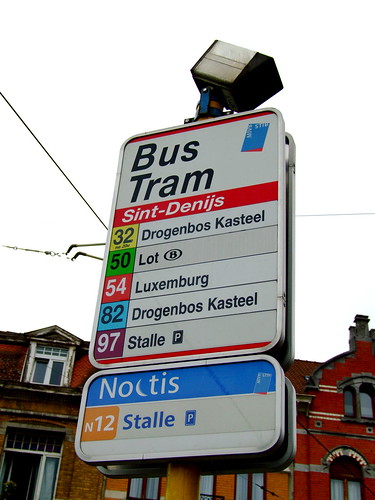
Public transport has been shut down in Brussels for four days now, a state of affairs we learned this morning will likely continue until Thursday. The entire situation has seemed to put people here in a more pronounced state of cynicism and disgust than normal, given both the circumstances of the incident which sparked the strike and the behaviour of the transit workers.

Early on Saturday morning, a city bus was involved in a traffic accident with a drunk driver. When a supervisor from Brussels’ public transport agency STIB came to investigate the accident and accused the car driver of being drunk, he became offended and called some friends to defend him. Those friends attacked the STIB supervisorand killed him.

In response, the STIB immediately shut down the network. This was done well before the facts of the incident were clear and before the employee had died (he didn’t die until later in the day at the hospital). Initial reports on the STIB’s web site said the trains weren’t running because of a “lightning strike”. Later it was a stabbing, until eventually it just said a “serious incident with dramatic consequences”.

The STIB employees said they wouldn’t go back to work until they had a meeting with the Belgian government about improving their safety on Monday night (this being Easter weekend, Monday was a public holiday). But last night, without providing much explanation, the STIB workers union said whatever had been offered them was not enough, and they would continue to stay home.

Tuesday, 3 April 2012

Are we entering the fact-free century?

America appears to have a lying problem. It’s hard to come to any other conclusion when looking at the string of easily disprovable untruths that have come out of the mouths of mainstream politicians during this season's Republican presidential primary.

The fact that these untruths have mostly gone unchallenged is an alarming reflection on American society. When you look at both the amount and the sheer audacity of the lies told on the campaign trail, and the fact that little to none of it has been challenged, it's truly bewildering. It would appear some kind of pseudo-reality is gaining an increasing foothold in the United States. And it leads to a disturbing question - is this a phenomenon that is unavoidable for the world at large in the internet age?

This week US presidential candidate Rick Santorum, polling second in the race to become the Republican nominee, told an audience, “I was just reading something last night from the state of California. The California universities – I think it’s seven or eight of the California system of universities - don’t even teach an American history course. It’s not even available to be taught. Just to tell you how bad it’s gotten in this country, that we’re trying to disconnect the American people from the routes of who we are.”

Just a five minute search on the University of California website reveals that this is completely untrue. It’s not even a little bit true. Not only does every university in the California system offer American history courses, but all UC bachelors programs actually require students to take one.

Dutch killing machines

Wednesday, 28 March 2012

EU internet roaming charges to be slashed

From 1 July this year using a mobile phone to surf the web in another EU country will be about 70% cheaper, following an agreement on rate caps reached today by European Parliament and member state negotiators.

For the first time, the EU roaming caps will limit the rates phone companies can charge you for using the internet in a different EU country. The cost per downloaded megabyte will be capped at 70 cents as of 1 July 2012, 45 cents in 2013 and 20 cents as of 1 July 2014. The current average cost of roaming within the EU is €2.23 per megabyte.

The EU first started limiting the rates EU carriers could charge for roaming within the EU back in 2009, limiting the charge for making calls to 45 cents a minute. That cap has steadily decreased over the past three years, and today's agreement will lower them a further 20% from the current 35 cents to 29 cents, dropping to 19 cents in 2014. Before then, it used to cost an average of €1.50 per minute to make a call elsewhere in the EU. Now, for the first time, internet usage will be capped as well.

Of course this only applies to people with an EU phone carrier. So if you're travelling to Europe from the United States, you'll still pay the high fees.

Friday, 23 March 2012

Don’t mention the Gaza

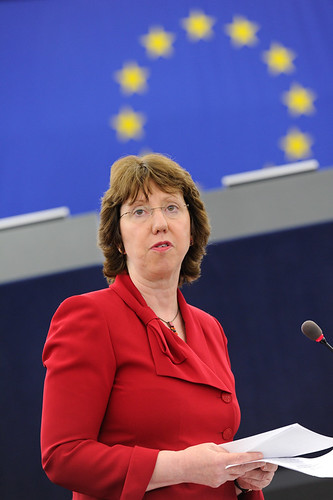
EU foreign policy chief Catherine Ashton was the object of fury in Israel this week - with the press, the pundits and even the prime minister all calling for her immediate sacking. Her crime? Mentioning the fact that children have been killed in Gaza.

Ashton was attending a Brussels conference on the subject of Palestinian children refugees on Monday when news came that three children had been shot and killed at a Jewish school in Toulouse, France. When she took to the podium to address the conference, Ashton broke the news. She then talked about how sad it is when a child loses a life, bringing up last week’s bus accident in Switzerland where 22 Belgian children were killed.
“The Belgian children have lost their lives in a terrible tragedy. And when we think of what happened in Toulouse today, when we remember what happened in Norway a year ago, when we know what is happening in Syria, when we see what is happening in Gaza and Sderot [Israel], in different parts of the world — we remember young people and children who lose their lives,” she told the audience (video here).
 When news of her comments reached Israel, the reactions were swift and furious. Israeli papers said her comparison of the shooting of innocent Jewish children with the deaths of Palestinian children during Israeli shelling of Gaza was “grotesque”. They labelled Ashton as anti-Semitic, people compared her to a Nazi, and the papers demanded her immediate removal from office.

Thursday, 8 March 2012

Eurovision controversy starts early as Armenia pulls out

As predicted, this is going to be one tumultuous year for Eurovision, the yearly singing competition where European countries compete with original songs (for Americans, it's a bit like American Idol and Miss America combined). News this week that Armenia has pulled out of the competition after Azerbaijan's president described Armenians as the country's "main enemies" has noticably rattled the competition's organisers.

The song contest, which has been held since 1956, is hosted each year by the country which one the previous year. Last year the contest was won by Azerbaijan, the Muslim former Soviet republic in the Caucasus on the border with Iran. The definition of 'Europe' has been stretched over the past decades to encorporate new countries such as Turkey, Israel and even one year Morocco.

But this year's contest in Baku is going to be an awkward one, given that Azerbaijan is still in an active conflict with its neighbor Armenia, which also participates in Eurovision and takes it very seriously. Having the warring countries both participating in Eurovision has caused problems in the past. In 2009 a number of Azerbaijanis who had voted for Armenia's entry Anush and Inga (pictured below) during the contest that year were reportedly summoned for questioning by the Ministry of National Security.