Thursday, 28 January 2010

Tony Blair the scapegoat

The UK has been in frenetic anticipation this week of Tony Blair’s testimony Friday in front of the Iraq War show trial, er I mean, inquiry. The British media has been baying for a dramatic crescendo to the three week grilling of former cabinet officials who were involved in the decision to join the war. So far it's failed to deliver the “smoking gun” of conspiracy they’ve wanted. My inbox this week has been flooded with emails from activists and NGOs demanding this or that question be asked of Blair. Anticipation is so high that Channel 4 News actually spent 15 minutes last night doing a staged enactment of how the proceeding might go on Friday.

But despite the high theatre, the inquiry has failed to reveal anything too interesting. Given that the panel has focused so relentlessly on the accomplice rather than the perpetrator of the Iraq War, one could have expected similar results from an inquest of Austrian officials after World War II to “unearth the truth” about the invasion of Poland.


Monday, 25 January 2010

How individualism shapes the US healthcare debate

Of all the activities I expected to be engaged in Saturday night, finding myself at a bar in Switzerland vociferously defending the right to name a child Adolf Hitler was not one of them. But as it happens, this curious discussion about European naming regulations gave way to a very interesting conversation about the healthcare hullabaloo in the US – a debate that has perplexed Europeans over the past eight months.

The two very different attitudes in the conversation about whether the government should get involved in the naming of a baby was symptomatic of a larger divide between the Anglo-Saxon English-speaking world and continental Europe. Being reminded of this vast difference helped me to put into perspective Americans’ huge resistance to increasing healthcare coverage.

Talking about the US, a German friend of mine who lives in Zurich said he thinks it's strange how Americans give their children crazy names like Apple Blossom or Stapler, and such a thing would never happen in Germany. Of course the most extreme example of a bizarre name, widely reported in Germany, was the case of the neo-Nazi man in Pennsylvania who complained when a local supermarket refused to write his son’s legal name (Adolf Hitler) on a birthday cake. In Germany, where it is illegal to use any of the imagery of the Nazi party, people couldn’t believe that the government would allow someone to give their child such a name in the first place.

Thursday, 21 January 2010

When 40 is more than 60: Why Republicans always win

In the wake of Tuesday’s game-changing Republican victory in Massachusetts I’ve been inundated by questions from perplexed Europeans. How is it, they ask incredulously, that one year after Barack Obama came into office on a wave of popular euphoria, he has somehow come to attract the rage of the very Americans he’s been trying to help?

The answer lies in this not-often-observed reality: despite the fact that voters banished Republicans from the leadership of every branch of government in the 2006 and 2008 elections, since Obama's inaugeration they have been able to wage one of the most effective oppositions in American history. Though the Grand Old Party is in the midst of a leadership vacuum and is no longer coming up with any actual policy ideas, they've somehow managed to stymie the Obama agenda to such a degree that in practice they are effectively a co-equal power in government. You’ve got to hand it to them, it’s truly a remarkable feat. They’ve managed to get the American public demanding a return to the party of George W. Bush.

Tuesday, 19 January 2010

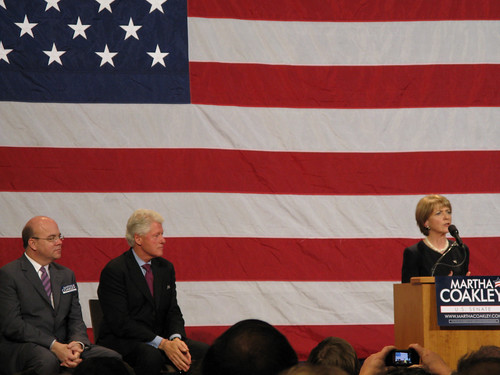
Today's election could doom Obama presidency

Without hyperbole, one can say that today’s special election in Massachusetts is the most important poll of Barack Obama’s first term. Stunned into action, Democrats are madly criss-crossing the state to prevent a shocking political defeat that could not only kill the healthcare bill, but could also doom prospects for passing climate change legislation and financial reform. In other words, the result of today’s election could deal the new president such a grievous injury that he will be unable to recover and spend the next three years in lame duck status.

Exaggeration? Not really. The special election is to fill the senate seat held for 40 years by the legendary Democrat Ted Kennedy, who died last year. Massachusetts (often derided as “Taxachusetts” by the right) is without a doubt the most liberal state in America, and it is almost entirely dominated by Democrats. The entire congressional delegation (both senators and all ten representatives) are Democrats. In the Massachusett’s 200-person state legislature, only 21 representatives are Republicans.

Friday, 15 January 2010

Who wants an EU Grammy?


I’ve just been alerted via a press release to the existence of something called the “European Border Breaker Awards”, which is apparently an award show put on by the European Commission for European music acts that “cross borders”. It’s an interesting idea but taking a look at it , I think the way its structured is kind of silly. It seems to ignore a fairly obvious fact – if they were being honest about the awards, almost all of them would go to British acts.

Apparently this award show has been going since 2004, and previous winners include France’s Carla Bruni, Germany’s Tokio Hotel, Italy’s Tiziano Ferro and Benito Benasi, Sweden’s Basshunter and Britain’s The Ting Tings. This year’s awards took place last night in the Netherlands, hosted by the BBC’s Jools Holland.

Intrigued by the concept, I did a little basic esearch and found that the objective of the awards, sponsored by the Commission and the European Broadcasting Union, is to “highlight the success of 10 debuting European artists in selling albums and touring outside their home territory” to “stimulate the cross-border circulation of artists' works”.

Thursday, 14 January 2010

London plans ‘USA Day'?? I'm out of here!

Well it’s been up in the air for awhile now but today it became official: my company is moving me to Brussels. I will be heading over there 1 March.

In the past year of doing this job covering the EU I’ve been living in London (where the company is based) and just going into Brussels when required. But someone in our Brussels office is leaving, so I need to be over there full-time now. I’m looking forward to it actually. Covering the EU from London has been a bit like trying to cover the US Congress from New York. You can do it (people do) but you can’t do it very well. Sure, you can hop on a Eurostar or Amtrak train to attend the key hearings, press conferences and events. But if you’re not immersed in the EU or DC bubble, you’re just not fully connected