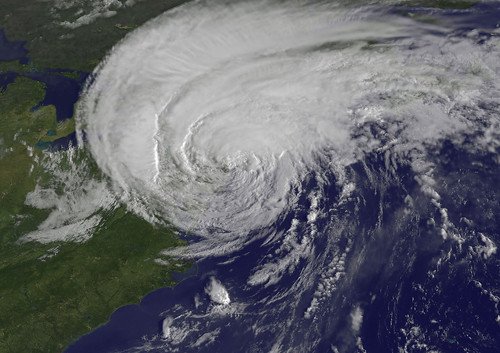
I've just returned to Brussels after a weekend of trying to navigate the hurricane-hit Northeast US. It was a bit of an adventure trying to get from Connecticut to JFK airport yesterday, navigating around floods and downed trees. As I flew out on Monday I had the feeling I was being airlifted out of a disaster zone.
Though Hurricane Irene itself may have packed less of a punch than the worst-case-scenario predictions, the aftermath of inland flooding and power outages is creating a mess from New Jersey to Vermont. And according to reports, funding for the recovery effort may be the subject of political brinksmanship in Washington over the coming weeks and possibly months.
I had gone to New York for two weeks for my grandparents' 60th wedding anniversary and my new nephew's baptism, both of which were scheduled for this past weekend. Needless to say, both were cancelled. I had to quickly make adjustments to my plans on Friday as predictions for the hurricane got progressively worse and the New York City mayor announced all public transport would be suspended from noon on Saturday.
Tuesday, 30 August 2011
Tuesday, 16 August 2011
British police don't want American supercop
David Cameron's announcement last week that he is appointing former New York City police chief Bill Bratton to guide the UK through its response to the riots has been met with a barrage of criticism from the country's police chiefs. The war of words over the appointment of the controversial 'supercop', who implemented New York's "zero tolerance" approach to policing in the 1990's, has exposed a deep rift between Westminster and Scotland Yard, and the atmosphere is only getting more heated.
Bratton gained fame as New York Mayor Rudy Giuliani's right-hand man in implementing the "broken windows theory" of policing in the city. The theory states that petty crime leads to serious crime, so the 1990's led to a serious crackdown on minor offenses. It turned New York from one of the most crime-ridden cities in the Western world to the safest large city in the United States. But on the flip side, many say it has turned New York into a virtual police state, where officers can arrest you for anything.
The original plan was reportedly to appoint Bratton as London's police commissioner, but this was shot down because he is not a British citizen. So instead he has been appointed as a government adviser. But even this has angered Britain's police chiefs, who say Bratton's 'zero tolerance' approach to policing in America is not appropriate for the UK.
Bratton gained fame as New York Mayor Rudy Giuliani's right-hand man in implementing the "broken windows theory" of policing in the city. The theory states that petty crime leads to serious crime, so the 1990's led to a serious crackdown on minor offenses. It turned New York from one of the most crime-ridden cities in the Western world to the safest large city in the United States. But on the flip side, many say it has turned New York into a virtual police state, where officers can arrest you for anything.
The original plan was reportedly to appoint Bratton as London's police commissioner, but this was shot down because he is not a British citizen. So instead he has been appointed as a government adviser. But even this has angered Britain's police chiefs, who say Bratton's 'zero tolerance' approach to policing in America is not appropriate for the UK.
Friday, 12 August 2011
Can the odd couple save Europe?
The European debt crisis has spread to France, with new concerns that the country is about to get its credit rating downgraded sparking fresh panic in the markets this week. In charistaristic style French president Nicolas Sarkozy has sprung into hyperaction, running around Paris giving speech after speech to reassure the markets he is taking drastic austerity steps. But his announcement yesterday that he and German chancellor Angela Merkel will hold a crisis meeting in Berlin has confused his German counterpart. "What meeting?" was her response.
Apparently this "crisis meeting" Sarkozy was referring to had already been planned before the rumours of a French downgrade started. Now senior figures in the German government are reportedly annoyed with Sarkozy's urgent tone this week, as Merkel has preferred to project a calm, level-headed response. She is reportedly unnerved by Sarkozy's extreme reaction and thinks it will spook the markets even further. next week's meeting, the Germans think, should not be portrayed as a "crisis" meeting.
The incident is typical of the relationship between the two leaders. Sarkozy is brash and impetuous, Merkel is reserved and thoughtful. As often as Merkel is accused of inaction, Sarkozy is accused of overaction.
Apparently this "crisis meeting" Sarkozy was referring to had already been planned before the rumours of a French downgrade started. Now senior figures in the German government are reportedly annoyed with Sarkozy's urgent tone this week, as Merkel has preferred to project a calm, level-headed response. She is reportedly unnerved by Sarkozy's extreme reaction and thinks it will spook the markets even further. next week's meeting, the Germans think, should not be portrayed as a "crisis" meeting.
The incident is typical of the relationship between the two leaders. Sarkozy is brash and impetuous, Merkel is reserved and thoughtful. As often as Merkel is accused of inaction, Sarkozy is accused of overaction.
David Cameron's 'Katrina moment'
Members of the British parliament were called back from their vacations for an emergency session yesterday to deal with the country's riots earlier this week. The past two nights have been quiet - a combination of bad weather and a surge in police forces seems to have done the trick. But now the political storm begins, with the public demanding to know how the situation could have gotten so out of control.
The focus of much of the public's ire has been prime minister David Cameron. He was seen to be back-footed during the crisis, spending the first few days of the rioting insisting he would not cut short his vacation in Italy, and only returning to the country after the riots got very serious Monday night. The media has been referring to it as his "Katrina moment", referencing the back-footed response of US president George W. Bush to Hurricane Katrina in 2005. The incident is being seen as a defining moment of his premiership, and he has been much maligned for it. The above gag photo of his speech on Tuesday from photoshoplooter illustrates the public's perception of his response.
Cameron has been working overtime to dispel that image over the past few days. In yesterday's emergency session he aggressively denounced the riots, saying the behavior of this bad element of society could not be excused by social factors or circumstances. And though his party often criticised the opposition Labour party for introducing "knee-jerk legislation" after crises during their time in government, he floated no fewer than six new policies. These include a ban on face masks in public, increased curfew powers, allowing courts to ban children from gathering in certain places and, most controversially, he said he is considering allowing temporary bans on social media during times of social unrest.
The focus of much of the public's ire has been prime minister David Cameron. He was seen to be back-footed during the crisis, spending the first few days of the rioting insisting he would not cut short his vacation in Italy, and only returning to the country after the riots got very serious Monday night. The media has been referring to it as his "Katrina moment", referencing the back-footed response of US president George W. Bush to Hurricane Katrina in 2005. The incident is being seen as a defining moment of his premiership, and he has been much maligned for it. The above gag photo of his speech on Tuesday from photoshoplooter illustrates the public's perception of his response.
Cameron has been working overtime to dispel that image over the past few days. In yesterday's emergency session he aggressively denounced the riots, saying the behavior of this bad element of society could not be excused by social factors or circumstances. And though his party often criticised the opposition Labour party for introducing "knee-jerk legislation" after crises during their time in government, he floated no fewer than six new policies. These include a ban on face masks in public, increased curfew powers, allowing courts to ban children from gathering in certain places and, most controversially, he said he is considering allowing temporary bans on social media during times of social unrest.
Thursday, 11 August 2011
Switzerland considers pegging to the euro
This was in clear evidence earlier this month when I took a trip on the Glacier Express train across the Swiss Alps with my father. Ordinarily this scenic tourist train would be packed in August, having sold out months in advanced. But our train was nearly empty. When we finished our journey in Zermatt, home of the Matterhorn, the city was dead quiet. It looked like three-quarters of the rooms in our hotel were vacant.
It makes sense. After all, who can afford a vacation in Switzerland these days? It was already an incredibly expensive country, and the current exchange rate close to one euro to one franc (three years ago it was 60 cents to one franc) makes it unaffordable for most tourists from France, Germany and Italy. When my father moved from the US to Zurich in 2006 the exchange rate was 80 US cents to one franc. Today it's $1.37 to one franc. Given that a value meal at McDonalds costs 15 francs ($20), it's a difficult place to be if you don't make a Swiss salary.
Tuesday, 9 August 2011
Britain's teenage riot
London was ablaze last night as an unprecedented wave of violence and looting spread throughout the city, spreading to other cities in England. It was the third day of rioting in London, initially sparked by the police shooting of a young black man in Tottenham last week. But last night saw the situation explode and quickly spread after the government and the police appeared to lose control of the situation. The rioters carrying out the violence were mostly children, teenagers in hooded sweatshirts covering their faces, bashing in store windows and setting cars on fire. I've written before about how Britain is terrified of its own children. Last night was a shocking manifestation of that problem. A 2008 poll showed that more than half of British adults are afraid of British children, believing they behave like animals and pose an increasing danger to themselves and others.
The images from last night are truly shocking, particularly the fires. It was the largest number of simultaneous fires London has seen since the blitz. There were reportedly children as young as seven taking part in the violence. What precipitated the violence was the fatal police shooting of a young black man last week in Tottenham. The police say he had a gun and was shooting at them, but his family says he was unarmed. The facts surrounding the case are still unclear.
Subscribe to:
Posts (Atom)


