Friday, 16 November 2012

Who is Captain Europe?


For two years, Brussels has grappled with a mystery that has taken on a sort of legendary aura – who is Captain Europe? Tonight, I may finally discover the answer.

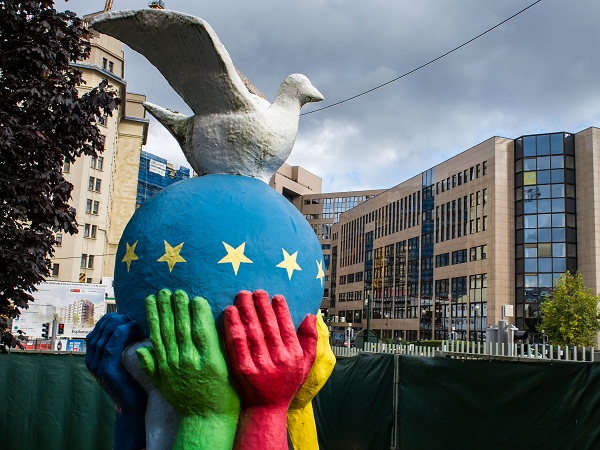
The caped crusader – pictured right – appears suddenly at various events around Brussels, dressed head to toe in euro-blue spandex. When the EU won the Nobel Peace prize last month, he was spotted at Place du Luxembourg (known affectionately by Eurocrats as ‘Plux’) shortly afterwards waving an EU flag and working the crowd into a frenzy of eurenthusiasm. Wherever euro-spirits are down, he suddenly appears to save the day. His tweets are a consistent source of amusement.

Thursday, 8 November 2012

A relief for Europe - but will gridlock persist?

Anxious Europeans have been able to breathe easier the past two days, after Tuesday’s reelection of US president Barack Obama. But the relief has much more to do with the defeat of Mitt Romney than with Obama himself.

Europe isn’t the only place feeling relieved because of a dislike for Romney. Outside Israel, there probably wasn’t one country on the globe that was excited about the prospect of a Romney presidency.

The Republican candidate's dangerous rhetoric seemed almost guaranteed to launch a war with Iran which no US allies would have been keen to sign up to. He had described Russia as America’s “greatest geopolitical foe” and had spoken of China as if it was the evil empire, promising to “get tough” with them in a way Obama hadn’t (although he never provided details about what that would mean). Latin America recoiled at his extreme anti-immigration rhetoric, and Africa was less than excited about his promises to cut US overseas aid.

In Brussels, there is a sense that long-stalled bilateral issues that were waiting until the resolution of the election can finally be taken off the back burner. There is (perhaps naïve) hope that a second-term Obama can show up to the UN climate summit in Doha next month with a reverse-course on the US intransigence in taking action to combat global warming. Negotiations on a US-EU free trade deal can now begin. Most importantly – fears that Europe was about to see a return to the trans-Atlantic tensions that marked the George W. Bush era have now been allayed.

Tuesday, 6 November 2012

The case for four more years? Look at the previous four

Rachel Maddow had an excellent review of Obama's first term last night. It's bizarre that anyone would say the American president "hasn't done anything" in his first term. Historic legislative actions were taken during the first two years. And even after the Republican takeover of the US Congress in 2010 ground all legislative activity to a halt, Obama still took important executive decisions over the following two years that could bypass the congress. Let's take a little stroll down memory lane, shall we?


Europeans are very anxious about the result of today's election in the US. It would appear that it is now up to 8 million people in Ohio to decide the fate of the world. Hopefully they will make the right decision.

Sunday, 14 October 2012

Catalonia: on the precipice of secession?


I’m on a plane back to Brussels from Barcelona at the moment, still digesting the amusingly polarised reaction to Friday’s announcement that the EU has won the Nobel Peace Prize. The significance of the announcement was only heightened for me this weekend by the fact that, as the Nobel committee spoke of the achievement of the EU in keeping Europe together, I was in a country that may be about to tear itself apart.

Friday was Spanish National Day, but you wouldn’t have known it on the streets of Barcelona. The Catalans may have been happy to take the day off work, but they were clearly not in the mood to celebrate. There was no parade, no festivities and - most noticeably - not even any Spanish flags.

In fact the only way one would have known it was national day at all was that in the morning, the streets around Placa de Catalonia were filled with Police officers preparing for a planned march by secessionist demonstrators. Helicopters thundered above us, preparing for the possibility that the city would see a repeat of the massive secessionist demonstrations that took place on 11 September (Catalan National Day) that saw more than a million protestors flood the streets of Barcelona. However from what I saw, this time around the Catalans seemed to prefer ostentatious non-observance to demonstrations.

Though there were Catalan flags draped from nearly every window (perhaps left over from the 11 September celebrations), I did not see one Spanish flag except for those on government buildings.

Friday, 12 October 2012

Does the EU deserve the Nobel Peace Prize?

What a day to be away from Brussels! I'm in Barcelona this weekend, but awoke this morning to the news that the European Union has been awarded the 2012 Nobel Peace Prize. I'll admit, I had to do a double-take after reading that news.

This is another deliberately provocative move by the Nobel committee, following last year's selection of Barack Obama. Like last year's choice, this one is going to have its share of critics.

The Nobel committee seems to have adopted a strategy of trying to aid well-intentioned people/institutions at a time when they're down on their luck. When they chose Obama, he was in a weak position domestically, showing the scars of the healthcare fight. And obviously, it goes without saying, the EU is also in a difficult place right now. The awards seem to be almost like a pep talk - don't get discouraged, keep hope.

And yet many of the uncomfortable contradictions are still there. Many questioned how a US president currently waging a war in Afghanistan and a secret drone war in Pakistan could be awarded a prize for peace. Several EU member states are also participating in the Afghan war, including Britain and France (though France is about to pull out). Of course the Nobel Committee would likely argue that this is member states, not the EU itself.

Monday, 24 September 2012

Britain snubs Europe, goes to the dance with Canada


It shouldn’t be a surprise to anyone that UK foreign secretary William Hague has found a new way to annoy his European counterparts. But today he’s managed to bring a North American country into the fray, and for once is isn’t the one with whom he believes he has a “special relationship”.

During a visit to Canada today Hague announced that the UK is going to close some British embassies across the world and merge them with Canadian embassies. The two countries will establish joint diplomatic missions, sharing embassy offices and consular services.

The move, an attempt to save money in these cost-cutting times, might seem logical enough at first glance. But the more you delve into it the more you realize it is diplomatically and logistically bizarre. While the UK and Canada may have similar foreign policy (something irrelevant to the consular services they are merging), they are completely separate countries which share no unified visa system. The only thing they share is a queen.