I'm back in Switzerland after my holidays in New York, and yesterday I decided to take a drive over to the border with Liechtenstein to see if they had set anything up as a result of the
Schengen discrepency. As I expected, there is no new passport check along the section of the Rhine seperating the tiny principality from Switzerland, but interestingly, I didn't see any sign of the
reported surveilance systems that they've now set up either.
Switzerland
joined the Schengen zone, which allows passport-free travel between European countries, last month. However Liechtenstein has not yet joined, because the EU is trying to
strong-arm it into cracking down on tax cheats before it will allow the principality in. Liechtenstein, which has had an open border with Switzerland since 1923, is now wedged between two Schengen countries and in theory, Switzerland must now set up border checks with Liechtenstein for the first time. This could be a big headache because for all intents and purposes Liechtenstein is pretty much part of Switzerland. It uses the Swiss franc, relies on Switzerland's military for defense, and many people live in one country and work in the other. Aside from a few small signs at the border, there is little differentiating the principality from its neighbor.
 The border guard corps in Eastern Switzerland has said it is setting up a series of surveilance cameras along the bridges in order to comply with Schengen rules, and in theory if any cars look suspicious they have border guards ready to investigate. However I didn't see any sign of such cameras when I was there, and considering I was walking around taking pictures you'd think if anyone was watching they might have come to ask me what I was doing! Perhaps they haven't set them up yet. Interestingly, I've heard that this surveilance system is going to cost several million francs, just to be dismantled once Liechtenstein does eventually join. Liechtenstein has even had to issue Schengen visas free of charge to foreign nationals living there, who would now in theory be legally trapped within the 160 square kilometre country. I guess Brussels has proven that it can make life difficult for the tax havens when it wants to.
I had never been to Liechtenstein before, it's a pretty weird place. It is true that from the prince's palace you can see almost the entire inhabited area of the country. It's really just a small strip of land on one side of the Rhine in a valley. It was a Saturday afternoon and Vaduz, the capital, was completely deserted. It was just me and some Eastern Europeans who seemed to also be there for the novelty factor, taking pictures of every Liechtenstein flag in sight.
 On the way back I came across a reminder of another ongoing issue with Switzerland's entry into the Schengen Zone. Switzerland's bilateral agreements with the EU requires that all EU nationals be allowed free movement in and out of the country, but Switzerland is going to vote on whether the two newest entrants, Romania and Bulgaria, will be afforded the same access. That vote will be February 8th, and in St. Gallen I came across this billboard from the FDP urging people to vote yes to giving Romanians and Bulgarians the same rights as other EU citizens. The billboard points out that a no vote, being advocated by the conservative SVP party, would send a hostile signal to Switzerland's neighbors and lead to further isolationism. It shows two people with SVP signs destroying a rail bridge to the rest of Europe. It reminds of the Swiss of the infamous "guillotine clause," which says that if Switzerland renegs on any treaty its already signed with the EU, all of the bilateral treaties will be rendered invalid, effectively completely cutting off the country from its neighbors.
Tonight I noticed that the SVP has put up a contrary billboard right outside my dad's house urging people to vote no (photo below), with their usual motif of dark nefarious foreigners greedily eyeing Switzerland's riches.
 Honestly the idea that people would be making decisions on these important issues based on some childish cartoons seems pretty absurd to me, but it's typical of this country's obsession with referendi. Neither of these cartoons clearly conveys what's really at stake with this vote. The SVP ad seems to be suggesting that this is some kind of additional right that the Swiss people can choose to give to their neighbors to the east, when in reality a no vote would be reneging on a treaty that Switzerland has already signed. The EU has made very clear that Switzerland cannot pick and choose which parts its bilateral agreements it's going to obey as if it was some sort of dipomatic buffet. On Saturday Switzerland's EU ambassador Michael Reiterer told the newspaper Tribune de Geneve that if the Swiss refuse to extend the free movement clause to the new entrants it will invalidate the country's entry into the Schengen Zone and the whole agreement will be torn up.
I'll be watching with interest to see what happens in that referendum. After stopping in Leichtenstein I drove over the border with Austria and as expected I found the border check dismantled. If the Swiss vote no in February 8th, those checkpoints may have to be hastily reassembled. And contrary to Reiterer's optimism, I'm not so certain the referendum will pass. A few years ago the referendum to join Schengen did not pass by a large margin, and the recent success of the SVP may reflect the fact that public attitudes on immigration may have continued to harden since then. In the mean time I'll be interested to hear from people here whether they understand what reprocutions a no vote could have.
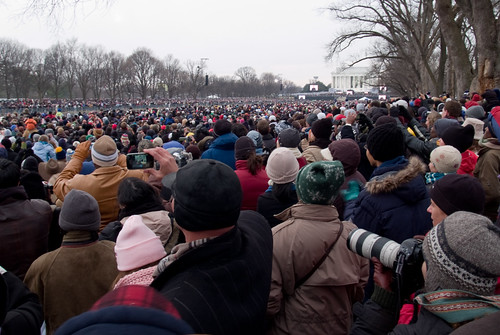 I'm watching the inauguration on TV now, a little sad that I'm not there in DC for it but I'm getting lots of twitter updates from my friends in Washington! Looks like fun. It's striking to me that every news channel over here in Europe has had live coverage of this event from the wee hours of the morning. Truly, all eyes are on Washington today.