Thursday, 5 March 2009

The Reports of Their Death are Greatly Exagerated

Is the established media dead, or are they stronger than ever? This is the question we've been grappling with over the past two days here at the Digital News Affairs conference in Brussels. The conference is a yearly cross-media, cross-platform look at the technologies shaping the media industry, and I've been here covering the event for CafeBabel. As with most conferences focusing on the media these days, the conversation has tended to be dominated by the big question: what is going to happen to the 'established media' now that the Internet has completely changed the game?

Such conversations took place just about every day back in journalism school at Medill in Chicago, and the level of chatter hasn't abated. But something significant has changed since then, and that is that the vast majority of the established media has caught up to the technological advances, and where they've entered they've entered in a big way. But will this be enough to keep them relevant? Various panelists over the past two days have staked their position on either side of the debate, and I've noticed that their position tends to reflect which side of the aisle they're coming from, established or start-up.

The conference opened with a panel of a few start-ups taking a look at how the economic downturn combined with the current technological revolution has turned the traditional media business upside down. Unsurprisingly this panel, composed of representatives from Google, Rue 89 and Demotix, seemed to conclude that traditional media models were dinosaurs and would be quickly eclipsed by young start-ups. In short, the web 2.0 revolution has created an equal playing field where news can be provided by anyone, anywhere over the web. The brands of the established media would not, some panelists concluded, protect them from being eclipsed by younger, more flexible start-ups. Users don't care who's providing the news any more, they argued, they just care how quickly and creatively they get it.

Contrast that with the the afternoon panel, appropriately titled "The Established Media React." Chaired by Ben Hammersley of Wired magazine, the panel was composed of folks from Deutsche Welte, Sky News, De Standaard, the Wall Street Journal and the BBC, who all vociferously defended their position. I have to say, between the representatives of the "new media" and the representatives of the "old media," I've found the established players to be far more convincing. Peter Vandermeersch of Der Standaard, the largest daily paper in Flanders, pointed out that despite all the predictions of the death of the traditional media his paper has actually been doing increasingly well over the past several years. "Newspapers are alive and kicking," he insisted. "Are we good enough now? No. But who is best equipped to deliver content, three geeks in their garage with no brands, no funds, and no customers, or us, the established media?"

Just to show how much things have changed, the established media panel opened with this amusing video from a local San Francisco news broadcast in 1981.

Although it sounds quite funny to us now, this reporter definitely gets points for being prescient!

As each panelist spoke, their company's web site was displayed behind them. Two things particularly stood out about them: For one thing, as Livestation's Matteo Berlucchi pointed out, you couldn't tell from any of them whether they were coming from a broadcaster or a publisher, suggesting that to users the original function of the company is irrelevant. And two, they were all highly sophisticated and aesthetically impressive. As much as the established media are lambasted by the new media as being old dinosaurs that haven't caught up with modern ways of presenting information, a quick look at the main players' web sites shows that to not be the case. The New York Times, BBC, CNN, The Guardian; they all have an impressive and extensive web presence. So clearly the established media, in the Anglo-Saxon world at least, has adapted and entered the new media space in a big way.

I spoke with Ben Hammersley after the panel, and he seemed to have reached much the same conclusion. While there is still a lot of cluelessness on the part of the established media, he said, the fact is that when they did set up an Internet presence they went all in. And with the extensive resources, audience and branding that they have, no-name start-ups can't hope to compete. Essentially, according to this line of thinking, what we've been looking at over the past five years was simply a lag. The established media is made up of big companies, and big companies move slow. But though giants may move slowly, when they make a move it has a big impact. And when an institution like the BBC masterfully sets up a great web site, 5 geeks in their garage aren't going to be able to touch them.

It was interesting timing for me to be hearing this line of argument, as earlier this week I learned that the start-up news web site I was contracting for in the fall has folded. I won't name the site but it was a user-generated news site, where anybody could post stories they had either observed themselves or read. The idea was that after witnessing news events first-hand, regular citizens could take photos and rush to this particular start-up web site to report what they had seen. When it did work, such as during the Mumbai terrorist attacks, it worked well and attracted a good deal of mainstream media attention. But the honest fact was that 95 percent of the time it didn't work. Most of the user-generated content was either crazy rambling or pure cut-and-paste jobs that added no unique content to a news story that was already out there. Trust me I know, my job was to read the posts as they came in all morning! The experience of contracting for them engendered in me a pretty strong scepticism about all this talk of an egalitarian Internet and valuable user-generated content. The fact is that most user-generated amateur news content is going to be just that: amateur.

I'm now listening to the final panel of the day, a question-and-answer session for people in the media business, and Michael Rosenblum is getting the crowd all fired-up with a rant about how all news outlets should fire half their staff and give everyone remaining a laptop and tell them to do everything on their own. I'm told he does this every year, and while he does have a point that the established media could stand to get rid of a lot of their infrastructure, I fundamentally disagree with his conclusion that newsrooms should get rid of edit bays, reporters, and any kind of specialized professional and instead pay people on an individual basis to produce content on their laptops. His implication, for broadcast at least, seems to be that producing good broadcast journalism is so easy a monkey could do it. Having worked as a broadcast journalist and as a video editor I can assert that this is absolute nonsense. Producing quality broadcast journalism (and in particular editing broadcast journalism) is a specific skill that not everyone can do well, and requires specific training.

So is the established media dying a slow death? Opinion at this conference seems to be divided on the subject. But I'm finding myself far more convinced by those that think that the extensive wealth, reputation and reach of the established players cannot be underestimated.

Hillary Fever: Catch It!

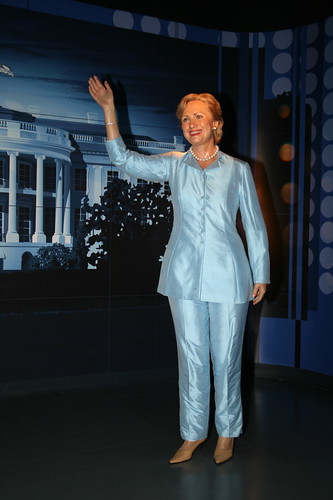
Hillary Clinton has touched down in Brussels, and already the city seems to be abuzz with excitement. I think I have a pretty good idea of where she's staying thanks to some pretty heavy security I noticed earlier tonight, but apparently journalists aren't supposed to talk about where she is, so I won't mention it! I was at a conference earlier today and all of the journalists were asking the same thing: Are you going to the big Hillary public debate at the European Parliament on Friday? I'm not, but I was speaking with a few people tonight who are and they're pretty excited. The debate is going to take place with European Parliament President Hans-Gert Poettering and apparently quite a motley crew has been invited to attend, including several young bloggers. It's a shame yours truly wasn't invited! But I did already get a chance to interview her back when I was working as a radio reporter in Washington.

Of course I wasn't here in Brussels for any previous US secretary of state visits but I doubt they generated the kind of buzz the Clinton visit is. It's all the rather strange byproduct of having a celebrity US Secretary of State, and it will be interesting to see how that dynamic affects US foreign policy. But it's safe to say few visitors to Brussels generate this level of buzz, and probably the only person who could match it would be President Obama himself.

So what's all the fuss about? Well this is Mrs. Clinton's first trip to Europe as Secretary of State, and it's a chance to lay down the ground rules for the Obama Administration's relationship with the EU. There was much speculation about who would be the first European leader to meet with President Obama, but that was fairly quickly answered. And really, was there ever any real doubt that it would be Gordon Brown? But as Brown meets with Obama in Washington, it's significant that Secretary Clinton's first visit to Europe in her new role is to Brussels to meet with EU institutions. It shows she intends to take the EU seriously as voice in foreign policy, something Condoleezza Rice and Colin Powell never seemed to be too enthusiastic about.

The debate on Friday is going to be broadcast on the European Parliament's new video portal web site EuroParlTV, and the gossip going around today was that the whole debate is just a marketing ploy to get people to visit the new site. I have no idea if that's the case, but it seems to me fairly unlikely Hillary's handlers would donate her limited time to a promotional gimick. Then again if that was the intent it seems to have done it's job; everyone today was talking about this debate.

Of course the debate won't be on the forefront of the new secretary's mind. Top on the agenda for Clinton's meetings over the next two days are relations with Russia, European cooperation in Afghanistan and the US missile shield program in Eastern Europe. Tonight Clinton held "transatlantic dinner" with European leaders, and tomorrow she will attend a Nato ministerial meeting. It is expected that at this meeting Clinton will make a formal request for greater European participation in the Nato mission in Afghanistan. It will be interesting to see what sort of official response this receives. Increasing troop presence in Afghanistan is going to be a hard sell for the European public.

On Friday, Mrs. Clinton will meet with European Commission President Jose Manuel Borroso before taking place in the public debate at the European Parliament, and following that she will go to Geneva to meet with her Russian counterpart Sergei Lavrov. Many in Europe are eager to see an easing in the Russia-US tensions that have built up over the past eight years, and this meeting in Geneva should give a pretty good first indication of whether that's a realistic expectation.

Monday, 2 March 2009

Brussels in Bulgaria

Much ink has been spilled over the accession of Romania and Bulgaria to the EU in 2007, and there are still many questions floating around over the decision. Should they have been admitted, or has the EU bit off more than it can chew in taking on two such poor countries? How can the EU effectively deal with the high level of corruption in the Bulgarian and Romanian governments? And when should the new EU entrants be given the full rights and privileges enjoyed by other EU citizens?

After spending last week in Bulgaria I am perhaps not qualified to offer a solid answer to these questions, but I have come to understand the country much more. For one thing, all this talk about 'Romania and Bulgaria,' as if they were one geopolitical block, seems strange to Bulgarians. When interviewing politicians and NGOs, I would often ask them if the factors they were mentioning in Bulgarian society were present in Romania. They would always respond that they had no idea, and even seemed a bit confused by the question. Though the countries tend to be talked about together now because they entered the EU at the same time with the same set of restrictions, in terms of culture, language and government they're quite different. In fact the photographer in our group was from Romania, and she said she doesn't necessarily feel any kind of strong connection to the country.

The event on Saturday went quite well. In addition to being an EU Debate on the Ground, it was also the official launch of CafeBabel Sofia. The event was hosted by a well-known local radio personality and was in Bulgarian, but the non-Bulgarian journalists had a great simultaneous translator. We had three MEPs there and the Bulgarian Minister for European Affairs, Gergana Grancharova (pictured above left). Essentially it was a debate between EU government officials and the public, designed to foster greater interaction between the European public and Brussels. Coming from Western Europe, it actually seemed to me that Bulgaria has a shockingly high level of interest in EU affairs. The attendees at the event were quite well-informed. Most of the major Bulgarian television networks showed up to film, and it made the nightly news. As I wrote last week, I learned on this trip that three times as many Bulgarians have faith in EU institutions as have faith in the Bulgarian government. This isn't surprising considering the level of dysfunction in the Bulgarian government, but as the MEPs mentioned at the event, the expectations of the Bulgarian public for the EU may need to be ratcheted down quite a bit. After all, the EU can't solve all of Bulgaria's problems, nor is that its intention.

Speaking with the French ambassador to Bulgaria on Friday, I learned this is an increasing concern for Western European nations. The high level of enthusiasm for EU integration in Bulgaria may be flattering for Brussels, but it will liekly lead to inevitable disappointment when the EU is unable to deliver, particularly as the economic crisis hits Bulgaria especially hard. The increasing trend of Bulgarian NGOs and business interests going directly to Brussels to get problems solved, bypassing the national government, is actually a worrying trend, he said. It is the dysfunction of the Bulgarian government that needs to be solved, and if it isn't, it will strengthen the increasingly popular far left and far right. The nationalist, anti-Turkish party Ataka (pictured left), is getting particularly popular, and it's thought that they will gain seats in the June national election as people cast a protest vote against the government.

Having only spent time in Sofia, I can't say I'm qualified to concretely answer any of the questions I posed in the first paragraph after my trip. I can say that while it was a bit rough around the edges, the level of development in Sofia didn't even resemble the post-apocalyptic picture often painted by the British media. As the poorest country in the EU, clearly Bulgaria has a long way to go before it enjoys the same standards of living as its Western counterparts. But at the same time Sofia looked like any other Eastern European capital. We felt perfectly safe walking around on the street at any time of day or night, and the modern conveniences were the same as most other capitals of the East. I'm told that Sofia is extremely different from the rural areas of Bulgaria, but of course that's true for any country.

So all in all it was a very interesting and fun few days, I'm glad I participated in the project. If you're interested in finding out if an EU Debate is coming to your city any time soon, check out the schedule.

Friday, 27 February 2009

Impressions of Sofia

I'm here in Sofia, taking a break at a coffee house in between interviews. So far the trip has been really interesting. My article on vote-buying is shaping up nicely. The political culture here is fascinating. There are something like 400 political parties, which has created a real mess of the government. It would seem they've gone from having too few parties (really only one, the Communist Party) to too many. This has led to widespread dissatisfaction with the political process, so much so that now three times as many Bulgarians say they have faith in EU institutions as say they have faith in their own national government. That's pretty much the reverse of Western European countries. In fact according to the people I've interviewed it's gotten to the point where Bulgarians now see the EU as the real leader of the country, and when NGOs or businesses want something done they bypass the Bulgarian government and go straight to Brussels. But more on that next week.

Sofia itself does remind me a bit of Prague, at least in terms of its eery quietness and the gloomy expressions on everyone's faces. It's interesting how much 50 years of Communism seemed to leave the same effect on such a huge and diverse swath of Europe. Before World War II, the Czechs had little in common with the Bulgarians in terms of their history, other than their shared Slavic ancestry, one being part of the Austrian Empire and the other the Ottoman Empire. Yet now you can observe so much similarity between their behavior and way of life. In my observation the same goes for Hungarians, Romanians, and Lithuanians; it's this sort of post-Warsaw Pact malaise. But you definitely notice it more with the older generation than the younger.

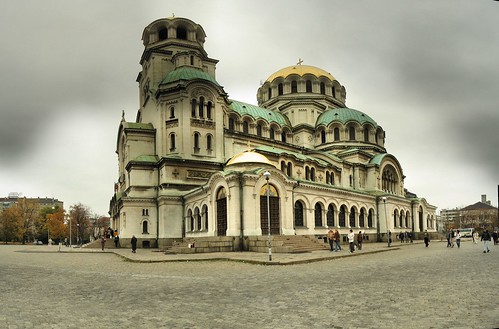
There aren't many tourist attractions in Sofia, really there's only one: The Alexander Nevsky Cathedral. And even that, when I went to visit, didn't have any non-religious visitors inside except me (in fact it was nearly empty). I spent a few hours walking around the city yesterday taking photos, and people seemed to be looking at me with bemusement, with my map and my camera in tow.

It's a shame really, because the city is actually thousands of years old. It was one of the first cities in the Roman Empire to adopt Christianity and was an early stronghold for the spreading religion. It was also an important centre for the Byzantine Empire. But the city centre was almost entirely destroyed during World War II, and over it was built a giant grid of characterless straight streets. There's actually nothing here that's much older than 150 years. And as it only became the capital of Bulgaria about a century ago, the government buildings have a rather rushed, characterless quality.

At the same time, the city is a lot of fun. The seven strangers have been having a great time, our Bulgarian hosts have been showing us some amazingly cool bars and restaurants. A bar we went to last night was down in a deep cellar, lit only by candles. Intense!

I'm actually the only Anglophone in the group, but naturally we've been speaking English as the common language between us all. A large portion of us speak French, but not everyone, so we're not using it. Take a note, France. It's a shame though because it takes away so much of the motivation for us Anglophones to learn foreign languages, when our native language allows us to communicate with most everyone we would need to. Still, I've had to remember to switch over to speaking Continental English instead of my normal way of speaking. Ironically, it's easier for everyone else in the group to understand each other speaking English than it is for them to understand me, since I have a tendency to speak too quickly. I need some Continental English lessons.

I'm about to head to the Parliament Building to interview an MP, she seems like she'll be an interesting character. I found some YouTube clips of her kicking up a fuss and yelling in the Parliament chamber. so she should be quite quotable! Then tomorrow we have our EU Debate on the Ground and the launch of CafeBabel Bulgaria. If you're in Sofia, come join us!

Wednesday, 25 February 2009

Six Strangers in Bulgaria

I'm flying to Sofia, Bulgaria later today to take part in a rather interesting project. CafeBabel, a web site I write for, is sending five journalists and one photographer to live in the city for about a week in order to participate in one of their ongoing EU Debate on the Ground forums. The forums have been taking place once a month in various cities throughout Europe, hosting debates about the EU with the local population as a run-up to the European Parliament elections in June. Several journalists are chosen from various corners of Europe and they assemble in the city, reporting on a specific issue and speaking at the forum. I'll be writing a feature on vote-buying in the country, as well as a second feature looking at how the global economic crisis is likely to effect Bulgaria.

We have quite a diverse group. There will be a Bulgarian from Sofia, a Spaniard living in Berlin, a Romanian living in Paris, an Italian from Turin, a Spaniard living in Paris, and an Italo-American living in Brussels (that's me). None of us know each other, but we'll be staying together in a large hostel room in the center of the city. We'll each be reporting on different issues, but I imagine we'll be swapping observations and ideas throughout the stay.

It should be interesting, it will actually be my first time back in Eastern Europe since I lived in Prague. One thing that's already throwing me is the country's use of the Cyrillic alphabet. It makes it very difficult to locate addresses on Google maps! I have appointments scheduled tomorrow and Friday with various government officials and NGOs, hopefully I've arranged them in some kind of logical order geographically. I learned from reporting in India that in a city with bad traffic, trying to zigzag across town going from interview to interview can quickly spell disaster.

The EU Debate on the Ground panel will take place this weekend. The purpose of the panel is to get a snapshot of the feelings on the ground about the EU, and to analyze those opinions in a way that can be meaningful for the upcoming parliament elections. I'll be particularly curious to hear the impressions of Bulgarians, who were promised much after their entry into the EU two years ago but have seen their economy teeter on the brink of collapse since then as a result of the global economic crisis. After many years of double digit growth in Eastern Europe, the sudden reversal of fortunes could lead Eastern Europeans to be more skeptical about what the EU can do for them. Additionally, Bulgarians were less than impressed with how the EU handled the recent gas crisis in January which left thousands of Bulgarians without heat for several days during a bitter cold snap.

All in all, it should be an enlightening trip.

Friday, 20 February 2009

La Crise Claims Her Second Victim

The Latvian government has become the second European administration to fall as a result of the global economic crisis, following the collapse of Iceland's government last month. Latvia's prime minister resigned today and the government folded as a result of the country's economic crisis, one of the worst in Europe.

Latvia is not in good shape, to say the least. With the country in severe recession, the economy is expected to contract by up to 12 percent in 2009, and unemployment is set to rise by 50 percent. GDP in the final quarter of 2008 fell by 10.5 percent compared to the previous year, and economists are predicting a further drop of 10 percent for this year.

The resignation follows last month's massive protests in Riga, the country's capital, which saw 40 people injured and 100 people arrested.

Latvia's situation is not isolated. The story throughout Eastern Europe is much the same. After years of boom following the east's entry into the EU, economies across the East have come to a crashing halt. Across Europe the countries that have experienced a boom in the past decade are now suffering the worst. The UK, for instance, is suffering severely while in France the effects have been less dramatic because the economy there had been performing poorly for some time before the crisis hit.

The plummeting fortunes of Eastern Europe have sparked fears that a "spring of discontent" is around the corner, a period that will see increasing violence in the young countries of the East and the collapse of several governments. Bulgaria, Romania and the Baltic states have all been hit particularly hard by the crisis. Sofia, Bulgaria has seen recent violence in which 150 people were arrested. I'll be travelling to Sofia next week to work on a story about vote buying and participate in a panel discussion organized by CafeBabel about the parliament elections. While I'm there, I'm also going to see what I can find out about the economic situation and whether the government is concerned about more dramatic protests in the near future. It will be an interesting time to be in the new EU state.