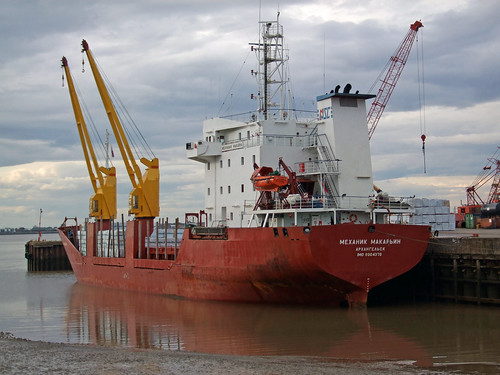
As video was played over European airwaves this weekend of the Russian defense minister proudly reporting to President Medvedev that the navy had gloriously rescued the Russian freighter that had gone missing in the English Channel, there were many in Europe who weren’t feeling as visibly reassured as the Russian president appeared to be. Though Russia has tried to portray the rescue of the apparently hijacked ship as an unparalleled success, the reality is quite different. This hijacking– thought to be the first incident of piracy in European waters since the 17th century – could herald a dangerous new era for European shipping.
Details about what exactly happened in this mysterious ship disappearance have been slow in coming. The 4,000-ton ship, named the Arctic Sea, first left Finland with a load of timber bound for Algeria in late July. However after passing through the Baltic and North Seas, it disappeared from radio contact in the English Channel. There was wild speculation for a few days about what could have happened to it. Because the Russian shipping industry is permeated by organised crime, people immediately thought it had something to do with drug or weapons smuggling, or perhaps political intrigue. Wilder theories speculated there could be nuclear equipment on the boat.
Over the weekend the Russians revealed they had tracked down the ship near the islands of Cape Verde off the coast of West Africa. The 15 Russian crew members were rescued and eight hijackers - from Russia, Estonia and Latvia - were arrested. They said the rescue effort had been a joint Russian, Swedish, Finnish and Maltese (the ship was flying under a Maltese flag) operation, and that no media had been informed about what was going on for the hostages’ safety. According to the Russians, the crew reported that they were boarded by a group of men in an inflatable boat while they were in Swedish waters. The men claimed to be police looking for drugs, but then forcibly hijacked the ship and forced it to go to West Africa. The ship’s insurance company says they were contacted with a $1.5 million ransom demand, threatening to blow the ship up if they didn’t receive it.
The US healthcare debate came to the UK in a very explosive way yesterday, when video of a British politician slagging off the NHS spread across the internets like wildfire. It was the twitterati who first started spreading the word, creating tags like #welovetheNHS to defend the NHS from this particular Tory politician, who happens to be a member of the European Parliament. My previous blog post on this subject has made the rounds pretty heavily on that tag actually.
The US media tour by Conservative MEP Dan Hannan has created a huge headache for Conservative leader David Cameron, who was scrambling yesterday to assert his love for the NHS and describe Dan Hannan as a fringe politician with "extreme views". The message is clear: the British National Health Service is a cherished institution in the UK, and politicians left or right criticise it at their peril. Whether this sort of "love it or leave it" mentality is helpful is debatable, but one thing is clear - any Briton can tell you that Dan Hannan's portrayal of the NHS doesn't bear the slightest resemblance to reality.
His description of the NHS, seen in this video above from Fox News, is so outrageously made-up that the Labour party - long trailing in the polls and virtually guaranteed to lose the next election - has pounced on it to show that the Conservative party can't be trusted with the NHS because they intend to make drastic cuts (Blair used the same argument in '97). The political headache for Cameron grew to such a fever pitch yesterday that some analysts were predicting that Cameron might sack Hannan from the partyand hence he would be out of the European Parliament). I know plenty in Brussels who would be relieved at this prospect, as Hannan has a long history of causing trouble in Strasbourg. But we'll see if the pressure remains through the weekend.
Of course as I pointed out in my previous healthcare blog post, the fact that the US media is focusing on the NHS at all doesn't make any sense. The healthcare plan being proposed by Obama and the US congress is not a single-payer system as exists in the UK Canada or France, but rather a hybrid multi-payer system as exists in Germany. Germany has a universal multi-payer system with two main types of health insurance: the public fund and private funds. Everyone is mandated to have healthcare, which is provided by the public fund to people below a set income level for a low rate. So, the wealthy can pay for exceptional private health coverage if they want to, or they can pay a small amount for the state insurance (many opt to do this). The end result is that everyone is covered and Germany spends 10% of GDP on health care, compared to 16% in the US. Obviously Germany would be the better example for the US media to use, yet the country, to my knowledge, has never been once by the US mainstream media.
This whole US "debate" (if you can call it that) has just been downright painful to watch, and has reminded me just how lucky I am to live in Europe. What's really unfortunate is that the hysteria and lies in the US are drowning out any actual debate on this bill - which will create one of two results. A bill will be passed without that perhaps lacks restraining measures that would have been helpful to it, or no bill will be passed which will represent the triumph of the mob, the victory of misinformation over reason. It's really a very sad thing to watch.
As for the British, perhaps watching the way this whole thing is unfolding in the US will make them feel a little more European. After all, this is one of those crucial ways in which the UK is much closer to the continent than to America. And the British should be grateful for it.
“Don’t worry, we will try it again.” The headmaster’s frustrated yet encouraging words were met with smirks and giggles by the journalists around the piano struggling to keep a straight face as we half-heartedly sang ‘Let it Be’. One had to admire his tenacity in trying to convert this group of hardened (and tone-deaf) international journalists to his lifestyle of self-enlightenment through group singing of ‘60’s hippie anthems, all sung out of a small blue-binded book that resembled a church hymnal.
I was part of a group of journalists being led on a tour of Denmark taking a look at environment-related projects they have there. As a base we stayed at a “folk high school” in central Jutland overlooking a beautiful lake, normally populated by young adults on a quest to find themselves (a quest that is half government-funded I might add). The headmaster’s efforts to teach us the ways of being in harmony with the earth were quite adorable, if in the end unsuccessful. We may have been environment reporters, but we’re still cynical journalists after all!
Yet as cynical as we were, you didn’t have to be a hippie to be impressed by Denmark’s pioneering green efforts. The tour was linked in to the hugely important UN climate change summit that will be held in Copenhagen in December. The meeting was pushed three years ago by Denmark with the intention of giving nations a firm deadline by which to be ready for a worldwide agreement on how to combat climate change. Denmark has been a natural leader in this fight, having been one of the earliest movers in environmental legislation. It was the first country to establish an environment ministry in 1973. Since a dispute with OPEC in the ‘70’s it has weaned itself almost completely off oil, now getting its electricity from a mixture of renewable energy and coal. It set up its first wind turbines in the 70’s and today wind power provides 20% of Denmark’s power generation (renewables in total provide 28%), The country is well positioned to meet the EU’s requirement of 30% energy consumption from renewables by 2020, and it is planning to go even further. Seasick Journos
We were on our way to visit one of these wind turbine farms far out in the North Sea on Tuesday when some of us realized we were in for more than we had bargained for. We were taken out for the 8 hour sea voyage in a small wooden boat which, though beautiful, took us for a wild ride as we bounced up and down on the tempestuous sea. It was quite an experience, and as the wooden boat creaked and moaned its way out from the Danish port of Estbjerg in Southwest Jutland, I could really get a sense of what ye olde long sea voyages must have been like (i.e., not pleasant!).
As we neared the windfarm site of Horns Rev, feared by sailors for centuries because of its wild winds and shallow waters, the boat began to literally leap up and down from the sea, and we all had to hold on to keep from being knocked over. A number of the journalists started losing their lunch over the side of the boat. Luckily I had taken a motion sickness tablet in the morning so I was ok.
When we finally reached the garden of turbines jutting majestically up from the sea, it was undeniably impressive. These things are massive, rising 115 metres into the air. The blades alone are 45 metres in length. Much of the objection to setting up wind turbines has been that they make a lot of noise, and yet I can attest that even though these blades are the size of a football pitch, I couldn’t hear anything even when the ship was right next to them (granted, the waves were pretty loud). Just one of these turbines supplies energy to 2,200 households. In total the whole Horns Rev site provides 350,000 households with power.
But the project hasn’t been an unblemished success. When they first installed the turbines there was a problem with the gears. Essentially they weren’t strong enough to handle the massive amount of wind in this area of the ocean. So all of the turbines had to be retrofitted with new motors, costing wind turbine company Vestas a massive amount to fix them.
We met with the CEO of Vestas on Wednesday, and I asked him about their recent decision to pull out of the UK which has resulted in demonstrations and a plant takeover on the Isle of Wight. He said straight up that the UK is not an attractive market for investment in onshore wind power right now, and now that the US has opened up as a renewables market with the Obama administration’s climate bill, they are focusing their energy there. That may be making the UK government quite nervous, as environment minister Ed Milliband just announced a big target for wind energy in the UK. Does this target reflect economic reality when the private sector seems to be wary of wind in the UK? I’m working on an article on this topic for the September ENDS Europe report. Clean Houses and Dirty Waste
It was interesting to compare and contrast the Dutch and Danish versions of these two things. The waste incineration plant was pretty similar, both in terms of its capacity to generate electricity and district heating and in its set-up. But the energy house was different in some significant ways. Whereas the Dutch version had been specifically designed to look like an average home and to be affordable in scale, the Danish house we looked at was designed as a luxury home.
I have to admit, the one in Denmark was a gorgeous house. It had an enormous amount of windows, meant to reduce the need to use lights during the day but that were also able to stop the sun from heating up the interior by being recessed. It also had a wind/temperature reading device at the top that would adjust the settings in the house to be the most energy-efficient. It would use its calculation of the speed and direction of the wind and temperature to automatically open and shut windows in the house and close/open shades. The entire thing was controlled by this futuristic control panel in the kitchen that gave out readings for the energy use of the whole home.
However the cost, at 5 million Danish crowns, would be prohibitive for any middle-class family in Denmark. Looking at it I got the impression I was seeing the house of the future, but perhaps not the practical energy-efficient house of today. It definitely looked nicer than the Dutch house, with almost unnoticeable solar panels built right into the roof as opposed to the obvious ones on the roof of the Dutch house (and also no wind turbine, which was good because the turbine on the roof of the Dutch house didn’t look very nice). But realistically, could anyone really afford to live in the Danish luxury house?
Both Denmark and the Netherlands are one of the few countries to offer feed-in tariffs for households with solar panels or wind turbines, letting customers actually output the excess energy they generate into the power grid. They then build up a credit with the power company and they can work off that credit when they need to take in energy from the grid at night whhile the sun isn’t out (a battery for just one house would be prohibitively expensive even for the luxury home). One interesting difference though was that in the Dutch house, if you didn’t use all the excess energy you had generated at day during the night, the power company would pay you for the leftover energy. In the Danish feed-in tariff system, that payment is not available.
Next week I’m going to pop up to Camden in London to take a look at such an energy house in the UK, where there is no feed-in tariff regime available at all. With the UK rather notoriously lacking in sunlight, I wonder how this Camden house can possibly be cost-effective. Green Slaughterhouses
One of our final stops yesterday was at the main Danish Crown abattoir outside Arhus. It’s the second largest slaughterhouse in Europe, in a country which leads the continent in pork exports. It kills an astonishing 87,000 pigs a week (17,500 every weekday) and we saw the whole process from start to finish. The facility is brand new, and almost everything in it is automatic. Each pig is stunned, killed, bled, gutted, chopped up and ready in less than a minute.
I’d never seen a slaughterhouse before, and wondered how I would react to it. It’s kind of a gross thing to watch, but as a meat-eater I felt I’m obligated to watch the process. It actually wasn’t all that surprising, in fact it was cleaner and more efficient than I was expecting. The actual moment of death was fascinating to watch, a man shoves a blade into each pigs throat one after the other in rapid succession as they come through hanging on a conveyor belt, limp and unconscious. It’s an almost constant in-out-in-out with the blade. Gruesomely efficient. Seeing it didn’t really change my opinion about eating meet. I’m dating a vegetarian right now and my flatmate is one as well, so I get a lot of pressure to convert.
After the slaughterhouse we went next door to see the biogas plant that uses the fat and unused organs from the pigs to produce biodiesel for use in cars. The EU has set a discretionary target for using biodiesel, although this is a bit up in the air now given the controversy over ethanol disrupting food supply. Biodiesel from animal fat is really the “good” kind of such fuel, as it’s made from animal parts that would just have been thrown out anyway rather than from food that could have been eaten.
Uncover the Bridge!
I spent Wednesday evening in Arhus, which is really a lovely town. It was amazing to see its transformation from a rather gritty port to a lovely preserved Scandinavian town. The river running through it had long ago been covered over and made into a road, with the water running under it in pipes (something unfortunately done in many European cities during industrialisation). But earlier this decade they decided to uncover it, making an actual river with a lovely pedestrian walkway running along it. We were given a tour by an architect instrumental in the design, who is now also involved in the redevelopment of the port into a knowledge-based business centre. Seeing the results, I wondered if the same thing could be accomplished in Brussels, where the Senne river was covered up a century ago. It would certainly go a long way in making Brussels a nicer place to be, something it badly needs.
Overall it was impressive to see all the green progress Denmark has made, and it was interesting to hear the observations and comparisons by the other journalists from around the world. Just like on the Holland trip we had a significant contingent from Brazil, who were particularly interested in the biodiesel. And once again I was the only American in the group.
Sitting in the main hall at the folk high school, I had a rather funny experience that showed how much my self-identification has changed over the past three years. At one point the headmaster was telling a story about an epiphany he had in Africa on a safari, and he was about to say something unflattering about some Americans with him there (Americans are often used as a foil in European anecdotes!) when he stopped and checked – “Oh, do we have any Americans here tonight?” There was a period of silence, and then I suddenly realized everyone was looking at me. “Oh right, I’m kind of American, I guess” I said sheepishly. I had literally forgotten for a minute there! Perhaps I only remember I’m American when people are telling flattering stories, not when someone’s about to launch into a diatribe. But usually, European stories about Americans fall into the second category!
All in all a fun trip. Now I’ve got two whole weeks in London without travel. Time to relax!
I'm in Denmark this week, on a press tour organsied by the Danish government showing journalists different environmental sites around the country. I'm in Copenhagen tonight, came a bit early to spend the weekend here and visit some friends. I was last here two years ago, so it's good to be back. It's a beautiful city.
Tomorrow we're heading out to Jutland, the mainland part of Demark (that "juts" out into the North Sea. It should be pretty interesting. On Tuesday we'll be taking a boat out to an offshore windfarm out in the North Sea off the Western coast. We're also staying in a "folk high school" which is a form of live-in adult education popular in Northern Europe.
I suppose I'll be blogging about the trip when I'm back in London on Friday, until then here's a map of where I'll be going. Being an environmental journalist kind of rocks!
I’m sometimes accused by commenters on this blog of wishing to make Europe into the US, and while it is true that I often yearn for European politics to be a bit more self-assertive, ambitious or efficient, make no mistake - I would never wish for European politics to devolve into the kind of mob hysteria US political discourse has sadly become.
The current debate going on in America over Obama’s attempt to overhaul the broken US healthcare system has been particularly hard to watch in this regard, and makes me feel pretty fortunte that I live in Europe. The way this healthcare debate is unfolding in the US is not only shockingly unreasonable, it’s getting downright scary. And unfortunately, what’s been occurring around the heathcare debate isn’t an isolated incident - it’s reflective of the dangerous road the American right wing is heading down.
The worst part is that the illogical hysteria surrounding the debate is drowning out any kind of reasonable argument. The scare stories being floated in the US media about single-payer systems in the UK and France would be missing the point even if they were true – what’s being proposed by Obama isn’t a single-payer system but rather a multi-payer combination of public and private plans, much like exists in Germany. But astonishingly, Germany hasn’t been mentioned at all in the US debate, even though it currently has a system very similar to the one being proposed, while the British and French systems don’t even resemble the Obama plan.
A ‘Plot to Kill Old People’
The health insurance lobby in the US has launched a full-on campaign to sink Obama’s efforts at health care reform. The plan that is working its way through congress is to add a public option to the list of private insurance options available to the American public. Currently the US has a completely private system for those under 65, the only non-universal healthcare system in the developed world, in which nearly one in five Americans under 65 don’t have any healthcare at all.
Not having healthcare can bankrupt a person if they get sick or have an accident, and it happens often. In fact, medical debt is the principle cause of bankruptcy in the United States.
Healthcare in the US has developed in an uncoordinated fashion over the past half century after the US government was unable to come to an agreement over a national health plan (Medicare, in which the government insures all people over 65 through a single-payer system, was a compromise enacted in 1965).
People under 65 have traditionally been insured through their employer. This means if you lose your job, you lose your health insurance (so if you get hit by a bus two months after losing your job, you’re facing a $30,000 hospital bill and no income!). But as healthcare costs have risen many small businesses have been unable to offer their employees health insurance any longer, leading to a dramatic rise in the number of uninsured. Even people who are insured face ever-rising deductable costs every time they visit a doctor, and their insurance companies can deny them coverage at any time by claiming that they had a “pre-existing condition” before they enrolled in the plan.
So to put it mildly, the system is a mess. Yet what Obama and congress are proposing isn’t a complete overhaul - it’s more of a reform. The private insurance companies would continue to exist, and everyone who’s already insured could keep their existing plan if they so wish. But a new player would be introduced into the market, a government-funded public insurance plan that people can opt into. Additionally, everyone would be required to have insurance, and regulation of the insurance industry would be tightened to prevent insurance companies from denying people coverage because of pre-existing conditions or charging exorbitant deductable charges.
However the insurance industry fears that having the US government as a competitor will eventually drive them out of business. So they’ve mobilised their media outreach, finding people in countries with single-payer universal healthcare systems like the UK, France and Canada, and trotting them out to do interviews with US media outlets about their horrible experiences. These strange, wild-eyed European defectors tell stories of being denied treatment and having to go to the US in order to have desperately needed operations to save their lives.
Or, they tell tale of public hospitals with dead people lying on the floor all over the place. I wish I was making this up. To hear the stories that have been spread in the US media, the NHS in England is effectively a government euthanasia program that kills people once they reach old age Republicsn Congressman Louis Gohmert has said under the reform seniors "be put on lists and force them to die early.”
This group that’s spreading word that the healthcare reform bill will kill old people have even been given a nickname, the “deathers” – a reference to the mob of people claiming that Obama wasn’t really born in the US – the “birthers”.
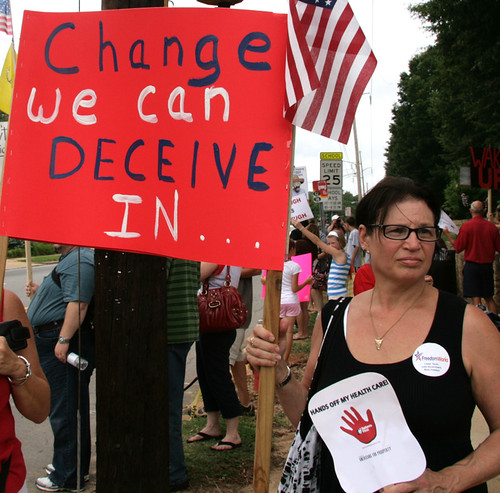
Now the healthcare lobby and the Republicans have gone a step further, actually organising mobs of angry 'birthers', 'deathers', 'teabaggers' and other assorted crazies to show up at open town hall meetings that Democrats typically host during the August recess. These mobs have been instructed to scream down the representatives as they try to speak. It’s absolutely insane, and getting quite scary. Take a look at this clip from the Rachel Maddow show.
Right-wing lobby groups are organising these mobs, telling them where the town halls are, and instructing them to block all discussions. They refuse to allow anyone to speak. If actual townspeople at these town halls try to ask a question, the mob shouts them down with chants of "just say no". Congressman Boehner, the Republican House minority leader, has praised these mobs and encouraged them to continue.
The Republican party is now aggressively harnessing the energy of the “teabaggers” –a group of mostly lower middle class Americans who are angry at Barack Obama’s election and were organized into protests by GOP groups earlier this year under the mistaken belief that Barack Obama’s budget was making their taxes go up (Obama is actually lowering their taxes or keeping them the same). It’s also harnessing the energy of the “birther” movement, a group of angry white Americans so incensed that Barack Obama was elected that they have developed a conspiracy theory that he wasn’t actually born in the US and is therefore ineligible to be president.
Republican congressmen and talk show hosts have given credence to the conspiracy by saying Obama has never released his Hawaii birth certificate – even though he has and it’s been on his website since the campaign.
So it’s a two-pronged attack by the right: organising mobs of crazy people to disrupt town halls where Democrats are attempting to explain heath care reform to their constituents, and getting fake healthcare scare stories into the media
Better European Comparisons
But beyond the fact that these random Canadians, Brits and Frenchmen being trotted out are just flat-out lying and are actually being put out there by the health insurance industry, the reality that everyone in America seems to be missing is that even if these stories were true, they are completely irrelevent to the current US healthcare debate. Canada, France and the UK all have single-payer systems – where you walk into the doctor’s office and never see a bill. That system is not on the table in the current debate in the US. What is being proposed is a combined public/private universal health insurance program much like exists in other European countries, most notably Germany.
Germany’s system would be the more obvious comparison, yet it has not been mentioned at all by the US media, which continues to focus on single-payer systems that have no relevance to the current debate.
Germany has a universal multi-payer system with two main types of health insurance: the public fund and private funds. Everyone is mandated to have healthcare, which is provided by the public fund to people below a set income level for a low rate. So, the wealthy can pay for exceptional private health coverage if they want to, or they can pay a small amount for the state insurance (many opt to do this). The end result is that everyone is covered and Germany spends 10% of GDP on health care, compared to 16% in the US.
Alternatively, the US media could use the example of Switzerland, although I’m not sure I would use that as a glowing model considering it has the highest health care expenditure in Europe. But they also have universal healthcare in a combination of public, subsidized private and totally private healthcare providers, where the insured person has full freedom of choice among the providers in his region.
Unfortunately, using comparative examples that make sense have not been part of the debate around this issue, which has instead focused on the hysterical screaming of the right. US policy, much like hotdogs, is always something that can be a little stomach-churning to watch being made. But lately the level of vitriol being launched by an increasingly desperate Republican party has been downright disturbing. Outright lies? Fake experts? Organised mobs? Is this America or a banana republic?
The most troubling part is that these tactics are working. Recent polls have shown that 42% of Americans now think Obama’s healthcare plan is a bad idea, and 69% of Americans are concerned their care would suffer if they were on a government-run plan.
They say citizens get the government they deserve. Perhaps it can be said that they also get the healthcare they deserve. If the American public can be so easily manipulated by the powerful forces of the right, even when it jeopardises their own health, I don’t know if there’s much hope for real reform in that country. It's very sad to watch. One thing is for sure – the behaviour exhibited over the past several weeks has not been a proud moment for American political discourse. These are dangerous tactics the American right is using, and they can easily spiral out of control. In the mean time, they are blocking meaningful discussion over how to reform a healthcare system whose dysfunction has reached crisis proportions.
I’ve just returned from a little weekend jaunt to Dublin, where I met my dad and my brother who flew over from Switzerland. It was actually my first time visiting Ireland, and it was great to finally visit a country that I’ve long focused on, both recently with the drama of the Lisbon Treaty ratification and in the past as a teenager when I looked to my Irish roots for a sense of identity and pride – something quite common in the US.
Ireland is a popular destination for American tourists, largely because so many Americans claim Irish heritage. Despite the fact that I’ve travelled all over Europe, the first question my relatives and friends back home always ask is if I’ve been to Ireland. It seems to have taken on the aura of a ‘holy land’ for the Irish diaspora, and for Americans the country has come to be more of a concept than an actual geographic place. To be fair, many Americans use their Irish ancestry to excuse bad behaviour like drunkenness or fighting, but many also feel a deep connection with Celtic traditions and the historical struggle of the Irish people.
I myself was not immune to this wistful gazing toward the emerald isle. I’m essentially only a quarter Irish (and Keating is an Anglo-Norman Irish surname rather than a Celtic one), yet as a teenager I went through a phase where I was fascinated by my Irish heritage, getting really into Celtic new age music and Druidic history. I dreamed of one day going to Dublin, the veritable Jerusalem of the Irish diaspora.
So I finally made it there, though by this point in my life Ireland no longer holds the same fascination for me. In fact coming from London I definitely arrived in Dublin with different expectations than I would have had coming from the US years ago. They say that many American tourists, arriving in Dublin expecting to find a gleaming Shangri-la, are struck by the issues of poverty the city still grapples with today. However living in the UK for the past three years I guess I’ve come to view Dublin as more of a regional city on the periphery of the British Isles, like Manchester or Birmingham – gritty, tough and far from London.
Actually Dublin reminded me of a smaller, grittier London. In fact it didn’t really feel like I had left the UK, not least because there is no passport check between the two countries. The Georgian and Victorian buildings, the loutish drinking culture, the use of British English and the endless array of British chain stores didn’t exactly seem foreign to me. Nor did the weather, as it was overcast and rainy most of the weekend!
Birth of a Nation: A Slow Start
In Dublin today you can really see the city existing between the three very different periods of its history: the intimidating Georgian splendour of its heyday as the second city of the British Empire, the drab and repressive first decades of the Irish republic, and the boom times of the IT and EU-fueled growth in the 1990’s.
Of course I imagine there are plenty of Irish people who would take issue with the above characterisation of recent Irish history, but listening to tour guides and locals it was impossible to ignore this distinct split. Almost every major landmark in Dublin was built by the English: Christchurch and St. Patrick’s cathedrals, Dublin Castle, the Bank of Ireland, the Four Courts, Custom house, St. Stephen’s Green, the list goes on (of course, there was a cruel tyranny these impressive monuments reflected). The guides will also proudly point to the shiny glass skyscrapers and monuments built in the years since the boom of the 1990’s: the redevelopment of the docklands, the financial centre, the new tramway, etc.
Yet as far as I could tell the only notable thing on the tourist map that was built by the Irish between the years of 1921 and 1990 is that ghastly spike in the middle of O’Connell street, which was put up after the IRA blew up a British-built mock Nelson’s Column in the 1970's. (the commenter below has alerted me to the fact that the spike was put up in 2003, so actually this wasn't built in the republic's first decades either!).
The more I read and talked to people, the more it seemed like now at the turn of the 21st century, those first decades of Irish Independence are starting to be seen as the proverbial ‘dark ages’. The country was hopelessly poor and saw its population fall throughout the period. Major literary figures, of whom the country has produced many, fled the country in reaction to the strict censorship laws imposed by the government, which was so closely aligned with the Catholic church it could almost have been considered a theocracy in all but name.
Incredibly, divorce was illegal in Ireland until 1995, and even then it only passed by a tiny margin. Homosexuality was a crime until 1993. Abortion is still illegal in the country, abut in the 1990’s rules were loosened to allow women to travel out of the country to get one.
How things have changed in 20 years. After Ireland joined the EU, it benefited from a huge wave of investment from Brussels. The government shrewdly used this money to position Ireland away from its history as an agrarian economy and toward a knowledge-based economy, instituting one of the lowest corporate tax rates in the world to entice US companies to set up shop there. The strategy paid off. Today Ireland has one of the highest GDPs per capita in the world, and in contrast to the decades after independence, it now has the highest population growth rate in Europe.
The evidence of this change can be seen in redeveloped pockets of Dublin, where a new, cosmopolitan vibe has taken hold. The boom times may have peaked off at the beginning of this decade, and Ireland may be suffering comparatively worse during the global recession, but it seems the attitude of the Irish, especially of Dubliners, has been irrevocably changed. These new Euro-Dubliners travel around the continent, sip cocktails in chic lounge bars by the river Liffey, and work in beautiful new office buildings in the redeveloped docklands by day. It doesn’t seem that anyone is in a big hurry to go back to the old days of an isolationist government under the foot of the Catholic Church (particularly after the church’s sex abuse revelations over the past two decades).
Nowhere is this more reflected than in a statistic I read in an Irish newspaper that 83% of the country favours enacting civil unions for same-sex partners (currently Italy and Ireland are the only two countries in Western Europe that don’t have a gay partnership framework).Last week the government published the civil unions law, and the gay community in Ireland right now is in the midst of a heated debate over whether to accept the proposed law (which stops far short of giving same-sex couples the same rights as heterosexual couples) or to refuse to accept anything but full marriage. It reminds me a bit of the debate that raged in Ireland after the Anglo-Irish treaty was drafted in 1920 offering Ireland conditional independence, with a civil war eventually erupting between those Irish who supported the treaty giving the lower counties autonomy under the British monarch, or those who said the country should refuse to accept anything but full independence for the entire island. I guess the age-old battle between idealists and pragmatists never changes.
EuroIreland
One thing I was really surprised by was how many tourists from continental Europe I saw in Dublin. I was expecting the vast majority of tourists to be American, with Brits, Canadians and Australians making up the rest. I figured without the mystique that Americans attach to it, rainy, quiet Ireland might not be the top destination for continentals. Yet throughout the weekend I was hearing Spanish, French Italian and German all over the place. I was especially hearing a lot of French – which I found really surprising. Even the bus tour we took of the Wicklow mountains on Saturday – which I thought would surely be all Americans – was mostly populated by continental Europeans. Colour me surprised!
Perhaps it just goes to show how much more European Ireland is these days. Despite the oft-used adage that “Dublin is closer to Boston than to Berlin” (geographically inaccurate but probably culturally true), there was plenty of evidence that Dublin, at least, is becoming Europeanised.
So where does this leave the Lisbon Treaty? Popular wisdom says that the Irish public will vote to approve the EU’s reform treaty, which it rejected last June, at the re-vote in October because the country’s financial situation has deteriorated so much since the first vote.
By this line of reasoning the Irish seem to only wanted to engage with Europe when it was going to give them money, and didn’t seem too keen to give something back once Ireland was doing well and the new entrants of Eastern Europe needed a helping hand. This is perhaps a rather cynical explanation, but given the morass the EU helped pull the country out of, it’s hard for me to understand the ‘no’ vote last year. Despite all its progress, are there still isolationist urges embedded in Ireland’s very DNA?
It seems to me that all evidence points to the fact that Ireland works best when it works in cooperation with others, not when it tries to go it alone. One need only look at the agenda for any tour of Dublin to see that.
 As video was played over European airwaves this weekend of the Russian defense minister proudly reporting to President Medvedev that the navy had gloriously rescued the Russian freighter that had gone missing in the English Channel, there were many in Europe who weren’t feeling as visibly reassured as the Russian president appeared to be. Though Russia has tried to portray the rescue of the apparently hijacked ship as an unparalleled success, the reality is quite different. This hijacking– thought to be the first incident of piracy in European waters since the 17th century – could herald a dangerous new era for European shipping.