Tuesday, 24 May 2011

Berlusconi: Milan will be 'full of Muslims and Gypsies' if Left takes power

Italian prime minister Silvio Berlusconi may have outdone even himself with his latest inflammatory comments. Rallying supporters in Milan ahead of local elections later this month, he warned people that if the centre-Left candidate for mayor wins, the city will be handed over to Muslims and Gypsies. According to Italian news agency AKI he told the Milanese,
"Milan can't become, on the eve of the Expo 2015, an Islamic city, a city of Gypsies, full of Roma camps and swamped by foreigners, a city that gives voting rights to immigrants in municipal elections."
The comments, which were not an off-the-cuff remark but rather part of a prepared speech that was also posted on the website of Berlusconi's conservative People of Freedom party, were met with open-mouthed disbelief by the leader of Italy's largest centre-left opposition Democratic Party. "Your words are laughable..you're going to need to wear a burqa to avoid people recognising you in the street," he told the Italian leader.

Monday, 23 May 2011

Germany still punching below its weight

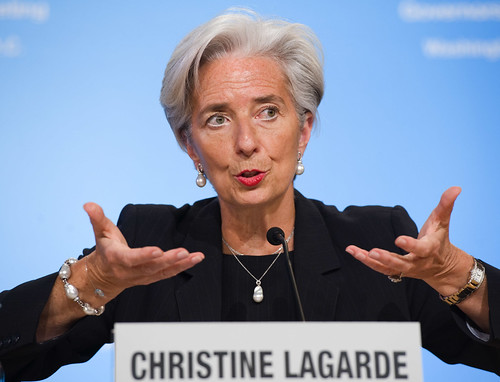
Europe hasn't wasted any time in getting its ducks in a row for the upcoming battle over naming a new IMF chief, with capitals across the continent voicing support over the weekend for French finance minister Christine Lagarde. That Europe so quickly agreed the monetary fund leadership should yet again go to someone from France reflects the political realities of Europe today. Britain can't be bothered, and Germany is too timid to take a leadership role.

Lagarde, who would be the first woman running the fund, received the backing of the British, German and Italian finance ministers over the weekend - with Luxembourg and Austria following suit. Chancellor Angela Merkel has yet to make her feelings known, but her finance minister would likely not have made the comments of support without her blessing.

The fund has been run since 2007 by Frenchman Dominique Strauss-Kahn, who has made it a mission of the fund to save Europe's faltering common currency. But following Strauss-Kahn's arrest on rape charges in the United States last week, countries like China and Brazil have signalled they intend to pressure the fund to take on a new leader from the developing world.

Thursday, 19 May 2011

US focus on French sex attitudes echoes Lewinsky saga

Something is very wrong with France, if we are to believe the Anglophone media commentary this week. The arrest of Dominique Strauss-Kahn, the head of the International Monetary Fund and contender for the French presidency, has provoked some soul-searching in France about whether the media was right to have kept quiet about his history of unwanted sexual advances toward women. This soul-searching has been reported on with fascination by the American and British media. But for many in France, the Anglo-Saxon attention to their national trauma is bordering on smugness.

Back in the late 1990's, the French were quite vocal in their confusion and disgust with the impeachment proceedings against US President Bill Clinton. France has long had an expectation that politician's private lives are just that – private – and should have no relevance to their office. 'What kind of a society would impeach their president because he had an affair?' they asked. In fact the period during the Monica Lewinsky saga was probably the only one in which the French openly talked about their history of philandering presidents – from Mitterand to Chirac – if only to demonstrate how different their society was to America. If their politicians were oversexed "séducteurs" it was none of their business. Indeed, sometimes it was celebrated as a good thing, a sign of a healthy libido.

But what goes around comes around, and it seems that now it’s the Americans' turn to look derisively across the Atlantic, shake their heads and say, 'if only they were more like us.'

Wednesday, 18 May 2011

Merkel to Southern Europe: work more, play less

Workers in Southern Europe shouldn't enjoy more vacation and earlier retirement ages than their Northern European counterparts, German Chancellor Angela Merkel told a meeting of her Christian Democratic Union party last night. The comments, highly surprising coming from this usually cautious and analytical politician, have been greeted by applause from the right-leaning papers in Germany today.
"People in countries like Greece, Spain and Portugal should not retire earlier than in Germany. We should all make the same efforts, this is important," German press agency DPA quotes Merkel as saying. "We cannot have a common currency where some get lots of vacation time and others very little. That won't work in the long term."
The notoriously early retirement ages in Southern Europe have been a cause of serious griping in Germany since the country was forced to foot most of the bill to bail out Greece and Portugal over the past year.  In Greece and Italy, a person can retire as early as 57. In Germany a person can't retire earlier than 65, and Merkel's government has voted to raise that to 67 over the next three years. Part of the conditions of Greece receiving its EU-IMF bailout was that it introduce reforms to raise the retirement age to 63.

Protests greet Queen's first visit to Ireland

Queen Elizabeth II is making a historic visit to the Republic of Ireland this week, the first time a British monarch has visited Ireland in 100 years. That the visit is even happening is a sign of how much relations between the republic and its former imperial master have healed in recent times. But there are still people on the island, including both Catholics and Protestants in Northern Ireland, who are quite upset about the visit. And those people were out in force yesterday to greet the British monarch with insults and epithets.

The Queen's 'reconciliation visit' to Dublin, where she will be protected by more than 8,500 police officers backed by the army, has virtually shut down the city centre. Her visit, during which she will be dressed in all green, has been meticulously planned out to the last detail, carefully choreographed around every diplomatic sensitivity. She has been making a tour of memorial sights where Irish republican fighters died fighting against British rule. Today she will visit Croke Park stadium, the site of a notorious massacre where 14 Irish civilians were killed by British troops in 1920. She also spent this morning visiting the Guiness Storehouse, where amusingly she was offered a pint of Guiness at 9:30 in the morning. According to the AP she smiled but politely declined.

Tuesday, 17 May 2011

Is Italy the worst place in Western Europe to be gay?

Today is the International Day Against Homophobia (IDAHO), and a European gay rights group has taken the opportunity to publish an updated map of the human rights situation for gays, lesbians and transgendered people in Europe. Italy has clocked in at the bottom of the league, scoring worst than every EU country except Cyprus and Latvia. Meanwhile the UK scored highest, moving up from sixth place the previous year.

This year's map (pictured right) from the International Lesbian, Gay, Bisexual, Trans and Intersex Association (ILGA) gives countries a dark green for being progressive on gay rights, lighter green for being somewhat progressive and grey for being poor on gay rights. Countries in the 'red zone' are accused of "gross violations of human rights and discrimination". The factors used to determine the rankings included whether the country has anti-discrimination legislation, gay marriage, parenting rights, hate crime laws and whether the country has allowed pride demonstrations to take place.