Wednesday, 13 October 2010

The real tea party

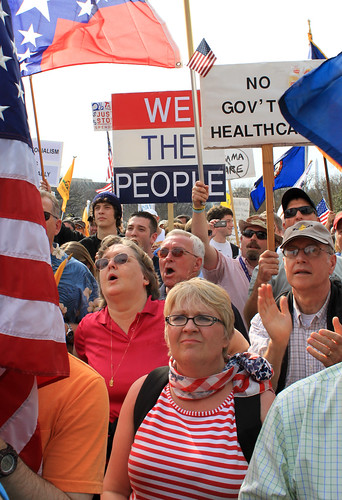
The other day I was at a conference here in Brussels and one of the speakers, who was German, made a joke about America's tea party movement. Making the case that European consumers would not like paying extra taxes in order to pay for recycling, he joked, 'but in the United States I understand they have the tea party to take care of this kind of thing'. The audience laughed, and I laughed as well, because I assumed it was said tongue in cheek. But then when I thought about it I realised, wait, maybe he's serious...

I wouldn't blame Europeans for thinking the American tea party movement is motivated solely by their opposition to taxes, after all this is how its portrayed in the European media - particularly by the British press. And they in turn are taking their cues from the American mainstream media, who have also been portraying it as a movement of libertarian fiscal conservatives concerned about deficit spending and taxes. But even as this narrative continues, there is clear and unavoidable evidence that this is not what the movement is mainly about at all. In fact the movement has no real focus, serving mostly as a confused jumble of rage. Its participants – who show up to street demonstrations and rallies wearing funny hats and revolutionary war costumes - appear to have various grievances, and some seem to have no specific grievances in particular. But one thing is clear – the leaders of the tea party movement, and the candidates they have elected to represent the Republican Party in November's midterm election, are the same old social conservative culture warriors that have been around for years. Only this time, they're wearing funny hats.

Tuesday, 12 October 2010

EU smoking ban in the works for next year

They've made tenuous moves in the past, but this time it looks like they're serious. Yesterday EU health chief John Dalli told a German newspaper that the European Commission will make a push to ban smoking in all public places, transport and workspaces throughout the EU next year. It is an ambitious idea considering that the status of smoking in public places currently varies widely across the union, and even the United States has been unable or unwilling to try to put in place a federal smoking ban.

Last year the European Commission took a rather half-hearted stand on public smoking, merely encouraging member states to adopt their own smoking bans by 2012. But since then a new commission has come to power and the new health commissioner appears to be more aggressive on the issue than his predecessor. He wants to propose new legislation next year to reduce the amount of nicotine used in cigarettes, make shopkeepers keep cigarettes out of view from customers and enforce new labelling requirements on cigarette packs. He also told the newspaper that he wants to push for an EU-wide smoking ban.

Monday, 11 October 2010

Anti-gay riot in Serbia deals blow to EU hopes

Some 140 people were injured and 200 arrested over the weekend in the Serbian capital of Belgrade as ultranationalist rioters sought to disrupt a gay pride march going through the city protected by armed guards. As the country seeks to join the European Union, the embarrassing incident is just the latest to demonstrate the gulf between the "good behaviour" demonstrated by the Serbian government and the "bad behaviour" exhibited by a large segment of the Serbian population. Or at least that's how Brussels sees it, and that gulf continues to make EU officials very anxious.

The new tension this riot creates with Brussels is heightened by the fact that there were several EU officials marching in the parade to show solidarity – including an expected appearance by the EU ambassador to Serbia. Today Jelko Kacin, who leads the European Parliament's unit looking at Serbian accession, told the Associated Press that the riots "show an elementary lack" of tolerance for minority rights in Serbia and the "inefficiency" of the state in preventing this trend. The march this weekend was the first one to be organised since the last attempt in 2001 resulted in mass chaos and street brawls as nationalists and football supporters' clubs attacked the gay rights marchers. Another march had been planned for last year but was cancelled because of concern over the violence. This year the parade was protected by 5,000 police officers – which equals roughly three officers per pride marcher.

Wednesday, 6 October 2010

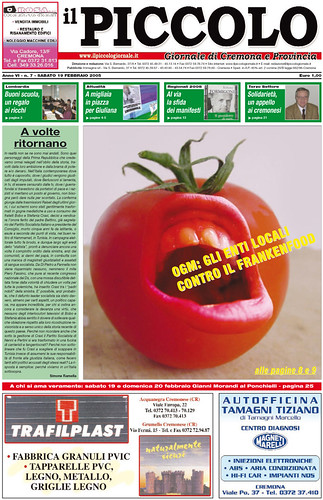
"Frankenfoods" the subject of first EU citizens initiative

The first citizens initiative petition will soon be presented to the European Commission under new rules created by the Lisbon Treaty. The treaty gives citizens the right to demand that the EU look into a specific issue if they can collect 1 million signatures. Perhaps unsurprisingly, the petition concerns one of the hottest and most controversial issues with the European public: genetically modified crops.

As an American, it’s been interesting to watch the GM debate progress here in Europe. Genetically modified crops are now widely used in the United States, and it was never a very hot or controversial topic there. GM crops and even GM food does not seem to bother the American public very much. The exact opposite is true here in Europe, where the public across member states remains concerned about GM. Across Europe the media has been very hostile to these so-called "Frankenfoods". In the US the issue has gotten barely a mention.

Monday, 4 October 2010

Travel warning confusion

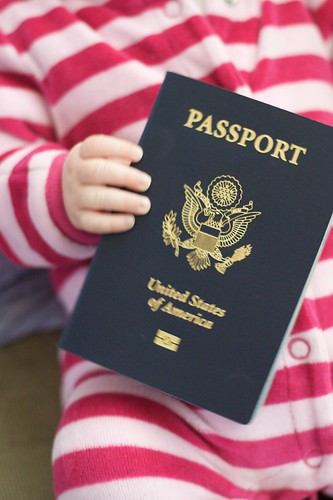
The United States issued a blanket warning yesterday for Americans in Europe, and I for the life of me can’t figure out what this is supposed to be. As an American living in Europe, I suppose I’m the intended recipient of this message. I’m sitting here at the Helsinki Airport ready to get on a flight to Brussels reading the US state department press release and the accompanying news coverage, and I’m left wondering what exactly the US government is telling me to do.

Despite issuing a blanket warning for Americans to avoid “public places” throughout the European continent until at least next year(what does that even mean?), a state department official on a press conference call today told reporters, “"We're not saying don't travel to Europe. We're not saying don't visit tourist, major tourist attractions or historic sites or monuments.” Yet they should register with the local US consulate (even if they’re only in Europe for a few days), avoid wearing or displaying anything that identifies them as American and try not to speak in loud voices with their American accents. Asking an American not to speak in a loud voice is probably as futile as asking an Italian not to talk with their hands, but that’s what they want.

Friday, 1 October 2010

Hard-Right Holland

You know we've entered a different era when Spain has become the leading progressive voice in Europe while the Netherlands has come under the sway of a hard-right party. If you had posited this scenario to someone in the early 1970's they would have thought you were crazy. But Holland's years-in-the-making drift toward hard-right conservatism was again demonstrated this week when a conservative coalition government was finally formed – with the participation of the far-right Freedom Party (PVV) of Geert Wilders. The new coalition is set to ban the veil and limit the number of "non-Western" immigrants allowed to come into the country.

Dutch elections were held back in June, but the two centre-right parties did not achieve enough of a majority to form a stable government on their own. The PVV, meanwhile, greatly increased their share of the vote. After months of negotiations, this week the centre-right parties concluded a deal with the far-right PVV, led by the controversial anti-Islam crusader Wilders, that will allow them to form a government with Mark Rutte as prime minister.