Thursday, 29 April 2010

"That bigoted woman”

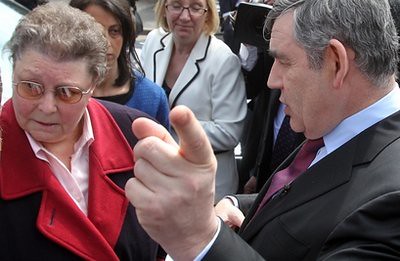
I was surprised to learn today that all the American nightly news broadcasts covered the british “bigotgate” scandal last night. I guess I shouldn’t be so shocked, it is a pretty crazy story and doesn’t require much background info to understand. A politician makes nice with a supporter, all smiles, then gets into his Lexus but forgets to turn his radio mic off. He launches into a rant about how horrible it is that he was made to talk to that awful “bigoted woman”. It’s fairly comical really, at least for those looking in. But for Labour supporters, yesterday afternoon was devastating. Coming just a week before the election, it has dashed any Labour hope of squeeking through and remaining in power.

It was almost the perfect storm to sink Prime Minister Gordon Brown – an aloof, awkward politician with a reputation for behind-the-scenes temper tantrums disrespects a middle England voter by deriding her as “bigoted” because she brought up a question about immigration, the most sensitive political issue in Britain. Add to that the fact that this was an elderly woman who had actually stated her concerns to Brown in a fairly reasonable manner and you’ve got a concoction that is virtually guaranteed to spell the end of Gordon Brown’s political career.

Brown has never liked the schmoozing, glad-handing aspect of politics. He has long been known to get frustrated with the American-style 'popularity contest'that Tony Blair brought to British politics. It is likely that on this occasion, his frustration boiled over. Unfortunately for him, it happened while he was still on mic.


Wednesday, 28 April 2010

Arizona moves toward Europe with ‘papers, please’ law

The growing far-right populist movements across the United States, from the ‘birthers’ to the ‘Tea Partiers’, may be disparate in nature but they all have one thing in common – they have all used ‘Europe’ as a bogeyman. According to their script Barack Obama is trying to move America toward the “socialist nightmare” that is Europe. How odd then that the new immigration law this movement has pushed through in Arizona moves that state closer to Europe than anything Barack Obama has passed or likely will pass.

The Arizona immigration law signed by the state’s Republican governor this week would require police officers to stop anyone who looks like an illegal immigrant and demand that they produce paperwork showing they have the right to be in the United States. The law’s passage has resulted in a furor in America, where critics say it mandates police to conduct racial profiling and is likely to be used by local officials to harass minorities. ‘Boycott Arizona’ movements are spreading like wildfire, and if there is speculation they could be as successful as the 1991 boycott when the state refused to recognize Martin Luther King Day. That boycott cost the state an estimated $400 million. On that issue, Arizona eventually caved.

Monday, 26 April 2010

Belgian government collapses, yet again

I'm in Trier, Germany today, attending a seminar for journalists on the European Court of Justice (the EU equivalent of the US Supreme Court, though with some important differences). Though I may be away from Brussels for the day the news feed on my iphone started blowing up this afternoon with news about my new host country as it became official - the Belgian government has fallen. Though the country's king worked tirelessly over the weekend to try to sort out a compromise between the warring Frencophone and Dutch-speaking parties, he has been unable to bring peace to the parliament, and today accepted the resignation of the prime minister.

International media reaction to the news has been muted, most likely because this is starting to become such a routine event. The government last collapsed in July 2008, during a period where at one point there was no Belgian government for well over a year. Not that you would have noticed. Belgium has become so decentralised - with authority split between the three regions of Wallonia, Flanders and Brussels - that the national government hardly does anything any more.

Friday, 23 April 2010

The Anti-American vs. the Anti-European

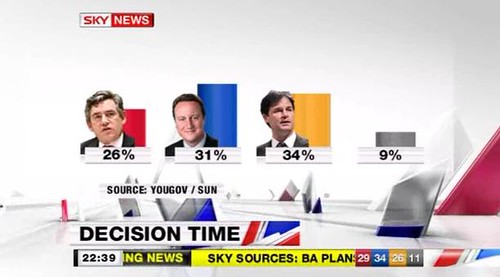
If we are to believe Gordon Brown, last night’s British election debate was between himself - the thoughtful moderate, Nick Clegg - the naïve anti-American, and David Cameron – the nationalistic anti-European. And Brown didn’t want us to forget this point, saying it over and over and even at one point pointing at the other two candidates saying forcefully “YOU are a risk to the economy and YOU are a risk to our security!” Really Gordon? Did this guy not receive any debate training at all?

I was eagerly awaiting this debate because it was meant to be focused on foreign policy. Unfortunately Sky News made a bit of a muck of it, the moderator was awful and the debate got off topic very easily. Bizarrely the moderator allowed the conversation to stay for long periods of time on silly questions (like “what are you personally doing in your daily life to help the earth?”) or questions that had already been covered in the previous debate (like immigration), while he cut questions on actual foreign policy topics (like the EU) short.

Still, I did get a solid 15 minutes of good EU discussion right at the start of the debate, so I was pleased. By far the most encouraging words came from Nick Clegg, the most pro-EU of the three candidates. Rather than lay off the usual meaningless populist nonsense that David Cameron comes up with or the usual “EU? What’s an EU?” of Gordon Brown, Clegg walked people through why the EU is important and why the UK cannot achieve its goals alone. His example of the EU pedophile law that the Conservatives opposed was brilliant (a friend of mine quipped, “The EU helps catch pedophiles? The Daily Mail is going to be so confused”). He also explained how he had worked in Brussels representing the UK to the EU under Margaret Thatcher and also represented the EU in its negotiations with China. He actually knows the EU, he has connections there and he would work to make the UK more influential in Europe instead of sitting on the sidelines as it does now.

Thursday, 22 April 2010

Should the EU reimburse ash-stricken airlines?

Things are slowly returning to normal here in Europe, with air travel resuming across the continent. Thousands of passengers are still stranded in various destinations, but already the finger-pointing has begun for this enormously costly fiasco. And all of the chaos and recrimination has some asking the question - would a pan-EU aviation authority have averted this mess?

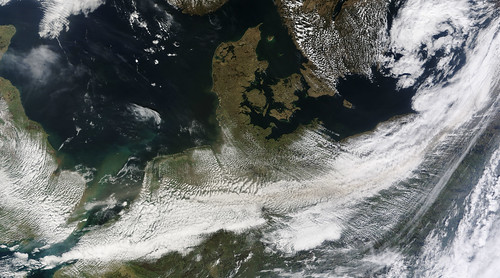
Flights have just gone back to 100% operation this afternoon. But the embarrassing reality is that they are not resuming because the ash has suddenly disappeared, but because a continued air travel ban was no longer economically sustainable. Now everyone is holding their breath to see if one of them falls out of the sky. So far, so good.

It's looking increasingly likely that an investigation will conclude that the flight ban, the biggest disruption in the history of civil aviation, was an unnecessary overreaction. If that is indeed the case, then the fight over who should shoulder the burden for the enormous losses the airlines have suffered is going to become fierce. A heated argument was developing yesterday between Ryanair and the EU over whether the ultra-budget airline would reimburse passengers for the hotel and meal costs they incurred while stranded by the volcanic ash cloud. CEO Michael O'Leary told Irish newspapers yesterday that it would refuse to comply with EU rules requiring airlines to reimburse passengers for these costs in the event of flight delays or cancellations.

Monday, 19 April 2010

Europe versus the volcano

As you're jetting around the world this week, Americans, think of us poor souls in Europe, trapped in our respective cities. We're now in the 5th day of the flight ban caused by the giant ash cloud covering Europe, and many are the stories of the "ash refugees" spread across not just Europe, but the entire world. I have a colleague trapped in Norway, my father's stuck in the US, and I have friends stuck in Southern France, Spain, Ireland, Bangkok, you name it.

The stories of people making long and bizarre treks across Europe via ground transport have been numerous. Saturday night I went to a friend's going-away party in Antwerp, and people there were full with stories about how they had made last-minute arrangements to get to Belgium by train after their flights were canceled.