Wednesday, 10 November 2010

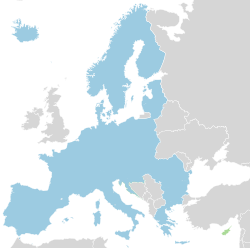
EU to crack down on Schengen border violations

Today the European Commission announced a crackdown on member state compliance with the Schengen passport-free area rules, and during the press conference I couldn't help but smile to myself. The other week I had a bit of a rant with my friends after I encountered a British woman on a airport shuttle bus in Prague who didn't know what Schengen was. Since then the joke has been that I'm obsessed with Schengen. So naturally, I had to write a blog entry about the new proposal.

So, the Prague airport story. I was taking the airport shuttle to the airport and we were just pulling in to terminal 1 (the "international" terminal with flights to the US, China, etc) when an announcement came on saying that this terminal was for non-Schengen countries, and the following terminal would be for Schengen Area countries. I had my headphones on but I could see that there was a woman a few seats away from me with a confused expression on her face asking her neighbour something. By the time I took my headphones off we were already on our way to terminal 2, but I could then hear that the woman was frantically asking people what Schengen was. Apparently her neighbour, also a Brit, had reassured her "Oh Schengen means EU. You're going to London? Then terminal 2, definitely."

Monday, 8 November 2010

Europe is the past, India is the future

I'm watching Obama's speech to the Indian parliament now, and I can't help but contrast it to his much-watched 2009 speech to Europe. The message and level of ambition for the relationship is remarkably different. Obama just said the US-India relationship will "define this century," an element that was completely missing from his speech to Europe. Obama's speech has been overflowing with compliments for the emerging Asian economy. He said his presidency would not be possible without India's founding father Mahatma Gandhi. He's talked up India's "rightful place" on international bodies like the UN security council and the IMF. He's spoken of India's growth as an economic miracle, quickly becoming the largest middle class in the world. He's said India's role as the world's largest democracy has something to teach the United States. And he's spoken enthusiastically of India's role in the 21st century. He's practically offered to do their laundry for them.

Sunday, 7 November 2010

Daily Show 'sanity' rally: more harm to the left than good?

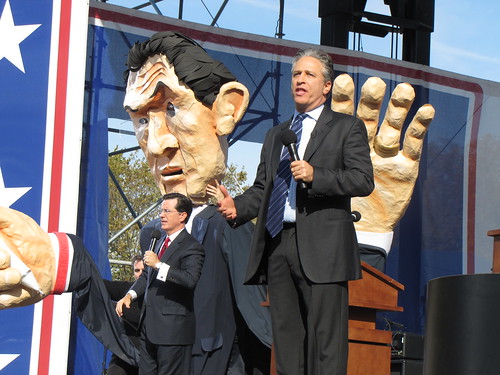
I thought I'd post a video from this weekend's Real Time with Bill Maher show on the subject of Jon Stewart's "Rally to Restore Sanity" because I remember last weekend a lot of Europeans were asking me about it and whether I was going to watch. "No," I told them, "I'm not going to watch it, and if I was in the US this weekend I wouldn't be attending it either." At the time I don't think I was articulating my annoyance with Stewart and the rally all that clearly, but I told my friends I thought the rally was going to be almost depressingly irrelevant. Of course in the end it was. Though the rally had a huge turnout, the youth vote in last Tuesday's election was the lowest in years. On Friday night, Bill Maher delivered a monologue that I think will resonate with a lot of American Daily Show viewers who were uncomfortable with Stewart's rally but couldn't articulate why.

Yes, the Daily Show rally, held on the national mall in Washington, may have attracted twice as many people as tea party pied piper and Fox News host Glenn Beck's "Rally to Restore American Honor" which it was meant to lampoon. But that was cold comfort to some in the dwindling ranks of the politically active American left, who saw the rally more as a depressing reminder of the current state of things than anything they could be proud of. The Daily Show's writers and producers have an undeniable liberal viewpoint, and the show spends most of its time making fun of Fox News and Republican politicians. But the show also likes to present itself as being "non-political." After showing outrageous clips from politicians on the right, host Jon Stewart frequently insists that the same level of craziness exists on the left. But he rarely provides any actual examples of this phantom American left.
Friday, 5 November 2010

EU to create "right to be forgotten"

As the public's concern over internet privacy violations on sites like Facebook continues to grow, the EU unveiled new proposals yesterday to give people more control over how their online personal data is collected and used. The new update to EU privacy laws would oblige service providers to make personal information and user-supplied content easily and quickly deletable. Citing the effect such information can have on a person's professional and private life, the European Commission says the issue is important enough to take EU-wide action. The commission says it has even received complaints from its own staff about Facebook's privacy policy. And that must be a big deal, because most of the people I know who work for the commission are on Facebook all day!

Perhaps the most interesting thing about the proposal is that it would create a new right for EU citizens, a so-called "right to be forgotten." The original EU data protection rules date back to 1995, when such issues of online privacy did not yet exist. In theory the right to control over one's own personal stored information is already enshrined in EU law, but the commission said yesterday its applicability to the online world has been patchy and unclear.

Wednesday, 3 November 2010

The United States of Paralysis

The results are in, and there were no big surprises from last night's US midterm election. As predicted, Republicans have wrested control of the House of Representatives from Democrats but failed to take the Senate. But maintaining "control" of the Senate is surely cold consolation for the Democrats today. As the Washington Post's Ezra Klein writes in his blog this morning, there was perhaps no worse outcome from the perspective of actually getting anything done in the next two years than the result delivered yesterday.
"Republicans don't fully control Congress, so they don't have enough power to be blamed for legislative outcomes," he writes. "But Democrats don't control the House and they don't have a near-filibuster proof majority in the Senate, so they can't pass legislation. Republicans, in other words, are not left with the burden of governance, and Democrats are not left with the power to govern. Republicans don't have to be responsible, and Democrats can't do it for them."
That's the rub, isn't it? Given that the Senate is the institution that has given Democrats so much trouble during the past two years in the first place, holding on to it is not much of a consolation prize for them. By overusing an ancient procedural rule that can block any vote with just 40 out of the 100 senators, Republicans in the Senate were able to block almost every bill the House of Representatives passed. Indeed yesterday's result is really stinging because it was the House Democrats that really showed political courage over the past two years, casting tough votes even though they knew they would be politically unpopular. There were few such profiles in courage among Democrats in the Senate. And yet it's the senate Democrats that have clung onto power. Nobody ever said politics is fair.

Could a Franco-British military be the start of an EU army?

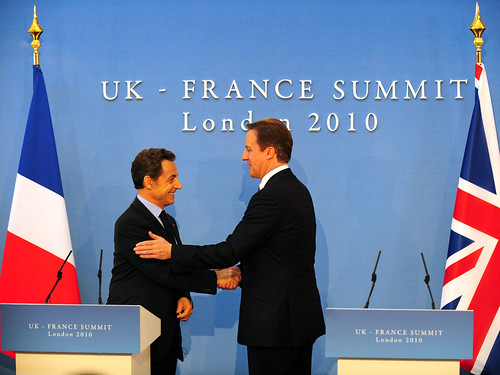
Today’s agreement for military cooperation between the UK and France may or may not be as “historic” as the media is claiming today – but it all seems to depend on which side of the channel you’re on. In the UK, political leaders have been keen to stress the “pragmatic” nature of the relationship between the two countries who are both pursuing austerity measures and looking for cuts wherever they can. The suggestion from Prime Minister David Cameron almost seems to be that this is a temporary arrangement. Meanwhile Nicolas Sarkozy and other French leaders are telling their newspapers that this is a “moment of history” and the start of a “long-term relationship” that essentially commits the two to work together for 50 years.

So who’s right? The answer is that it will be very dependent on what type of relationship the UK and France have over the next 50 years. After all, military agreements like this have been signed between the two countries before which came to nothing. Most famously, a more general agreement was made between Tony Blair and Jacques Chirac before their dramatic falling out over the Iraq War put an end to all that. So who’s to say that this agreement won’t also be scrapped as soon as the two countries differ again on foreign policy?