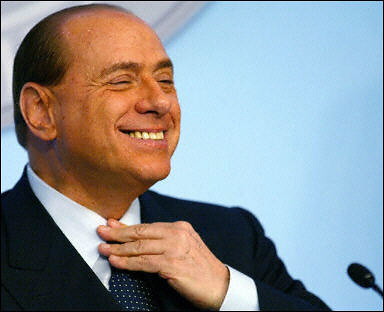
This, the journalists learned, was Frigide Barjot - the
leader of France’s
anti-gay-marriage movement. The Conservative MEPs had invited her to the
European Parliament to speak about her desire to extend her anti-gay-marriage
movement to all of Europe. While notorious in France, Ms
Barjot is unknown outside the country, and the journalists were perplexed as to
why she was there. But I knew of her already, if only from the many Facebook
posts I see from my French friends decrying her antics.
Friday, 15 March 2013
Frigide Barjot - a very French protest
Friday, 1 March 2013
A week of turmoil for Europe
Yesterday was a big news day for EU politics, with a series
of high-profile speeches in reaction to the disastrous election result in Italy on
Monday. But despite the many speeches, the message has been singular: there is
“no alternative” to austerity, and hostility toward the EU in domestic politics is exascerbating the euro crisis.
The day started with a speech by humiliated ‘technocrat’
prime minister Mario Monti at the European Commission. Having been rejected by
his home country, it is perhaps unsurprising that the former European Commissioner wanted
to come to Brussels,
where people understand him. It was Brussels
after all, at the behest of Berlin,
who installed Monti on the Italian throne after forcing out Silvio Berlusconi
at the height of the Italian crisis in 2011.
And it is no coincidence that it was the ‘Italians abroad inEurope’ voting region in which Monti received
his highest share of the vote – 30%. This compares to the 9% of the vote he
received at home – less than half the vote chare received by anti-establishment
comedian Beppe Grillo.
Location:
Brussels, Belgium
Tuesday, 26 February 2013
Send in the clowns
Elections have consequences, and people get the leaders they
deserve. Those Italians who insist on re-electing the clownish SilvioBerlusconi despite the ruin and shame he’s brought to Italy - and
those Italians who decided they would rather see political anarchy by voting
for a comedian who will not even sit in the parliament – will get the future
they deserve. The problem is that because of the Eurozone debt crisis, we are
all going to get the future they deserve.
Those outside Italy have long been baffled at how
such a sizable portion of the Italian population could still support Berlusconi after the corruption allegations, Bunga Bunga parties, dalliances with
underage Moroccan prostitutes and – most consequentially – the disastrous
handling of the Italian economy. But what is newly shocking is the other surprise winner of this
election – an anti-establishment comedian. The fact that so many Italians would
vote for what is essentially an anarchist party, led by a comedian who does not
even intend to take a seat in the Italian parliament, has rattled the world
today.
Friday, 22 February 2013
The Italian election that could sink Europe
Italy’s constant lurching between left and right since WWII had, in the past, become so frequent that few people bothered to pay too much attention to the vagaries of Italian politics. But all that has changed since the advent of the eurozone crisis. All eyes are on the Eurozone's third largest economy this weekend as Italians go to the polls in what could be the most consequential Italian election of the modern republic.Much of the international media attention has focused on the possibility of a return to power for the country’s notorious former leader Silvio Berlusconi, who was ousted in 2011 by what essentially amounted to an EU putsch. The prospect of a return to power for the now clearly mentally unstable Berlusconi is terrifying to the rest of Europe and would likely result in absolute panic in the Eurozone. But such a scenario is unlikely, even with Berlusconi’s last-minute efforts to try to buy votes by promising tax rebates.
Tuesday, 5 February 2013
UK rejects ‘separate but equal’ marriage
The British House of Commons has just concluded a historic
vote, voting 400 to 175 to adopt gay marriage in England. But despite its historic nature, the legislation will prove to be of more symbolic than practical importance –
particularly for its author, Conservative Prime Minister David Cameron.
In effect, the UK has already had gay marriage for eight years – but by another name. The Civil Unions signed into UK law in 2004 confer the exact same rights as a marriage – to the letter. Interestingly, as I’ve written about before, this made the gay marriage debate fade out of the limelight for many years in the UK. Because the civil unions were theoretically “equal”, gay rights activists weren’t really pushing too hard to have the word changed to ‘marriage’.
That was until an unlikely hero came along – David Cameron, leader of the British Conservative party. Cameron made it the central mission of his leadership to “detoxify” the conservative brand in the UK after years of being successfully cast as the “nasty Tories” by Tony Blair. Part of his effort to modernise the party was an campaign pledge in 2010 to enact gay marriage if elected. The response from gay UK was, “well, alright then I guess.”
Wednesday, 23 January 2013
Brexit begins
By all accounts, the speech delivered by UK Prime Minister David Cameron this morning outlining his vision for a British disengagement with the EU was short on substance, contradictory and hackneyed. He mixed metaphors, made embarrassing errors reflecting a lack of EU knowledge and managed to enrage his EU partners even without having made specific demands.
But despite its rhetorical
flaws, Cameron’s speech will be one for the history books. With three words - "in/out
referendum" – Cameron has plunged the UK into four years of economic
uncertainty. The prime minister will have the dreaded ‘Brexit vote’, but only
in 2017, after the next election. With this he hopes to placate the fiercely eurosceptic
wing of his party while at the same time kicking the can down the road. But the
long time frame, business leaders and non-EU governments have warned, could be hugely damaging to the
British economy. Investors will likely be hesitant to invest in the UK when their
future in the European market is uncertain.
Subscribe to:
Posts (Atom)