Sunday, 29 March 2009

On the Eve of the G20

I'm heading back to London tomorrow, just in time for the kick-off of the G20 Summit. The meeting of world leaders is already being called the most important G20 ever held, and it isn't just world leaders that are anticipating the big event.

This weekend G20 protests raged across Europe. At least 35,000 people marched in London calling for drastic government action on jobs, welfare and climate change. Of course, protests and the G20 have gone hand in hand since the group's inception, but this year is different. The old protesting stalwarts, who have always opposed the global capitalist system, are now finding a more receptive audience standing at the side of the road watching them march. One large banner at today's protest in London read, "Capitalism isn't working - another world is possible." Four years ago such a banner at the G20 would have seemed silly and irrelevant. For a middle class that has watched the economy collapse around them, the argument may sound quite convincing these days.

Today's march to Hyde Park in London was largely peaceful - just one person was arrested all day, for being drunk and disorderly. But there is a risk that as the week goes on the protests - in London and elsewhere - could turn violent. People are anxious, and there is a palpable sense that this G20 summit may be a turning point in the way this crisis unfolds. Last week George Soros predicted that this G20 summit could be the last opportunity to avoid a world-wide depression.

Large protests have already taken place in Rome, Berlin, Frankfurt, Vienna, Paris, Madrid and Barcelona, and many more are scheduled for later this week across Europe.

It will be an interesting week to be in London.

Tuesday, 24 March 2009

Czech Government Falls

They're falling like dominos in Eastern Europe. The government of the Czech Republic has become the latest to fall as a result of the financial crisis, following Hungary, Latvia and Iceland. The timing is not only scary for the struggling non-Eurozone EU member states, it's also potentially disastrous for the EU presidency, which the Czech Republic still holds until July.

The resignation of the country's center-right prime minister Mirek Topolanek has thrown the government into chaos. With the G20 talks coming up, and an EU-US summit in Prague on 5 April, it remains unclear who is going to be representing the Czech EU presidency, as this role would normally fall to the prime minister. Topolanek was supposed to represent the EU at the G20 talks in London next week. Now it could end up being an empty chair. Or perhaps even more worrying to Brussels, the EU could instead be represented by the controversial Eurosceptic Czech president Vaclav Klaus.

There were more than a few people in Brussels today pointing out that this very bad situation wouldn't be happening if the Lisbon Treaty had already been adopted, as it would end the rotating EU presidency and instead create a permanent president. But the Czech Republic still hasn't ratified the treaty, and the government's collapse will likely delay any ratification until Autumn at the earliest.

It's not a good situation for the EU.

Thursday, 19 March 2009

Another Day, Another Protest in France

Street protests are obviously not an unusual occurrence in France. The country is known for its love of demonstrations, and anybody who's lived in Paris for even a bit knows how frequently a strike or a march can throw you off your daily commute. But recent demonstrations in France have been something different entirely, and they're making the government increasingly nervous.

First there was January's one-day strike protesting the economic crisis, and now today another nation-wide strike has gone ahead, with unions claiming that three million people have taken part. 200 towns across the country have seen demonstrations, in which all eight of the country's big unions are demanding more protections for workers in the recession. And as unemployment has risen to two million, they are demanding more is spent in any rescue package on more unemployment benefits.

Benoit Hamon, a leftist rising star in the Socialist party, has been at the forefront of the protests, saying French President Sarkozy has been aggravating the crisis my making the "wrong economic and social choices."

The huge numbers these two strikes have attracted are causing the French government increasing worry. Sarkozy's popularity is perilously low, and the number of French people supporting the strikers is increasing. 74 percent of the French said today they support this week's protests. according to BVA. That's up from 69 percent in January. There is increasing talk of violent revolts this spring. And as evidenced by Hamon's increasingly prominent role, the hard left is gaining power and influence. Olivier Besancenot, a postman and the leader of the New Anti-Capitalist Party, has also been gaining popularity. A recent poll put him as the candidate who could pose the most viable threat to President Sarkozy.

And this is all happening in France, which analysts will be the least affected by the crisis among major European countries. All of this is making leaders across Europe increasingly concerned about a "spring of discontent."

Friday, 13 March 2009

Could the Tories Bring the Euro to Britain?

Last night I attended a gathering of economists and politicians at The Center discussing the current situation vis-à-vis Britain and the Euro. Had such an event been held a year ago, you probably would have been lucky to get three people to show up. After all, the debate about Britain joining the Euro had been dead in the water for years. But things are looking very differently recently after the unprecedented collapse in the value of the pound, and the assembled speakers at the session had some surprising things to say about what may be around the corner for Britain.

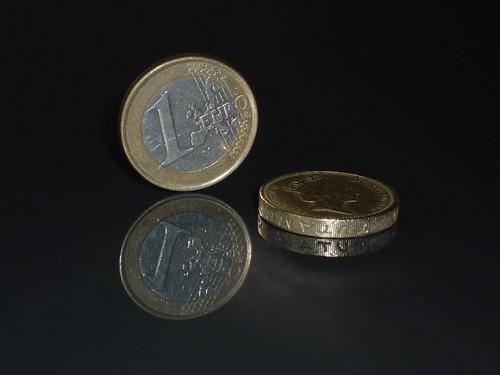
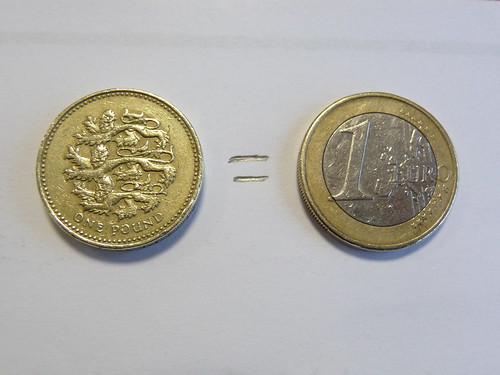
The pound has lost 30 percent of its value since last summer, the most dramatic drop in the currency's history. It's fallen from $2.00 to one pound in July to $1.39 to one pound today. The pound fell to just €1.02 recently, when it was €1.33 at the beginning of last year. So the situation for the sterling is bleak.

So now a debate which was once thought to be done and dusted is beginning to resurface, although not yet out in the open in Britain. Speaking at the session, former British MEP John Stevens observed, "It's much easier to talk about Britain and the euro outside than inside." Indeed Stevens, who just wrote a report concluding that the best monetary option for Britain is to join the euro, said that his report has received much more attention in the rest of the world than it has in the UK. In Britain, the currency problem remains the issue that dare not speak its name. Opinion polls have consistently shown that a majority of the public opposes joining the euro, and no politician in today's Britain is willing to take a principled stand on an unpopular issue. Both Labour and the Conservatives know that reawakening the euro debate could easily have the effect of spooking British consumers even further. "If the public hears talk about joining the euro, there will be mass fear that Britain is really in trouble," Stevens said, perhaps only half joking. A country's currency has much to do with its national pride, and having to give up the pound would be a massive blow to Britain's self-esteem.

Yet the country may get to a point where it has few other options. Last night's panelists seemed to agree there is a good possibility the pound may have much further to fall, and a full-on run could cause it to be worth drastically less than the euro. Stevens noted that if the UK were to start negotiations for joining the currency now they would be coming from a position of strength. "We wouldn't be coming just as supplicants, we would be bringing something to the table," he noted. "Britain joining the euro would position it as the world currency." At the same time, it would demonstrate to currency speculators that the pound is a safe currecy. On the other hand, waiting until the bottom has truly fallen out from the pound to begin negotiations would be a very weak position indeed.

But how to sell the idea politically? A representative from the British Chambers of Commerce asked how the organisation could make small-and-medium-sized enterprises come around to the idea. Stevens pointed out that SMEs actually benefit disproportionately from a common currency. Large businesses have mechanisms to get around currency barriers which small businesses do not. Studies have shown that SMEs within the Eurozone have been some of the greatest beneficiaries of the common currency, Stevens said.

But does any political party in Britain have the political will to sell the public on an unpopular issue like this? Simon Titley, a consultant who also worked on the report, said the reticence to do so may be a result of the systemic over-dependence on polls in modern British politics. Public opinion polls may show that a majority of the British are opposed to joining the euro, he said, but those same polls also show that they also don't care very much about the issue either. It's what pollsters call a 'soft issue,' something which people are willing to express an opinion on but actually isn't very important to them. "It's not an issue that would decide an election," he said. "Politicians that are in favour of the euro need to come out of the closet and stop caring what Rupert Murdoch's newspapers will say about them."

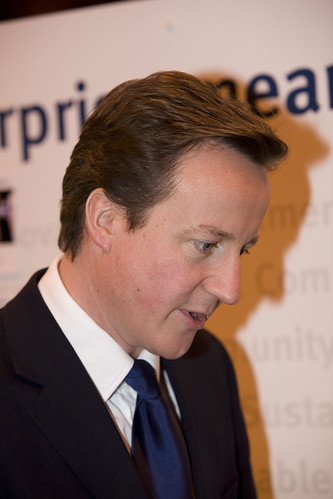
So what's likely to happen? All the panelists seemed to think that the next government of the UK will likely be the Tories under David Cameron, who just this week has signaled his intention to leave the main centre-right Europarty in the European Parliament to form a fringe Eurosceptic party, a move many have seen as making the Tories into an isolationist party. However, Titley had an interesting prediction for what may be in store for the a Conservative government. "I think a likely scenario is that a UK Tory government will adopt the euro, under the whole 'Nixon going to China' idea," he said. "Sometimes an idea seems so far to the left that only a right-wing government could do it."

These certainly have been unpredictable times, so I would say even the conservatives bringing the UK into the Eurozone wouldn't surprise me these days!

Thursday, 12 March 2009

A busy week for eurosceptics

He may have promised to do it years ago, but it was only yesterday that UK opposition leader David Cameron officially started the process of taking the Tories out of the European Parliament's centre-right grouping, the European People's Party. And with that, the Tories' 'slow walk from Europe' has begun.

Cameron's intent, which he outlined in his 2005 campaign to become the Conservative Party's leader, is to form a new European party that would be more hostile to the federalist viewpoint. The EPP is the largest of seven Europarties in the parliament. It's the main centre-right party standing astride the Party of European Socialists, the main centre-left grouping. Both parties are more or less federalist in their platform.

Since he came to power Cameron has been attempting to take the conservatives in a strongly Eurosceptic direction, something fraught with danger since the party is split over the Europe issue. As time has gone on the inconsistencies between Cameron's platform in the UK and the EPP's platform has become politically awkward for him. For instance, the EPP was opposed to the UK having a referendum on the Lisbon Treaty while Cameron was loudly calling for one. The EPP also wants more common European policies on the economy, immigration, defence and foreign policy - while Cameron seems to be opposed to any expansion of the EU's remit.

Tuesday, 10 March 2009

The French Strawman

For decades, it's taken only one word to strike fear into the heart of Americans, and that word is France. Of course Americans aren't afraid of a new Napoleonic army invading the Western hemisphere, what they fear instead is the French economic model. In American political discourse, 'France' is often used not so much as a country but as an ideology; a boogey man representing a bloated welfare state with high taxation, widespread unemployment, overregulation and low productivity. It's a classic strawman argument.

Over the past two weeks, as debate has raged in the US over Barack Obama's revolutionary budget plan, the use of this anecdotal device has skyrocketed. Republicans are calling the proposed Budget the "final moves toward socialism," saying it will lead to the "Europeanization of America." Essentially, the proposed budget does three main things that have elicited this reaction:

-An introduction of higher taxes on the top 3% of income earners
-A funding mandate for definitive healthcare reform
-A massive expansion of the federal debt

David Leonhardt of The New York Times has called this budget, "nothing less than an attempt to end a three-decade era of economic policy dominated by the ideas of Ronald Reagan and his supporters. ... More than anything else, the proposals seek to reverse the rapid increase in economic inequality over the last 30 years." This editorial in the Wall Street Journal this week does a great job of breaking down the tax aspect of it.

Considering the changes afoot, it was only a matter of time before the F word started getting tossed around. On the March 2nd edition of Meet the Press, former McCain advisor Mike Murphy managed to work 'France' into the discussion over this budget a total of five times, no small feat for a short segment. According to Murphy, Obama can "hardly wait to turn us into France," and he is squandering his political capital on a "failed ideology." That ideology, a democratic social welfare state, is not only reviled by American conservatives but has also been deeply unpopular with Americans for decades, particularly after the Reagan revolution. Socialism in most Americans' minds is inseparable from Communism, which any American fifth grader can tell you was a failed ideology which the US triumphantly defeated in the cold war. So for some time the logic has been that if you can associate a policy with 'socialism,' or even better, with 'France,' you're going to have a pretty easy time making the policy unpopular with the American public (one only needs to look at the so-called "Death Tax" debate).
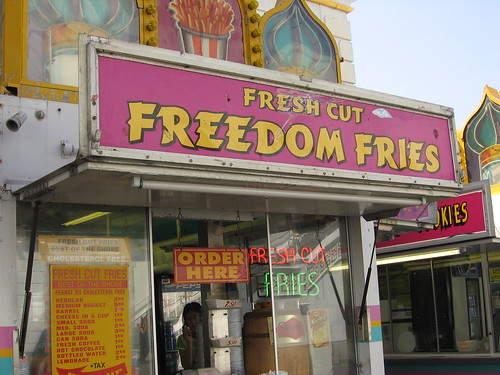
But in invoking the old France cliches, are Republicans missing the way the winds are currently blowing? Isn't it a bit odd that, at the same time that Republicans are trying to scare the American population by saying Obama wants to turn them into France, across the Atlantic Sarkozy is proclaiming the death of the Anglo-Saxon model of capitalism and the vindication of the European social model? If the French economic system translates to more regulation on banks and financial firms, more safety-net protections for people who lose their jobs, and more government action to protect the economy, what exactly is it in that image that would scare an American in 2009? Considering that the current crisis was largely the result of a lack of regulation in the US, 'Anglo-Saxon style capitalism run amok,' if you will, it seems almost absurd for Republicans in the US to still be using the French boogeyman tactic. They seem to be saying, "Look out America! Or else you could become like that country where everyone has healthcare, job security and pensions!" I'm oversimplifying of course, and I don't usually find myself in the position of being a strident defender of the French economic model, but it seems to me that Republicans don't have much of a leg to stand on here if they want to keep using the France-baiting.

I was curious to get the reaction of some of my French friends to this kind of talk. After all, they must have an opinion on the fact that their country still stands as the antithesis of America's self-image, the boogeyman in the closet children remain terrified of at bedtime. "I think it's funny," one French friend who works for the EC told me after seeing some of the comments being made in the US media. "In France we do the same thing with America if we want to scare people about Sarkozy. They say he is 'Sarko the American' and that he's trying to make France become America. That scares the French probably as much as Americans are scared to become France."

As we edge closer to a hammering out of the new "Bretton Woods 2" agreement that will reshape the world's economic structure, this France-America ideological labelling is likely to get even murkier. The ideal solution, as with most things, is probably a happy medium somewhere between the two.