Tuesday, 5 February 2013

UK rejects ‘separate but equal’ marriage

The British House of Commons has just concluded a historic vote, voting 400 to 175 to adopt gay marriage in England. But despite its historic nature, the legislation will prove to be of more symbolic than practical importance – particularly for its author, Conservative Prime Minister David Cameron.

In effect, the UK has already had gay marriage for eight years – but by another name. The Civil Unions signed into UK law in 2004 confer the exact same rights as a marriage – to the letter. Interestingly, as I’ve written about before, this made the gay marriage debate fade out of the limelight for many years in the UK. Because the civil unions were theoretically “equal”, gay rights activists weren’t really pushing too hard to have the word changed to ‘marriage’.

That was until an unlikely hero came along – David Cameron, leader of the British Conservative party. Cameron made it the central mission of his leadership to “detoxify” the conservative brand in the UK after years of being successfully cast as the “nasty Tories” by Tony Blair. Part of his effort to modernise the party was an campaign pledge in 2010 to enact gay marriage if elected. The response from gay UK was, “well, alright then I guess.”

Wednesday, 23 January 2013

Brexit begins

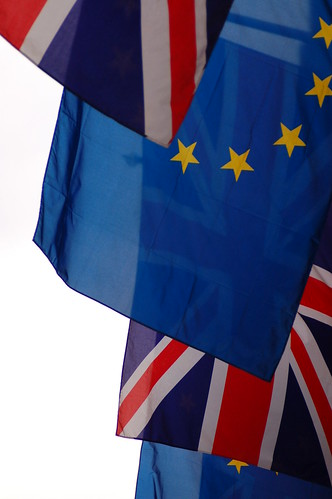
By all accounts, the speech delivered by UK Prime Minister David Cameron this morning outlining his vision for a British disengagement with the EU was short on substance, contradictory and hackneyed. He mixed metaphors, made embarrassing errors reflecting a lack of EU knowledge and managed to enrage his EU partners even without having made specific demands.

But despite its rhetorical flaws, Cameron’s speech will be one for the history books. With three words - "in/out referendum" – Cameron has plunged the UK into four years of economic uncertainty. The prime minister will have the dreaded ‘Brexit vote’, but only in 2017, after the next election. With this he hopes to placate the fiercely eurosceptic wing of his party while at the same time kicking the can down the road. But the long time frame, business leaders and non-EU governments have warned, could be hugely damaging to the British economy. Investors will likely be hesitant to invest in the UK when their future in the European market is uncertain.

Friday, 11 January 2013

Obama warns Cameron over his dangerous EU game

The British eurosceptic right, normally known for their fawning obsession with America, have been in a strange state of cognitive dissonance this week after the Obama Administration delivered this frank warning to British Conservatives on Wednesday: if the UK leaves the EU, it could doom itself to international irrelevance.

Philip Gordon, the US assistant secretary of state for European affairs, said in a speech in London that the UK leaving the EU would be a mistake, implying that Britain’s relationship with the US (and, presumably, most other major global players) would be damaged as a result.
"We have a growing relationship with the European Union as an institution which has a growing voice in the world – and we want to see a strong British voice in that European Union. That is in the American interest," he said. "When Europeans put their resources together and have a collective decision-making function they end up playing a major role in the world…And for the UK to be a part of that stronger, more important voice in the world is something I know a lot of British people welcome."
It isn’t just an academic debate. At the end of this month, British prime minister David Cameron will deliver a speech in The Hague on Britain’s future relationship with the EU. It is expected that he will announce a public referendum on EU membership that will take place in 2018 – well after the next general election and most likely after Cameron is out of office. Cameron has found it increasingly difficult to assuage the demands of a significant contingent of his increasingly anti-European party for a referendum on Britain leaving the EU.

Friday, 16 November 2012

Who is Captain Europe?


For two years, Brussels has grappled with a mystery that has taken on a sort of legendary aura – who is Captain Europe? Tonight, I may finally discover the answer.

The caped crusader – pictured right – appears suddenly at various events around Brussels, dressed head to toe in euro-blue spandex. When the EU won the Nobel Peace prize last month, he was spotted at Place du Luxembourg (known affectionately by Eurocrats as ‘Plux’) shortly afterwards waving an EU flag and working the crowd into a frenzy of eurenthusiasm. Wherever euro-spirits are down, he suddenly appears to save the day. His tweets are a consistent source of amusement.

Thursday, 8 November 2012

A relief for Europe - but will gridlock persist?

Anxious Europeans have been able to breathe easier the past two days, after Tuesday’s reelection of US president Barack Obama. But the relief has much more to do with the defeat of Mitt Romney than with Obama himself.

Europe isn’t the only place feeling relieved because of a dislike for Romney. Outside Israel, there probably wasn’t one country on the globe that was excited about the prospect of a Romney presidency.

The Republican candidate's dangerous rhetoric seemed almost guaranteed to launch a war with Iran which no US allies would have been keen to sign up to. He had described Russia as America’s “greatest geopolitical foe” and had spoken of China as if it was the evil empire, promising to “get tough” with them in a way Obama hadn’t (although he never provided details about what that would mean). Latin America recoiled at his extreme anti-immigration rhetoric, and Africa was less than excited about his promises to cut US overseas aid.

In Brussels, there is a sense that long-stalled bilateral issues that were waiting until the resolution of the election can finally be taken off the back burner. There is (perhaps naïve) hope that a second-term Obama can show up to the UN climate summit in Doha next month with a reverse-course on the US intransigence in taking action to combat global warming. Negotiations on a US-EU free trade deal can now begin. Most importantly – fears that Europe was about to see a return to the trans-Atlantic tensions that marked the George W. Bush era have now been allayed.

Tuesday, 6 November 2012

The case for four more years? Look at the previous four

Rachel Maddow had an excellent review of Obama's first term last night. It's bizarre that anyone would say the American president "hasn't done anything" in his first term. Historic legislative actions were taken during the first two years. And even after the Republican takeover of the US Congress in 2010 ground all legislative activity to a halt, Obama still took important executive decisions over the following two years that could bypass the congress. Let's take a little stroll down memory lane, shall we?


Europeans are very anxious about the result of today's election in the US. It would appear that it is now up to 8 million people in Ohio to decide the fate of the world. Hopefully they will make the right decision.