Showing posts with label EU accession. Show all posts

Wednesday, 29 March 2017

With Brexit looming, time for a Celtic Union?

David Davis says Northern Ireland can opt to stay in the EU by joining with the Republic. So why can't Scotland?

Today British Prime Minister Theresa May took the historic step of requesting a divorce from the European Union. 

It will be remembered as a defining moment in history. Some are predicting it is the beginning of the European Union's disintegration. But others say, perhaps more convincingly, that it signals the start of the British union's disintegration.

Yesterday the Scottish Parliament voted to back First Minister Nicola Sturgeon's call for a new referendum on Scottish independence. The timing was no accident. Sturgeon timed her announcement of the new referendum push earlier this month to be one day before May planned to submit her divorce letter to the EU, upstaging the British PM and forcing her to delay the delivery until today. Scotland is remaining one step ahead of Westminster.

Tuesday, 19 July 2016

It's time for the EU to drop the Turkish accession charade

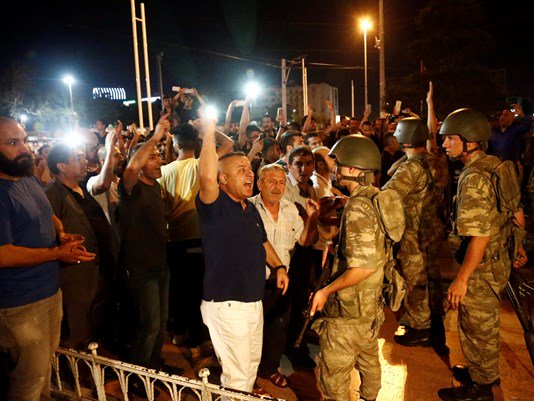
Whether the coup was real or staged, it is beyond time that the EU drop the pretence that Erdogan's Turkey will ever join the bloc.

As the implications of the events of Friday night have sunk in, world leaders have started to suggest what they dared not say over the weekend.

Since Friday Turkish President Recep Tayyip Erdogan has rounded up and arrested more than 6,000 members of the military and judiciary, accusing them of being involved in the supposed coup. "It looks at least as if something has been prepared," Johannes Hahn, the European Commissioner from Austria, said today. "The lists [of people to arrest] are available, which indicates it was prepared and to be used at a certain stage."

"I'm very concerned. It is exactly what we feared," he added.

Hahn's words carry significance because he happens to be the commissioner for EU enlargement. He is directly responsible for Turkey's accession process to join the EU. But in realty, that process is as theatrical and illusory as Friday night's coup probably was (more on that below).

Saturday, 25 June 2016

Why Spain will not object this time to an independent Scotland

Spain is less likely to veto EU accession for a Scotland that is leaving a non-EU country.

Today Nicola Sturgeon, the leader of Scotland, left an emergency cabinet meeting in Edinburgh and declared that her government will seek "immediate" bilateral discussions with Brussels to "protect Scotland's place in the EU."

She already said yesterday that a second referendum on Scottish independence was "highly likely" following the UK's vote to leave the EU. The vast majority of voters in Scotland, Northern Ireland and London voted to remain in the EU, but a majority of people in England and Wales voted to leave - resulting in a 52% vote for leave. 

All of it gives the impression of a vote driven by English nationalism - whether the leave voters realised it or not. With their vote, they may have created the nation-state of England. It now seems likely Scotland and Northern Ireland will leave the union.

Sturgeon has said it would be unconstitutional for Scotland to be taken out of the EU against its will.

Monday, 23 May 2016

What planet are the Brexiters on?

No, Turkey is not about to join the EU. And the only country that wants it to is the UK.

Yesterday, on one of the UK's main Sunday morning politics shows, the UK's defence minister Penny Mordaunt made an astonishing claim. 

The pro-Brexit Tory politician told the BBC's Andrew Marr that Turkey is about to join the European Union, which would open the flood gates to Turkish immigrants coming into the UK. Asked if the UK has veto power over Turkish accession, Mordaunt replied, "No, it doesn't".

Except that it does - quite obviously. Any new EU member state must be approved unanimously by every county in the union, something that UK Prime Minister David Cameron, who is trying to stop the UK from voting to leave the EU, was quick to point out later in the day. 

Monday, 21 October 2013

How small is too small?

Yesterday the citizens of San Marino voted on becoming an EU member state. But is that even possible? 

As Brussels braces itself for the inevitable disappointment of a referendum on EU accession in Iceland, when or if that ever takes place, it will come as little comfort that another non-EU European country rejected EU membership yesterday.

The Republic of San Marino, the tiny microstate of 33,000 people situated within Northern Italy, held a referendum yesterday on whether to apply for EU membership. The proposition failed because not enough people turned out to vote. Though a narrow majority of people who voted approved the measure (50.3% versus 49.7%), a referendum needs 32% of eligible voters to vote yes in order for the measure to pass. The 'yes' vote amounted to just 20%.

Unlike an eventual Iceland referendum, the San Marino referendum was not a response any actual offer of EU membership.  The question of whether to start accession negotiations with Brussels was put to voters after a group of citizens collected the required number of signatures. No matter how the referendum turned out it was non-binding. It would be up to the San Marino government whether to actually request accession negotiations, and it would be up to EU member states whether to accept that request.

Sunday, 14 October 2012

Catalonia: on the precipice of secession?


I’m on a plane back to Brussels from Barcelona at the moment, still digesting the amusingly polarised reaction to Friday’s announcement that the EU has won the Nobel Peace Prize. The significance of the announcement was only heightened for me this weekend by the fact that, as the Nobel committee spoke of the achievement of the EU in keeping Europe together, I was in a country that may be about to tear itself apart.

Friday was Spanish National Day, but you wouldn’t have known it on the streets of Barcelona. The Catalans may have been happy to take the day off work, but they were clearly not in the mood to celebrate. There was no parade, no festivities and - most noticeably - not even any Spanish flags.

In fact the only way one would have known it was national day at all was that in the morning, the streets around Placa de Catalonia were filled with Police officers preparing for a planned march by secessionist demonstrators. Helicopters thundered above us, preparing for the possibility that the city would see a repeat of the massive secessionist demonstrations that took place on 11 September (Catalan National Day) that saw more than a million protestors flood the streets of Barcelona. However from what I saw, this time around the Catalans seemed to prefer ostentatious non-observance to demonstrations.

Though there were Catalan flags draped from nearly every window (perhaps left over from the 11 September celebrations), I did not see one Spanish flag except for those on government buildings.

Monday, 3 September 2012

A long-distance relationship

There are many clichés used to describe Iceland’s position in the middle of the Atlantic. Torn between Europe and North America – quite literally sitting on the fault line separating the two continents geologically – the country’s location is the most frequently used metaphor. This has been particularly true now that the country is in the process of EU accession.

While in Iceland over the past four days – a stopover on my way back to Brussels from a visit home to New York – the question of EU accession was very much on my mind. In fact I made it a point to ask every Icelander I met how they plan to vote in the coming referendum (what can I say, I’m tons of fun at a party). I planned to write some kind of blog entry on the way back reflecting people’s opinions and concerns, and here I am on the plane writing it.

It’s tempting to start trying to explain Iceland’s reluctance to embrace Europe with an anecdote about geography, since it is so far the European mainland. I could describe the intense sense of isolation I felt while out in the uninhabited lava fields away from Reykjavik. Or I could muse about the feeling of being torn in two directions which I felt while standing in the gorge separating the two continents at Pingvellier Park.

Monday, 23 January 2012

Croatians vote to join EU

Amidst all the bad news, the EU can feel at least a bit reassured following the strong endorsement given by Croatians this weekend to their country joining the European Union. Though you'd be forgiven for getting the impression from the English-speaking media that the EU is now a toxic project that few want to be associated with, 67% of Croatians voted on Sunday to join the union.

An accession agreement was already signed by the country's government in December, and they are set to become the 28th member state at the end of this year. But the accession required a public referendum to go through. There were some rumblings of concern last year that the eurozone crisis could deliver a surprise no from the Croatian people. Brussels received a pleasant surprise last night when news came that the referendum had not only passed, it had passed by a large majority.

The vote comes a year after Estonia's decision to join the euro currency. Both decisions show that even in the midst of the eurozone crisis, the European project continues to move forward - not backward. Of course, both of these things were planned and in motion before the eurozone crisis hit. The real test may come next year when the people of Iceland vote on whether to move from their status as a pseudo-member-state in the EEA to a full member state of the EU. Opinion polls are already showing that referendum could have a hard time passing, particularly as the Icelandic economy recovers from their crisis as the eurozone slips further into its much larger crisis.

Wednesday, 11 January 2012

Would the EU allow a Scottish secession-accession?

Following the whirlwind events of this week, Scotland now appears to be closer to secession than it has ever been in the 300-year history of Great Britain. This week the first minister of the devolved Scottish Parliament set a date for the first referendum on Scottish independence in history. And according to polling, if the referendum were held today, Scots could very well vote to separate from the United Kingdom.

The discussion of secession has been hanging in the air for some time, ever since the secessionist Scottish National Party won a majority in the Scottish Parliament in 2007. But now with an independence referendum date set, discussion has turned for the first time toward the real practicalities of what a split would entail and the difficult questions it would present. Who does the oil in the UK's territorial North Sea waters belong to - Britain or Scotland? Who would be on the hook for the massive bailouts of Scotland's two banking giants in 2008? Would Scotland use the British pound, the euro, or a new Scottish pound?

Scottish First Minister Alex Salmond took the decision in response to a call from UK Prime Minster David Cameron to call a referendum, which the SNP had promised in their election, now. London knows that with the current economic crisis, Scots would be unlikely to be very brave at the polls. But Salmond balked, saying he would not take orders from London and setting a referendum date in 2014. 

EU complications

Though there have been a lot questions asked in the British media today about what secession would mean, as far as I can tell not a lot of thought has gone into the EU implications of all this. Everyone has been asking whether or not Scotland would choose to use the euro. But there's a leap being made there. In order to use the euro, Scotland would have to be part of the EU. That is not up to them, it is up to the 27 member states. And there are plenty of member states with good reason to block Scotland's entry.

Thursday, 28 April 2011

Turkey from West to East

Is Turkey part of Europe? This question was at the back of my mind during a week-long visit to Istanbul over the Eastern break. Far from being an academic geographical consideration, the question has big implications for both the future of Turkey and the European Union. At least, that's what were told.

Turkey is a candidate country to join the EU, having started accession talks in 2005. Most of the countries of continental Europe are against Turkey joining, particularly France. But the UK, backed by the United States, is forcefully pushing for Turkey's membership in the union. Nicolas Sarkozy insists that Turkey is not geographically or culturally part of Europe and does not belong in the EU. David Cameron says that it is Islamophobia that is keeping Turkey out, and that the EU should not be an 'all-Christian club'. The argument for accession stresses that Turkey's largest city as well as 3% of its territory is in Europe, and that historically Turkey (as the Ottoman Empire) ruled over many countries now in the EU including Greece, Cyprus, Bulgaria, Romania and Hungary.

Monday, 13 September 2010

Referendum in Turkey - Careful what you wish for, Europe

Yesterday's referendum in Turkey, which saw 58% of Turks vote 'yes' to a dramatic reform of the country's constitution, was being warmly welcomed in press releases from both Brussels and the European capitals today. But despite their warm words for the vote's institution of Democratic reforms, there are no doubt worries behind the scene in Europe today as they take in what the vote really means for the direction Turkey is headed in. Paradoxically, although this is exactly the type of reform the EU has been demanding of Turkey in order for it to be able to join the EU, the vote's outcome can actually be seen as an indication of how quickly the Turkish population is drifting away from Western influence.

The changes are mostly aimed at reducing the role of the military in the country, and were champtioned by Turkey's current Islamo-conservative prime minister Recep Tayyip Erdogan. The vote represents a huge victory for Erdogan over the country's uncompromisingly secular military. It indicates that his Islamnic party will likely win the upcoming elections next year. And, it satisfies a main demand of the EU for Turkey to be able to join the union. But considering that the legitimate concern over the wisdom of a Turkish accession is now a consensus everywhere in Western continental Europe, this could actually cause some real headaches for European policy makers. It is likely they will just move the goal posts further out for Turkey's accession, a tactic criticised by last year's report on EU policy toward Turkey.

Friday, 30 July 2010

Cameron promises the world to Turkey

This week's speech by UK prime minister David Cameron in Ankara was notably aggressive – not toward his Turkish hosts, but toward Britain’s EU allies. Perhaps it shouldn’t come as too much of a surprise from a leader who promised to be combative with the EU when sticking up for Britain’s interests. But Cameron’s strong (and unrealistic) guarantees to Turkey and his condemnation of Germany and France will set UK foreign relations on a tricky tightrope walk. What exactly is Mr. Cameron playing at here?

In his speech, Cameron was unusually outspoken about his support for Turkey’s membership in the EU. Of course this is long-held British policy, and the previous Labour government was also supportive of the membership. But Cameron went above and beyond this by ratcheting up the rhetoric. Saying he wanted to “pave the road from Ankara to Brussels,” Cameron stated that “the EU would be poor without Turkey.” Pointing to Turkey’s membership in NATO, Cameron said “It’s just wrong to say Turkey can guard the camp but not be allowed to sit inside the tent.”

By contrast German foreign minister Guido Westerwelle, who was in Ankara with Mr. Cameron, was much more cautious. Westerwelle, the leader of Germany’s Liberal party, also supports Turkey’s membership in the EU. But his party is in a governing coalition with Angela Merkel’s Christian Democrats, who strongly oppose such an accession. He’s already been in trouble with Merkel for being too effusive in his public support for Turkish membership in the union, and this time around it was clear he had learned his lesson. Though he encouraged Turkey to carry on in its efforts to join, he gave a frank assertion that Turkey is “not ready” to join the EU. Even more importantly, he pointed out that the EU is not ready to absorb Turkey.

But guess which speech the Turkish media splashed across the front pages? The Turkish press was positively effervescent over Cameron’s lavish praise for Turkey, and his face was all over Turkish TV screens this week. A quick and easy diplomatic coup for the UK no doubt, which is keen to establish strong ties with Turkey’s new Islamist-leaning government.