Showing posts with label Flanders. Show all posts

Wednesday, 23 October 2013

Dutch rally round ‘right to be racist’

It’s that time of year again. The stockings are being hung by the chimney with care, the hot wine stands are setting up shop, and of course, the Dutch have begun putting on their blackface, big red lips and afro wigs. It’s time again for ‘Black Pete’ to pay us a visit.

And right on cue, it’s also time for the perennial hand-wringing about whether or not this minstrel character, who tags along with Saint Nicholas as he hands out presents to Dutch and Flemish children at Christmas, is racist.

But this year, thanks to some comments by a human rights observer, the debate has taken on an almost frenzied dimension that has even seen a prominent Dutch politician call for the Netherlands to pull out of the United Nations.

The Dutch are furious that a member of the UN’s human rights committee is looking into the issue of whether Black Pete is a racist caricature. The head of the committee, who is Jamaican, told a Dutch TV station she found it impossible to understand how Dutch people do not see it as racist. Dutch people have responded with a torrent of outrage, accusing the UN of trampling on something that is an age-old tradition and is culturally important to them. A petition organised to 'save Black Pete' gathered a million endorsements in its first day. News broadcasters are dressing up as Pete in protest, and Dutch people are making YouTube videos dancing around in blackface singing about how not racist they are.

Sunday, 14 October 2012

Catalonia: on the precipice of secession?


I’m on a plane back to Brussels from Barcelona at the moment, still digesting the amusingly polarised reaction to Friday’s announcement that the EU has won the Nobel Peace Prize. The significance of the announcement was only heightened for me this weekend by the fact that, as the Nobel committee spoke of the achievement of the EU in keeping Europe together, I was in a country that may be about to tear itself apart.

Friday was Spanish National Day, but you wouldn’t have known it on the streets of Barcelona. The Catalans may have been happy to take the day off work, but they were clearly not in the mood to celebrate. There was no parade, no festivities and - most noticeably - not even any Spanish flags.

In fact the only way one would have known it was national day at all was that in the morning, the streets around Placa de Catalonia were filled with Police officers preparing for a planned march by secessionist demonstrators. Helicopters thundered above us, preparing for the possibility that the city would see a repeat of the massive secessionist demonstrations that took place on 11 September (Catalan National Day) that saw more than a million protestors flood the streets of Barcelona. However from what I saw, this time around the Catalans seemed to prefer ostentatious non-observance to demonstrations.

Though there were Catalan flags draped from nearly every window (perhaps left over from the 11 September celebrations), I did not see one Spanish flag except for those on government buildings.

Wednesday, 11 January 2012

Would the EU allow a Scottish secession-accession?

Following the whirlwind events of this week, Scotland now appears to be closer to secession than it has ever been in the 300-year history of Great Britain. This week the first minister of the devolved Scottish Parliament set a date for the first referendum on Scottish independence in history. And according to polling, if the referendum were held today, Scots could very well vote to separate from the United Kingdom.

The discussion of secession has been hanging in the air for some time, ever since the secessionist Scottish National Party won a majority in the Scottish Parliament in 2007. But now with an independence referendum date set, discussion has turned for the first time toward the real practicalities of what a split would entail and the difficult questions it would present. Who does the oil in the UK's territorial North Sea waters belong to - Britain or Scotland? Who would be on the hook for the massive bailouts of Scotland's two banking giants in 2008? Would Scotland use the British pound, the euro, or a new Scottish pound?

Scottish First Minister Alex Salmond took the decision in response to a call from UK Prime Minster David Cameron to call a referendum, which the SNP had promised in their election, now. London knows that with the current economic crisis, Scots would be unlikely to be very brave at the polls. But Salmond balked, saying he would not take orders from London and setting a referendum date in 2014. 

EU complications

Though there have been a lot questions asked in the British media today about what secession would mean, as far as I can tell not a lot of thought has gone into the EU implications of all this. Everyone has been asking whether or not Scotland would choose to use the euro. But there's a leap being made there. In order to use the euro, Scotland would have to be part of the EU. That is not up to them, it is up to the 27 member states. And there are plenty of member states with good reason to block Scotland's entry.

Thursday, 1 December 2011

After 18 months, Belgium will have a government again

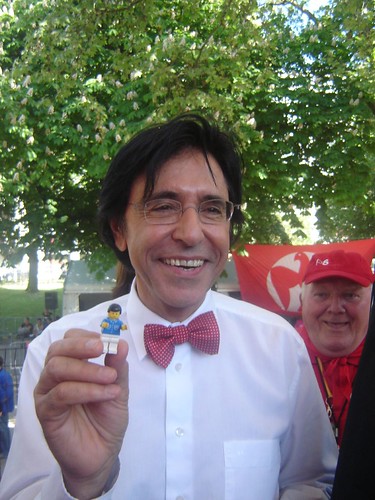
Belgium will make history this weekend in two ways. When a new government is finally formed on Sunday it will end the longest period that any country has gone without a government in modern history. And when Elio di Rupo is appointed prime minister, Belgium will become the first country in the world to have an openly gay male head of government.

I've specified 'male' because Iceland actually beat Belgium to the punch for the first gay leader of any sex – their openly lesbian Socialist Prime Minister Johanna Sigurdardottir was elected in 2009. In both countries the leader’s sexual orientation has been of little concern to the public or the media. In Belgium it is rarely ever mentioned, and in Iceland people were actually confused in 2009 when their PM’s sexual orientation received worldwide attention.

The sexual orientation of Di Rupo, also a Socialist, isn’t the only thing that makes him a different sort of politician. He is the son of Italian immigrants – a sizable population in Belgium’s Wallonia region who are descendants of the Italians who came to work in the mines in the early 20th century. This fact prompted one Belgian politician to say Di Rupo was evidence that the “American dream” is possible in Belgium.

Tuesday, 14 June 2011

Belgium hits one year with no government

A rather embarassing anniversary was reached here in Belgium yesterday - it has been one year since an inconclusive election threw the country into a period with no government. At the time, it would have seemed obscene to suggest that there would still be no government in Belgium in a year's time. But that's where we are today, and perhaps the only thing more surprising than the length of this governmentless period is the barely noticeable effet it has had on the country.

In truth, it's hard to say whether the current governmentless period hit it's one year mark yesterday or a few months earlier. The previous government of prime minister Yves Leterme collapsed in April of last year, so in truth Belgium has not had a government for a year and three months. Either way, this is the longest period any country in modern history has ever gone without a government. In February Belgium surpassed the previous record held by the fledgling Iraqi democracy.

Wednesday, 25 May 2011

Music wars on the Brussels metro

If you've ever ridden the Brussels metro subway system you may have noticed that your journey is accompanied by catchy pop tunes. In fact this past Monday was 'Lady Gaga Day' on the metro, when the gaag was played all day long, non-stop. I've pretty much gotten used to the music and I barely notice it any more, but there's one aspect of it I never thought to question - the songs being played are almost always in English.

I never thought to question it because, as is the case in most European countries, the majority of songs on the radio are always in English as well. But I had never noticed before that despite the fact that this is a Francophone city, I have never heard a song in French. Nor have I ever heard a song in Dutch, the city's other official language (spoken as a primary language by 7% of the Brussels population).

Apparently there is method to this madness. According to an article today in FlandersNews, the Brussels public transport company STIB has a policy of only playing English songs on the metro, with a smattering of Spanish and Italian songs thrown in for good measure. French and Dutch songs have not been played for fear of aggravating tensions between the two sides of the language divide here.

Thursday, 17 February 2011

Who punched whom? Brussels transit hangs in the balance

There are many expressions that expats have come up with to describe life in Belgium, but perhaps my favourite is this: "It's as if someone made surreal a country." No expression seemed more appropriate on Tuesday when the Brussels transit union suddenly called an immediate strike to protest the fact that a metro conductors had been punched by a passenger. But after a day of chaos with the city's entire transit system shut down, it emerged that in fact it was the conductor who had punched the passenger, not the other way around.

On Monday night the conductor got into an argument with a passenger and then throttled him. Afterward, fearing he would get in trouble, he lied and said the passenger had punched him. Upon hearing this, the transit workers union immediately rallied to his defence and that night, just two hours after the incident occurred, called an immediate strike. Every transit worker walked off the job, and did not come back the next morning.

So when I and everyone else went to the metro station Tuesday morning we found it shut - with no explanation. There was no sign, no people telling us what was going on, nothing. I had to go all the way back to my apartment and go online to find out what was going on. All metro trains, trams and buses didn't run the entire day. And with every cab taken, I had no choice but to work from home.

Sunday, 23 January 2011

Belgian shame rally: can ideology be fought with neutrality?

Today more than 34,000 Belgians marched in a demonstration across Brussels demanding that the country's bickering politicians reach a compromise in the ongoing talks to form a government. Belgium has been without a government for 224 days now, the longest government-less period for any European country since the end of the Second World War. As the political crisis continues with no end in sight, there are increasing worries that this could finally be the end of the line for this country, which may be on the verge of splitting into separate Dutch-speaking and French-speaking halves.

I was out at the "Shame Belgium" march today and I was impressed by the very large turnout. It was particularly notable because the demonstration was not organised by unions or political parties, as is usually the case, but rather by a group of five young people via Facebook. The demonstration had no political or regional allegiance - organisers even said it didn't even have an official unionist or separatist stance. In fact the organisers even discouraged people from bringing Belgian flags, though clearly everyone chose to ignore that advice. The stated purpose of the rally was simply to demand that the politicians urgently get on with their negotiations to prevent the country descending into crisis.

Monday, 6 September 2010

“We must prepare for the end of Belgium”

Is it a bluff, or are they serious? That’s the question all the Belgian media is asking today after the Francophone Socialist party leaders made an abrupt U-turn this weekend and, for the first time, started openly talking about the break-up of the country.

Up until now only the Flemish Dutch-speaking politicians that have seriously proposed breaking up the country, while the Francophone parties have refused to even entertain the possibility. But that seemed to change quite suddenly this weekend after talks on forming a new Belgian government collapsed yet again and the king accepted the resignation of Socialist leader Elio di Rupo as lead negotiator. Francophone socialist Philippe Moureaux came out saying Belgium is on the verge of an orderly separation. Rudy Demotte, the head of the government of Wallonia, said that “all options” are now on the table for them. Francophone Socialist Laurette Onkelinx told the magazine DH Dimanche, “We must prepare for the end of Belgium, otherwise we might be the ones to suffer.”

Monday, 30 August 2010

No end in sight for Belgian political chaos

I just returned to Belgium this morning after a week in the US, and when I disembarked from the plane to my new country of residency I learned that it is one step closer to not being a country for much longer. The government talks following June's election have just collapsed – meaning the country still has no government and is unlikely to be able to form one before the end of the year. Not such great timing considering Belgium still holds the EU rotating presidency for the next 4 months. But even if that extra responsibility weren’t sitting on the Belgian government’s shoulders right now, this continuing chaos is starting to border on Kafka-esque absurdity. So as I readjust to life in Belgium this morning after a week home in the US, I’m yet again left asking – is there a compelling reason for this country to continue to exist?

Last night the leader of the French-speaking Socialist Party (PS), Elio di Rupo, offered his resignation to Belgian King Albert II after negotiations to form a new government broke down. He is trying to negotiate with the Flemish separatist party NVA, which won the majority of the vote in Flanders in the June election. Di Rupo’s Socialists won the majority of votes in Wallonia, and so the two parties with directly opposing goals must come to some kind of coalition agreement to form a national government with other parties. In the mean time, no government has existed at national level since April. But since most governance functions have by now been devolved to the three regions (Flanders, Wallonia and Brussels), you’d never know the difference.

Monday, 21 June 2010

Flemish nationalists win big in Belgium

I’m back in cold, rainy Belgium, which is truly painful after a week in the warm sunshine. I spent this past weekend in the muddy, rain-soaked fields south of Waterloo, attending a reenactment of the decisive battle 200 years ago that spelled the final defeat for Napoleon. Despite the rain it was quite an experience (check out the video I shot below). I was particularly impressed with the international diversity of the people there, - both of the spectators and the 3,000 people participating in the battle. Most significantly, I noted that there seemed to be an even mix of Flemings and Walloons who had come to watch the battle. The harmony on the battlefield seemed a contrast to the battle going on at the moment between the country’s politicians.

The country went to the polls last Sunday to vote for a new government, and as predicted the result was inconclusive. But surprisingly, the election delivered more certainty than had been expected. There was a clear winner in both French-speaking Wallonia and Dutch-speaking Flanders. There was a large (though not surprising) victory for the Socialists in Wallonia, and a shock victory for the New Flemish Alliance (N-VA), a nationalist party, in Flanders. Because the parties did so well in each of their regions, there is now a realistic prospect that the two could form a coalition by September, with the Socialist MP Elio di Rupo to be appointed prime minister. Significantly, he would become Belgium’s first Wallonian prime minister in decades.

Monday, 7 June 2010

Belgian elections - the EU fiasco around the corner

Belgians will go to the polls this Saturday to vote for a new government, just two weeks before the country is slated to take over the rotating EU presidency from Spain. Considering that it took Belgium nine months to form a government after the last general election in 2007, Brussels is getting increasingly worried about a potential leadership vacuum in the council after 1 July.

The difficulty, as with everything in Belgium, is over language. The Belgian government collapsed in April over a disagreement between French- and Dutch-speaking parties over whether an electoral district on the outskirts of Brussels should be part of the Brussels Capital Region or Flanders. It may sounds like an innocuous issue but it goes to the heart of the language conflict, as explained in this previous blog entry.

Monday, 26 April 2010

Belgian government collapses, yet again

I'm in Trier, Germany today, attending a seminar for journalists on the European Court of Justice (the EU equivalent of the US Supreme Court, though with some important differences). Though I may be away from Brussels for the day the news feed on my iphone started blowing up this afternoon with news about my new host country as it became official - the Belgian government has fallen. Though the country's king worked tirelessly over the weekend to try to sort out a compromise between the warring Frencophone and Dutch-speaking parties, he has been unable to bring peace to the parliament, and today accepted the resignation of the prime minister.

International media reaction to the news has been muted, most likely because this is starting to become such a routine event. The government last collapsed in July 2008, during a period where at one point there was no Belgian government for well over a year. Not that you would have noticed. Belgium has become so decentralised - with authority split between the three regions of Wallonia, Flanders and Brussels - that the national government hardly does anything any more.

Tuesday, 15 July 2008

Belgian government collapses

Here we go again. Last night the Belgian government collapsed, just four months after it was formed in March. Before then, the nation had been without a government for nine months while the French- and Dutch-speaking parties were unable to form a unity government.

Belgium’s King Albert II is considering the resignation, but he doesn’t really have much leeway to block it. The prime minister of the four-month-old coalition government, Yves Leterme, had set a deadline of July 15 for getting an agreement on devolving more power to the regions. Belgium is made up of Dutch-speaking Flanders in the North, French-speaking Wallonia in the South and Brussels, which is French-speaking but located within Flanders. The Flemish, who are wealthier, want more local power, but the Walloons are resisting this because it would marginalize their influence.

Wednesday, 19 December 2007

King steps in to end Belgian crisis

Belgium’s King Albert II has interceded in order to resolve the long-running crisis in Belgium, which has had no government for six months now as the Dutch-speaking north and French-speaking south have been unable to form a coalition government.

An emergency interim government has been formed, which can stay in office for no more than three months. Then the situation may be back to square one.

Perhaps the most remarkable thing about the whole situation is that for the most part life has gone on as normal while the country has had no government, which has made many Belgians begin to question the point of having a government in the first place. But the situation was starting to affect the economy, and last week the European Commission warned that the political paralysis was beginning to affect Belgium's economy.

For more information on the history of the Belgian crisis you can read my blog entry about it here.

Monday, 10 September 2007

Dismantle Belgium?


There was an interesting piece in The Economist last week about Belgium and whether or not its existence really makes sense in the 21st century. Ostensibly it was just about the current conditions in this one tiny country, but in effect it cuts to the heart of the future of Europe as a whole.


The magazine asks the question, given that we’re now in month three of Belgium having no new government because the two parties can't agree, is it time to revaluate the Belgian state? After all if the parties, made up along ethnic/linguistic lines of French-speaking Walloons in the south and Dutch-speaking Flemings in the north still have so much tension after nearly 200 years, perhaps the time may be coming to rethink Belgium’s status.