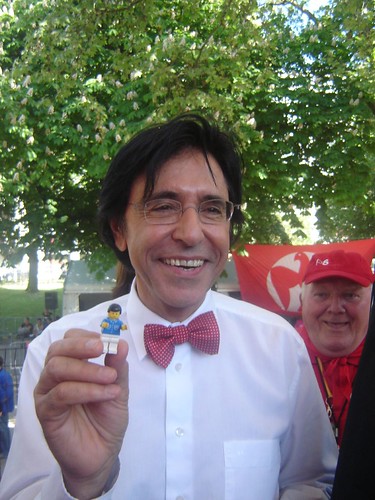
Belgium will make history this weekend in two ways. When a new government is finally formed on Sunday it will end the longest period that any country has gone without a government in modern history. And when Elio di Rupo is appointed prime minister, Belgium will become the first country in the world to have an openly gay male head of government.
I've specified 'male' because Iceland actually beat Belgium to the punch for the first gay leader of any sex – their openly lesbian Socialist Prime Minister Johanna Sigurdardottir was elected in 2009. In both countries the leader’s sexual orientation has been of little concern to the public or the media. In Belgium it is rarely ever mentioned, and in Iceland people were actually confused in 2009 when their PM’s sexual orientation received worldwide attention.
The sexual orientation of Di Rupo, also a Socialist, isn’t the only thing that makes him a different sort of politician. He is the son of Italian immigrants – a sizable population in Belgium’s Wallonia region who are descendants of the Italians who came to work in the mines in the early 20th century. This fact prompted one Belgian politician to say Di Rupo was evidence that the “American dream” is possible in Belgium.
Showing posts with label Elio di Rupo. Show all posts
Thursday, 1 December 2011
Wednesday, 30 November 2011
Brussels – enter at your own risk
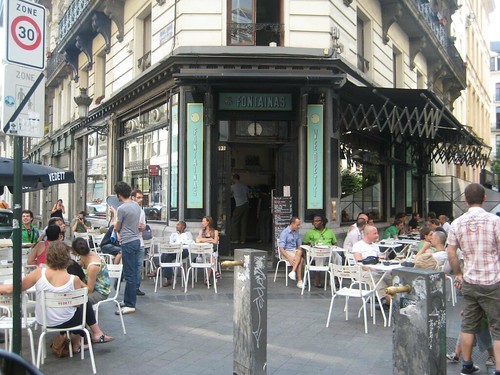
Fontainas, a cafe in central Brussels that could best be described as the headquarters of the city’s gay community, is shut down this week. Its doors have been closed since an incident Sunday night that sent a man to the hospital with severe stab wounds. News of the attack, which has been spreading like wildfire through social media all week, seems to have left the city’s gay community shocked yet unsurprised at the same time. The storyline has become a familiar one in Brussels. Three drunk men entered the café, began hurling homophobic abuse at the people inside, and before long a violent altercation ensued. The details of what took place are still unclear, but the incident was serious enough to shut the doors of this Brussels landmark since Sunday. And although homophobic attacks are unfortunately common in Brussels city centre - an area of the city that is known for its crime and grime - this incident has still caused huge shock because the establishment is so well-known. Even the soon-to-be Belgian prime minister, who is openly gay, can often be seen there.
A movement has been growing to try to pressure the city authorities to do more to keep the city centre safe since a gay-bashing attack in June that many saw as the straw that broke the camel's back. A man was beaten by a group of young men near the Bourse (stock exchange), just next to Grand Place, because he was gay and behaving in an effeminate manner.
Monday, 6 September 2010
“We must prepare for the end of Belgium”
Is it a bluff, or are they serious? That’s the question all the Belgian media is asking today after the Francophone Socialist party leaders made an abrupt U-turn this weekend and, for the first time, started openly talking about the break-up of the country.
Up until now only the Flemish Dutch-speaking politicians that have seriously proposed breaking up the country, while the Francophone parties have refused to even entertain the possibility. But that seemed to change quite suddenly this weekend after talks on forming a new Belgian government collapsed yet again and the king accepted the resignation of Socialist leader Elio di Rupo as lead negotiator. Francophone socialist Philippe Moureaux came out saying Belgium is on the verge of an orderly separation. Rudy Demotte, the head of the government of Wallonia, said that “all options” are now on the table for them. Francophone Socialist Laurette Onkelinx told the magazine DH Dimanche, “We must prepare for the end of Belgium, otherwise we might be the ones to suffer.”
Monday, 30 August 2010
No end in sight for Belgian political chaos
I just returned to Belgium this morning after a week in the US, and when I disembarked from the plane to my new country of residency I learned that it is one step closer to not being a country for much longer. The government talks following June's election have just collapsed – meaning the country still has no government and is unlikely to be able to form one before the end of the year. Not such great timing considering Belgium still holds the EU rotating presidency for the next 4 months. But even if that extra responsibility weren’t sitting on the Belgian government’s shoulders right now, this continuing chaos is starting to border on Kafka-esque absurdity. So as I readjust to life in Belgium this morning after a week home in the US, I’m yet again left asking – is there a compelling reason for this country to continue to exist?
Last night the leader of the French-speaking Socialist Party (PS), Elio di Rupo, offered his resignation to Belgian King Albert II after negotiations to form a new government broke down. He is trying to negotiate with the Flemish separatist party NVA, which won the majority of the vote in Flanders in the June election. Di Rupo’s Socialists won the majority of votes in Wallonia, and so the two parties with directly opposing goals must come to some kind of coalition agreement to form a national government with other parties. In the mean time, no government has existed at national level since April. But since most governance functions have by now been devolved to the three regions (Flanders, Wallonia and Brussels), you’d never know the difference.
Subscribe to:
Posts (Atom)