Saturday, 15 November 2008

The Imminent Collapse of the Pound?

Gordon Brown is in Washington this weekend, along with the other leaders of the G20 countries, attempting to come up with a solution to the global economic crisis. The ambitions for the group are huge, with suggestions of a global stimulus package and perhaps the creation of a global financial regulatory body. And it is the first time that the leaders of the G8 countries have met to discuss the current crisis with the growing economies like India, China and Brazil, which analysts say will be crucial in jolting the world out of the financial mess its in. But despite the big plans, everyone knows that at this weekend's meeting little is likely to be committed because of one very important absence from the conference: Barack Obama. With the Bush Administration leaving office in two months, countries see little point in making firm commitments now when everything could change come January.

Just now the summit has released a declaration of intent, with key points saying that each country has committed to financial stimulus, with each using government money to prop up the economy. It's also come out with pretty damning language about what got us into this mess, laying the blame on the door of the US and the lack of macroeconomic regulation.

But with little concrete policy news coming out of the meeting, the media in the UK has focused today largely on some side comments made by prime minister Brown on the sidelines. The comments were a response to something said by the Tory shadow chancellor George Osbourne in the Times newspaper today. Osbourne told the Times that Brown's stimulus plans could cause a "proper sterling collapse, a run on the pound." From Washington Brown lashed out at the comments as "irresponsible," suggesting that talk like that could become a self-fulfilling prophecy.

Osbourne's rant was the first time a senior UK politician has suggested that the country may be just weeks away from a currency collapse similar to what happened in the early 1990's. The pound has lost more than a quarter of its value in four months, dropping from over $2.00 in July to less than $1.50 today. It has also plunged against the Euro, declining by 20 percent just in the last month, particularly in the last week. A Euro is now worth a shocking £1.16. If the currency continues falling at this rate it could be worth less than a euro by the end of the year. With an economy that has become almost completely reliant on financial services, currency speculators seem to have concluded that the UK is going to be disproportionately affected by the economic crisis.

As someone who lives in continental Europe but whose savings and salary are in pounds, this is obviously not good for me. In fact the timing of my little jaunt over to the continent apparently couldn't have been worse. Considering I'll be moving to Zurich at the end of this month (the pound-franc exchange is also not good), it's really hitting home how volatile working across borders can be, especially in times of economic turmoil such as these.

It is clear that Osbourne and many other Tories are hoping that a currency collapse could damage Labour in the same way that the Tories were hurt by the sterling crisis in 1992. But as someone who's livelihood depends on that not happening, I share Brown's annoyance at Osbourne's seeming attempt to use the economic crisis to score political points.

Wednesday, 12 November 2008

The Kaliningrad Question

Having written an in-depth article on Russia's Kaliningrad oblast for an article I was working on back in 2002, I'm always interested when the territory makes its way into the news. Most people don't even know of the existence of this strange corner of the earth, but judging from Russian President Medvedev's state of the union speech last week, it could feature very prominently in relations between Russia, the US and Europe over the next decade.

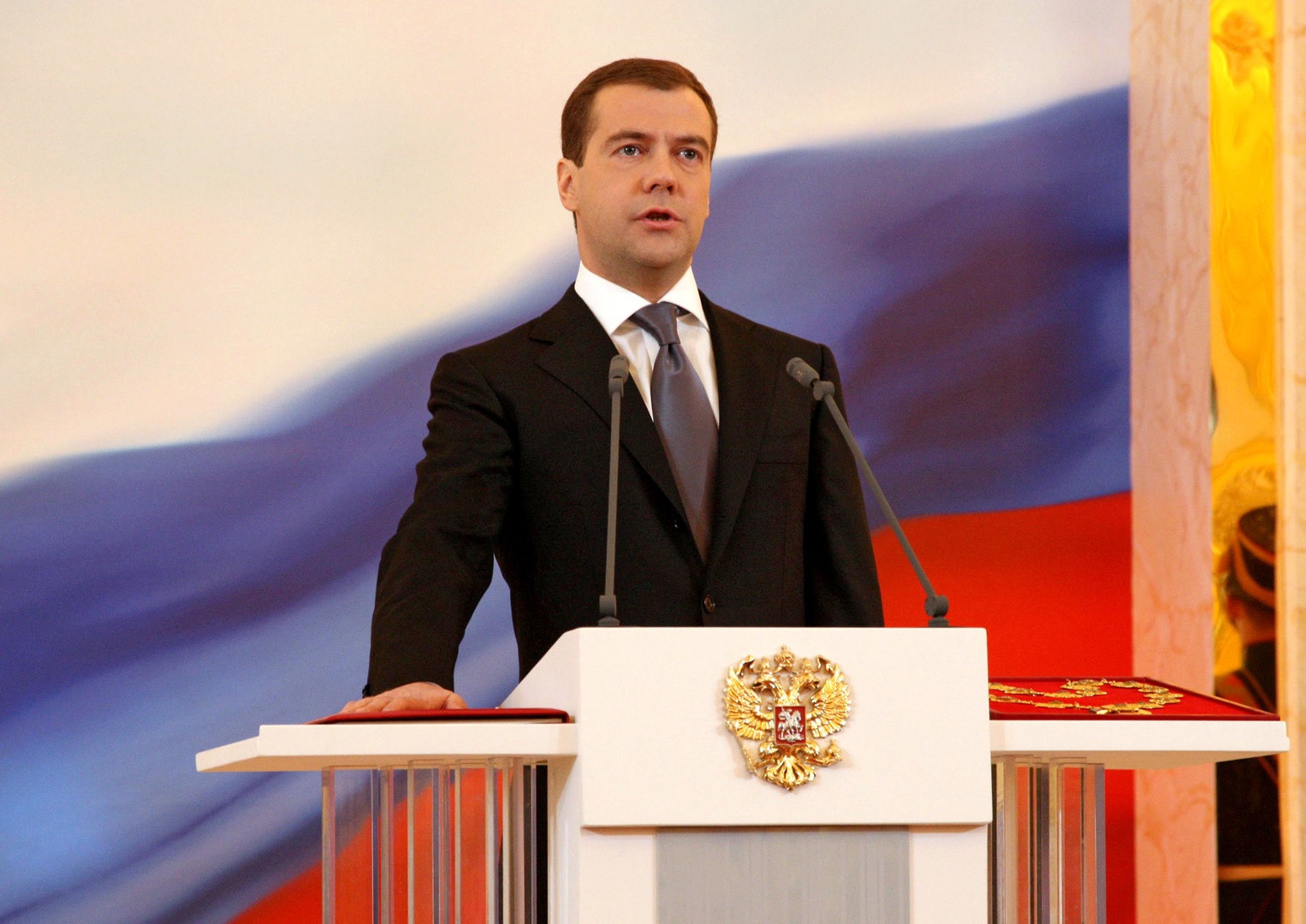
Russia didn't waste any time testing Obama's mettle, with President Dmitry Medvedev delivering a speech the day after the historic election lambasting the United States for provoking the Georgian conflict, leading the world into economic disaster, and threatening Russia with its missile defense system it is installing in Poland and the Czech Republic. These complaints aren't new, but on the last point President Medvedev matched actions to words, saying Russia would install short-range missiles just off the Polish border in its territory of Kaliningrad, in response to the US "provocation." If Russia were to carry out this threat, it could provoke a new Cuban missile crisis for the EU and the new US president Obama. A spokesperson for Obama said today that the president-elect hasn't yet made a decision on whether to continue the Bush Administration's plans for the missile defense system.

So I think this is big news, but coming as it did after Obama's historic election, its been largely overshadowed. Additionally, I've been struck by some of the basic points the media seems to be missing with this news. For one, they keep referring to Kaliningrad as an "enclave" of Russia, when in fact it is an exclave (a territory is an enclave of a country it is completely surrounded by, it is an exclave of the country it belongs to). This may seem like a trivial semantic difference, but by failing to highlight the fact that Kaliningrad is an exclave of Russia it seems to me the media is missing the point. When they refer to the territory as being "on the border of Lithuania and Poland" they fail to mention that it is surrounded by those countries, which are both now in the EU. That means the Russian territory of Kaliningrad is located within the EU. It would be as if Russia owned the US state of Connecticut and was going to install missiles there. Keep in mind this is no insignificant territory, being larger than Connecticut and located on the strategically important Baltic Sea.

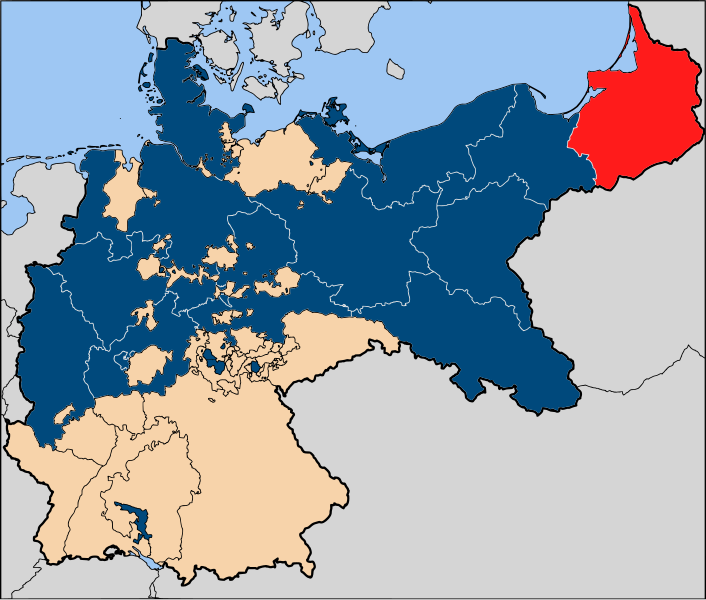
So why does Russia have this territory anyway? It's actually a peculiar accident of history and I think an incredibly sad one. The city of Kaliningrad was until the 1950s a German city named Konigsberg. The entire area was settled by crusading Germans in the 13th century and became
the kingdom of Prussia. It was actually the nucleus of what eventually became Germany, with the capital of the growing German Empire only moving from Konigsberg to Berlin in the 18th century. However after World War I, with the re-creation of a Polish state, the allied powers decided that the new country needed access to the Baltic Sea, so they created a "Polish Corridor" cutting through Germany, separating East Prussia from the rest of the German state. One of Hitler's main initial aims was to retake Poland to unite east Prussia with the remainder of Germany. But in the end of course Germany lost the war, and Russia demanded huge territorial concessions. It was decided at the Potsdam Conference that East Konigsberg should be given to Russia, resulting on one of the largest forced population moves following World War II. Before Potsdam East Prussia was almost completely inhabited by ethnic Germans, Russians had never lived in the territory. But at the end of the war about 2 million ethnic Germans were evacuated or forcibly expelled, and ethnic Russians moved in to the territory, which had been almost completely destroyed by World War II.

Kaliningrad was made into an SSR within the Soviet state, and at the time it was contiguous with the rest of the country because the Baltic states were part of the USSR. And with Poland and East Germany in the Warsaw Pact, Kaliningrad was located comfortably well within the Soviet sphere. But with the collapse of the USSR in 1991, things suddenly changed dramatically. Lithuania and Belarus broke away from the USSR and became independent countries. However it didn't make sense for Kaliningrad to become an independent country since it was still inhabited mainly by the ethnic Russians who had moved in during the 1950's. So the territory became a Russian island hundreds of miles away from Russia. Now that Lithuania and Poland have joined the EU and the Schengen Zone, the situation has become tricky.

What makes this situation especially complicated is that Kaliningrad is a sparsely populated, barren wasteland. Russia seemed to almost purposefully punish the territory after they acquired it. Rather than developing this incredibly strategic piece of land - now Russia's only year-round Baltic port - they ignored it. It is very difficult for foreigners to be granted a visa to enter the territory, and even Russians need permission to go there. It is an incredibly sad, desolate place.

For the past 15 years, while the West considered the new Russia to be a friend, the awkward situation of Kaliningrad didn't seem so important. But now with tensions rising between the West and Russia, and with Russia threatening to build up its military presence there, the territory's status could quickly become an issue. Can the EU handle a hostile enclave within its territory?

**Fun semantic trivia for your next cocktail party: Kaliningrad is an exclave of Russia and an enclave of the EU, but it is not an exclave or enclave of Lithuania or Poland because it is not completely surrounded by either.

Wednesday, 5 November 2008

The Obama Urban Coalition

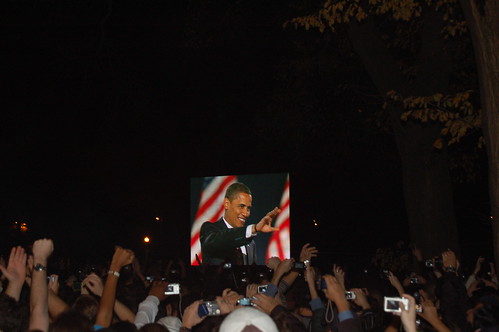
Wow, what a night. I have to say I was pretty bummed to not be in the US for election night. Watching Grant Park and the city streets across the nation erupt in celebration, it just wasn't the same sitting alone in my apartment at five in the morning. Still it was an amazing moment, seeing the celebrations across the world as the Bush era was declared definitively finished.

I started the evening by going with some American friends to a US election party at the town hall of the 3rd arrondisement here in Paris. We were expecting your classic election party, with television, food platters, drinks, etc. Instead we found an art exhibit! Apparently the French conception of an 'election party' involves an exhibition of photography from the US election and the screening of a conceptual art film about American politics. And no booze! There was a large screen showing French coverage of the election, but it was outdoors so the prospect of hanging out to watch the results there for six hours wasn't too enticing! Still it was interesting, when people heard our accents they were very eager to talk about the election. They were really fascinated by it, as the art exhibits reflected. And as the only Americans there we were the self-appointed experts of the moment.

We sort of moved around from cafe to cafe but after it started to get late I went back to my apartment to watch the results. I live on a street with a lot of expat bars and the place across from me was having an election viewing party, but I don't think they realized how late the result was coming because when they finally called it at 5am I went to look out the window to see if they were pouring into the street, and the bar had already closed! So I was a bit jealous as I talked to my friends in the US and they told me how people were pouring into the streets to celebrate. It was really wild. I spoke with one friend who lives in DC, he was outside the white house among the huge crowds that had gathered outside the lawn. He said it almost looked like they were going to storm the gates and drag Bush out themselves. Another friend called me from Grant Park in Chicago and said it was absolutely amazing, unlike anything he had ever seen. It wouldn't be hyperbole to say it looked like a third world country that had just overthrown a dictator. Here's a video someone took from a window in New York's east village.


So what prompted this huge outpouring of jubilation? Certainly it was an extremely unusual reaction to an election result in the US, especially in the last ten years, when election nights were more likely to see people crying in the streets of American cities. To understand why US cities erupted in celebration like this, you have to look beyond the current campaign and look back at the last ten years. Since the election of 2000, which most Democrats considered to have been stolen from Al Gore, residents of American cities in the Northeast and the West Coast have felt as if the Bush Administration was literally at war with them. The Republican Party's strategy during this time has been to appeal almost exclusively to rural white voters, vilifying urban dwellers and using social issues like abortion and gay marriage to drive cultural conservatives to the polls. The strategy worked, and the GOP was voted into office again and again by turning out rural votes. This left American city dwellers feeling almost completely powerless. as if they had no power and no voice while their country's leaders continually vilified and insulted them.

The same playbook was used by the McCain campaign in this election, dividing the country into "real America" and "fake America." So when that strategy didn't work this time, it signalled to city-dwellers that their long period of exile from power was finally over.

Of course there was another reason for the celebrations as well. Part of the GOP's process of vilifying urbanites also involved fostering distrust of African Americans, albeit not with direct language. African Americans felt completely ignored by the Bush Administration, particularly during Hurricane Katrina. Tuesday night the African American community celebrated a minor victory, the defeat of a party which most of them despise, and a major victory, the election of the first black president. No wonder there were tears in the streets. And it was hard not to be moved by them.

What's Next?

The fact is that despite their personal ideology, politicians often take their cues from the people who put them in office. For instance, no matter how much she is vilified as a "liberal" by the American right, Nancy Pelosi has pursued a rather moderate agenda as speaker of the house over the last two years, because she knows Democrats were given their majority by moderate voters in a center-right country. So who put Obama in office?

I thought former speechwriter David Frum made an interesting comment on the BBC Tuesday night, saying Obama was elected into office by a coalition of "the very top and the very bottom." Frum questioned whether over the long term these two groups will have aligning interests. College-educated whites voted almost exclusively for Barack Obama, as did 96 percent of African Americans. But non college-educated whites, especially those in rural areas, voted largely for McCain. Frum insisted on calling this group of McCain voters the "middle class," which I think is debatable. But there is no denying that the majority of blue collar white voters, those in the middle of the income spectrum, did not vote for Barack Obama.

So will this coalition of college-educated whites and African Americans hold? Do they have more in common philosophically than their hatred for George W. Bush? Only time will tell, but early philosophical differences may have already been exposed by the passing of Proposition 8 in California. The proposition sought to amend the constitution to overrule a recent California Supreme Court decision to allow gay marriages in the state, which prompted 18,000 marriages including those of a few celebrities including Ellen DeGeneres. In the end the proposition to ban gay marriage passed by a very narrow margin, and ironically it looks like it was Barack Obama's presence on the ballot that enabled it to pass. Because although the college-educated whites who turned out for Obama would have mostly voted against it, the huge African American turnout that was driven to the polls for Obama would have mostly voted for it. This is perhaps the biggest divide between African Americans, who are largely socially conservative and religious, and college-educated whites, who are often socially progressive and secular.

With control of both houses of congress and the presidency, the Democrats have a huge mandate for action. But what action will they take? it's going to be fascinating to watch.

Wednesday, 29 October 2008

Cross-Border Suicide is Tricky Terrain

A UK court reached an interesting decision today about the legality of transporting someone to another country for the purpose of assisted suicide. Assisted suicide is illegal in the UK, but the law is unclear about whether it is a violation of the law for someone to take an ill person to another country where assisted suicide is legal and do it abroad.

One such country is Switzerland, and a British woman suffering from MS has been seeking a ruling from the High Court that would clarify the law. She says that if she can be sure her husband won't be prosecuted for taking her to an assisted suicide facility in Switzerland, she wants to wait until the last stages of her illness, when she has lost all function, to be killed. She says if the law isn't clarified, she cannot take the risk that her husband could be prosecuted for transporting her to the facility in Switzerland, and she will have to take herself there, earlier in the stages of the illness when she can still get herself around without assistance.

Her legal argument is that the lack of clarity in the law is essentially forcing her to end her life earlier than she would like, while she could still lead a functioning and happy existance.

Though the practice is illegal, since 1992 almost 100 British citizens have had themselves killed at this facility in Switzerland, and the relatives who transported them there haven't been prosecuted. But the plaintiff, Debbie Purdy, says that she cannot in good conscience let her husband transport her to the facility if she knows there is a possibility that he could be prosecuted.

The high court as ruled that the law's lack of clarity doesn't infringe on Purdy's human rights, and it has concluded that only an act of parliament could clarify the law. Purdy's attorneys say she plans to appeal.

It seems a shame that this woman should have to spend what little time she has left on this earth dealing with a high-profile court case.

Friday, 24 October 2008

Austria's Far-Right Gay Secret: History Repeating?

The death of far-right Austrian politician Jörg Haider took an interesting twist today. The huge outpouring of mourning and sympathy which Haider's death inspired has received much press coverage in Europe over the past two weeks, but the biggest open secret about Haider has not - the fact that he was gay. That is until yesterday, when his lover of five years Stefan Petzner publicly acknowledged their relationship in a tearful confession.

What has followed has been some hesitation from European media about whether it is appropriate to cover the sexuality of Haider, who is married with two children, as a news story. The issue has been further complicated by the fact that his sexuality was hardly inconsequential in the details of his death. He died in a car crash driving home drunk from a gay bar he had been at with his lover. But before Petzner's televised admission, that detail was left out of all press reports in Austria. It's not hard to see why, when the reality of Haider's personal life are so inconsistent with the public image of the party he led - the far-right Alliance for Austria's Future (BZÖ). After his admission, Petzner was fired from his position as leader of the BZÖ. He had already attracted attention at Haider's funeral after television cameras caught him loudly weeping more than Haider's wife and two daughters combined. Petzner said in his interview that Haider's family was aware of their relationship.

The revelation has put the party into full damage-control mode, fearing that the news will scare off the core conservative voters in Southern Austria that make up the group's voters. The hugely popular Haider had recently led the party to great success, ushering in a victory scoring 8 percent in last month's general election. Now that this news might throw the party into disarray, there has been speculation it may merge with the populist Freedom Party (FPÖ). That merger would create the second-strongest political party in Austria.

So, the revelation about Haider's sexuality is hardly inconsequential. But still, Austrian media outlets have remained extremely hesitant to cover it. In fact, it was Germany's Bild newspaper that forced the details surrounding the circumstances of Haider's death into some of the Austrian press. Austria is one of the most conservative countries in Western Europe (many would say the most conservative) and has a particularly bad reputation for gay rights (though it does not have a form of civil partnership). The rest of the European media is full of criticism today for Austria's press, questioning why the country's media seemed to show such deference to the far-right leader in not reporting his homosexuality, which seemed to blatantly contradict the policy goals of his party. However the Austrian media has defended itself by pointing out that though the party's official platform demonized gays, Haider himself was never heard to utter any criticism of homosexuality amidst his attacks on foreigners and his praise for Nazis.

I can't help but wonder what effect all of this will have on the public perception of Austria in the rest of Europe, already badly damaged by the recent string of bizarre imprisonment cases, most notably the horrific tale of Josef Fritzel. That last case was also notable for the shocking way in which people 'looked the other way.'

Fascist leaders who lived secret gay lives while publicly condemning gay people to death is a familiar theme in Europe's history. As Austria slides further and further to the right, revelations such as these are bound to make people pretty uncomfortable, especially due to its almost creepy historical parallels.

Tuesday, 21 October 2008

Europe's Moment

The blog's been noticeably quiet the past week, apologies for that. I had two language exams for my French certification last week, and then this weekend I had a friend from London visiting. My life's been a lot busier than I thought it would be during this sojourn, non-stop French tests all week and then visitors from London on the weekends. It's fun though!

To answer the question I posed in my post last Monday, in the end the US did go ahead and follow Europe's lead on the bank buyout plan. It really has been an astounding thing to watch. Though it initially looked like the EU was stumbling in trying to devise a unified response to the crisis, over the past week that trend has been reversed and the EU has actually taken on a leadership role in the world's response to the crisis, with the United States following!

Perhaps one of the most surprising elements of the past week was to see UK prime minister Gordon Brown rise to the occasion and become the man of the hour. As BBC Europe correspondent Mark Mardell noted last week, Brown has suddenly become the leader of Europe, having devised the bank bailout plan which continental Europe shortly copied and then the United States followed. Though he initially failed to lead Europe with his first summit, French president Sarkozy's gung-ho 'throw everything at the wall and see what sticks' approach has actually served him well during this crisis. He was full of ideas when addressing the European parliament last week, saying the EU must lead in "overhauling capitalism." In fact it is Angela Markel - Germany's chancellor who is respected throughout Europe for her calm, steady and thoughtful leadership - who has really stumbled during this crisis, seeming almost erratic and lost. I couldn't help but smile when I saw Paul Krugman's piece in the New York Times last week praising Brown's leadership (on the same day that he won the Nobel prize, so it got lots of press). The UK had basically given up on Brown until last week. Now he's quickly rising in the polls, closing David Cameron's lead over him to single digits. As the saying goes, "cometh the hour, cometh the man." But how long will the praise last?

The new clout that the EU has during this crisis was in evidence at the Camp David meeting over the weekend. During this crisis the EU has some new clout and it is being wielded loudly by Sarkozy. The EU is, after all, now the world's largest trading block. And for the first time, the EU is being listened to seriously by an American president (albeit a lame duck one). Just to see the sight of a French president standing at Camp David and calling for regulatary overhaul of the world's financial system while the US president stands next to him was an amazing sight. And on his other side was European Commission president Jose Manuel Barroso, whose advice at the end of the summit that the world needs new rules and regulations and that these should be based on the European model, "not gung-ho liberalism." The fact that this is being taken seriously by the US shows how much things have changed in the past few weeks. Is this Europe's moment to take the reigns and devise a new global financial system based on European values? It seems suddenly, and unexpectedly, within reach.