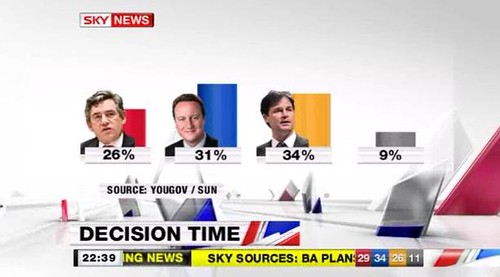
It was a long night, and it was only just a moment ago that the BBC was finally able to declare an official UK election result – or non-result, as the case may be. For the first time in decades, a British election has yielded a hung parliament. No single party has a majority, with the Conservatives falling well short of the 326 seats they needed to form a government. Now the clock is ticking as politicians scramble to come up with some kind of solution.
It’s looking as if a Liberal Democrat – Labour coalition may not be enough for a majority either, which may rule out that option. It was a disastrously disappointing night for the Lib Dems and their supporters. Despite all the speculation after the first televised debate that this could be their year, the Lib Dems actually lost seats in this election. It’s truly stunning.
Of course along with all the polling showing surging support for the Lib Dems after the first debate came notes of caution that the pollsters did not know how the increased support would affect the actual vote. UK elections still use a peculiar first-past-the-post system for their elections which heavily favours the two main parties. This type of electoral system is normal in the presidential system of the US, but it is unusual in a parliamentary system. Most other parliamentary democracies use a ranked voting system where people indicate your first choice and then a second choice. The Lib Dems have made switching to a proportional representation or ranked system a cornerstone of their campaign, and recently Labour agreed to put it to a referendum. The Tories have refused to consider such a change, but it is likely that the Lib Dems would demand this if they were to enter into a coalition with the Conservatives..