Travel-weary members of the European Parliament issued an aggressive challenge to France today, voting to skirt the requirement that they meet in Strasbourg twelve times a year by combining two of the 'Strasbourg sessions' into one. It remains to be seen whether member states, who are the only ones who can decide where the institutions meet, are going to challenge this.
Every month the entire European Parliament is made to trek from Brussels to Strasbourg, France - which lies on the German-French border not far from Switzerland. This is because the original European Treaties designated Strasbourg as the headquarters of the parliament. Over time, the real work of the parliament has moved to Brussels in order to be closer to the other two EU institutions as well as lobbyists and NGOs. But the founding treaties still require the parliament to meet in Strasbourg twelve times a year, and all binding votes must take place there. The majority of members of the European Parliament (MEPs) hate the monthly "traveling circus" which requires them to go to Strasbourg for five days every month. A 2007 survey by Liberal MEP Alexander Nuno Alvaro showed that 89% of MEPs want to end the Strasbourg sessions.
But MEPs don't have a say in where they meet. Changing the Strasbourg requirement in the treaties would need the unanimous support of all member states, and France has always refused to support moving the parliament permanently to Brussels. In 1999 France built a massive new building for the parliament in Strasbourg, despite objections from MEPs who said they didn't want it. Now France points to the expense of the building to justify maintaining the Strasbourg seat.
Wednesday, 9 March 2011
Monday, 7 March 2011
Germany still world's most popular country
The figures are in, and Germany has again taken the top spot in the BBC's annual poll of nations' popularity - with 62% of those surveyed ranking its influence as positive for the world. The UK was the next most-loved country, rising to second place in its highest ever placing in the annual poll.
But while Germany and the UK sit at the cool kids' table in the world lunchroom, over in the losers corner sit Iran, North Korea, Pakistan and Israel, all ranked as the most unpopular countries. The United States was ranked seventh in popularity out of the 16 countries respondents had to choose from, polling behind Canada, France, Japan and Brazil.
Friday, 4 March 2011
While the right leads in Helsinki, the left is sidelined in Athens
Europe's two main political groupings – the center-right European People's Party (EPP) and the center-left Party of European Socialists (PES) – are today holding dueling summits in Helsinki and Athens, respectively. The simultaneous timing of the two-day events, a bit like the party conferences in the UK or US – is highly unusual. But they are coinciding because they are both meant to get each side singing from the same hymn sheet at next Friday's incredibly important European Council summit. And given Europe's current political reality, the choice of a Northern capital for the right's meeting and a Southern capital for the left's meeting seems entirely appropriate.
But despite the fact that these are nominally meetings of Europe's two main political groups, the reality is that the Helsinki summit will effectively be a meeting of those running Europe while Athens will be an ignored meeting of those sitting on the sidelines. Because the European left has been pushed to Europe's geographic fringes and marginalized by the debt crisis, the Athens meeting will be a meeting of politicians "in opposition". In Helsinki, German chancellor Angela Merkel will lead a meeting of representatives of the governments of 17 of the 27 EU member states. At the Socialist conference in Athens only five governments will be represented.
In addition to national leaders like Merkel, Berlusconi and Ireland's incoming prime minister Enda Kenny, European Commission President Jose Manuel Barroso and European Council President Herman Van Rompuy– both from the EPP – are also in Helsinki. The president of the European Parliament, EPP politician Jerzy Buzek, may come tomorrow. They will be discussing the Eurozone Competitiveness Pact drawn up by Merkel and Sarkozy as well as the debt relief fund. They will also discuss a united European response to the events in North Africa. In effect it will be a sort of mini European Council summit.
What will they talk about in Athens? Who knows. Who cares? Whatever is on the agenda, it will have little consequence for the direction of EU policy.
But despite the fact that these are nominally meetings of Europe's two main political groups, the reality is that the Helsinki summit will effectively be a meeting of those running Europe while Athens will be an ignored meeting of those sitting on the sidelines. Because the European left has been pushed to Europe's geographic fringes and marginalized by the debt crisis, the Athens meeting will be a meeting of politicians "in opposition". In Helsinki, German chancellor Angela Merkel will lead a meeting of representatives of the governments of 17 of the 27 EU member states. At the Socialist conference in Athens only five governments will be represented.
In addition to national leaders like Merkel, Berlusconi and Ireland's incoming prime minister Enda Kenny, European Commission President Jose Manuel Barroso and European Council President Herman Van Rompuy– both from the EPP – are also in Helsinki. The president of the European Parliament, EPP politician Jerzy Buzek, may come tomorrow. They will be discussing the Eurozone Competitiveness Pact drawn up by Merkel and Sarkozy as well as the debt relief fund. They will also discuss a united European response to the events in North Africa. In effect it will be a sort of mini European Council summit.
What will they talk about in Athens? Who knows. Who cares? Whatever is on the agenda, it will have little consequence for the direction of EU policy.
Thursday, 3 March 2011
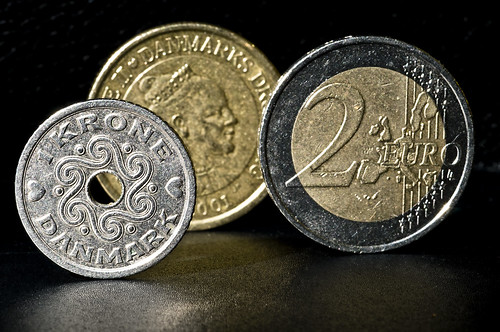
Denmark may join the euro before the summer
It might seem counter-intuitive given the ongoing tremors within Europe's common currency, but believe it or not Denmark is considering holding a referendum on joining the euro in the next few months. Though Danes rejected joining the common currency in 2000, the country's prime minister said yesterday that they may give it another shot. And poll numbers indicate that this time it could succeed.
All EU countries are required to join the euro eventually, but Denmark and the UK have an opt-out from this requirement. But, as is the case with so many EU opt-outs, Denmark is actually a pseudo-member of the eurozone. Because Denmark is in the European Exchange Rate Mechanism, its currency is pegged to the euro. So essentially, Denmark is already on the euro, it just uses different pieces of paper. But because it doesn't technically use the euro, it can't take part in eurozone decisions. And now that Angela Merkel and Nicolas Sarkozy are pushing for the creation of Eurozone decision-making body, the situation has become quite undesirable for Denmark. It will be affected by the decisions made in this new body, but it won't be able to join it. And that is why, despite the eurozone trouble, this might be exactly the right time for Denmark to join the euro.
Wednesday, 2 March 2011
Low taxation of company cars: a perverse incentive to pollute?
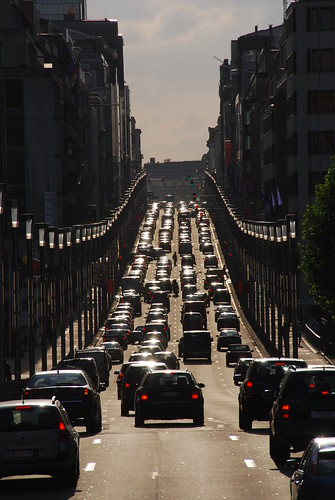
As residents of Brussels know all too well, this is a car city. Sure, there's an efficient metro system – but it has only two lines and doesn't cover large swathes of the city's more affluent areas, which are instead covered by glacially slow trams and buses. The city is small enough to be easily covered by bike, but the extremely poor quality of the roads, the hilly terrain and the lack of cycle lanes often make cycling here more of a nuisance than it's worth (take it from a cyclist). That leaves only driving by car, an activity I would say the vast majority of my friends here are engaged in.
I myself have never owned a car, having always lived in large cities with good public transport systems. I still don't own a car in Brussels, but after living here a year I can say I've never before felt such temptation to get one. Not necessarily because I have difficulty getting around here. Despite its flaws I find the public transport to be sufficient for my needs, and when it's not I go by bike. But I feel like a bit of an oddity sometimes for getting around the city by metro, tram and bike. Peer pressure? Car envy? I'm not sure, but the fact that most of my friends drive is making me suddenly want a set of wheels. By contrast, none of my friends in London or New York had cars.
But if the Brussels public transport system is sufficient, why do all of these white collar workers I'm friends with – many of whom are only in Brussels temporarily – have cars? The answer is simple – Belgium pays them to have one.
I myself have never owned a car, having always lived in large cities with good public transport systems. I still don't own a car in Brussels, but after living here a year I can say I've never before felt such temptation to get one. Not necessarily because I have difficulty getting around here. Despite its flaws I find the public transport to be sufficient for my needs, and when it's not I go by bike. But I feel like a bit of an oddity sometimes for getting around the city by metro, tram and bike. Peer pressure? Car envy? I'm not sure, but the fact that most of my friends drive is making me suddenly want a set of wheels. By contrast, none of my friends in London or New York had cars.
But if the Brussels public transport system is sufficient, why do all of these white collar workers I'm friends with – many of whom are only in Brussels temporarily – have cars? The answer is simple – Belgium pays them to have one.
Tuesday, 1 March 2011
EU bans cheaper auto insurance rates for women
Female drivers in the EU will likely see their insurance premiums rise significantly next year following today's European Court of Justice ruling that charging lower rates for women than for men constitutes illegal gender discrimination. At the same time, men are about to see their insurance premiums drop.Insurance companies across Europe as well as in North America generally charge women much less for auto insurance than their male counterparts. Statistics show they are less risky drivers and are therefore less likely to get into an accident. The difference in pricing is particularly large for people under the age of 30, where women typically pay half of what men pay.
Previously such a distinction in pricing was allowed through an exemption for insurers from having to follow national discrimination laws. But a Belgian consumer group challenged the exemption, saying that assuming men are dangerous drivers simply based on their gender constitutes unlawful discrimination. The court agreed, and insurers in the EU will have to end their systems of separate rates by December 2012.
Subscribe to:
Posts (Atom)