Friday, 15 May 2009

Eurovision Riot in Moscow?

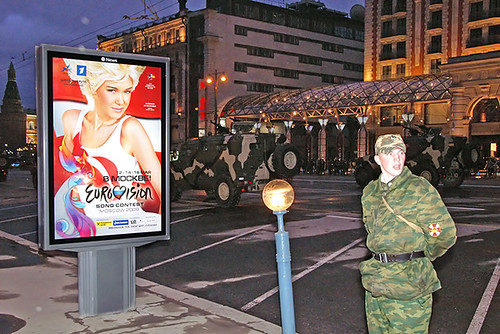
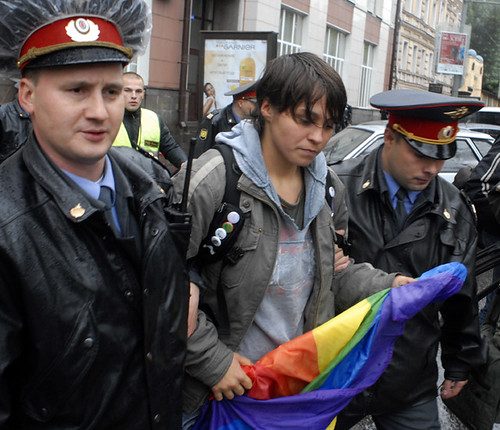
Moscow is alive with excitement for tomorrow night’s Eurovision final, but the real drama could unfold tomorrow afternoon if violence breaks out at an illegal gay rights march in the city. With Western cameras thronging the city for the yearly song contest, Russian authorities seem astonishingly blasé about the very real possibility of some embarrassing scenes on the day of the final.

The notoriously kitsch song contest has for years been a favourite of gays and lesbians, in fact it’s often been said that the only people left in the UK who still watch Eurovision are gays (an exaggeration I’m sure). Wherever the contest is held, gays usually flock to the city to see it live. Moscow has been no different, with local hotels reporting a large number of European male couples booking rooms. But Russia is without a doubt the most gay-unfriendly place to have hosted a Eurovision Song Contest since gay rights came to the forefront of public consciousness.

Russia has ranked up there with the nations of the Caucasus and Poland for being one of the worst countries to be gay in Europe. The post-Soviet legacy has left Russian gays attacked from many sides. During the communist period homosexuality was demonized as a “Western capitalist decadence,” and many Russians see gay rights advocates as foreign intruders into Russian society (even if the activists are Russian themselves). Homosexuality was an actively prosecuted crime in Russia until 1993. At the same time the Russian Orthodox Church, which has grown increasingly powerful since the fall of Communism, considers homosexuality to be one of the worst sins imaginable. Add to that a sizable neo-Nazi presence in Russia and you have three groups ready to disrupt any gay pride march tomorrow with violence. Even the police have said they will get tough with any protest, and stories were rife three years ago of police beating marchers during an attempted pride march. Gay rights activists have an enemy in the Russian media as well, which frequently equates homosexuality with paedophilia and refers to gays as dangerous people. The Pew Research Centre has found that only 20% of Russians believe that homosexuality should be accepted by society. Gay activists are still actively prosecuted in Russia for, “homosexual propaganda towards minors” in one instance merely for holding a sign that said “homosexuality is normal”.

Gay rights activists have applied to have a march in Moscow on Saturday but their request was denied by the city’s mayor, who has described gay pride parades as "satanic”. But the activists say they will go ahead with their March tomorrow, sensing a once-in-a-lifetime opportunity with Eurovision bringing the world’s eyes (many of them Western gay eyes) to the capital. The march is set to be the largest gay mobilisation in Russia’s history, prompting the mayor to legally authorize several counter demonstrations by the Orthodox Church and neo-Nazis. The roughly 1,000 estimated gay rights activists who will march tomorrow (many of whom will be Western foreigners) will be met by 1,000 members of United Orthodox Youth. Bizarely, the counter-demonstration by the Orthodox Youth is legal, the gay march is not. The leader of the Orthodox Youth is openly saying that violence is likely.

And if the past is any indication, the result could be very embarrassing for Russia, or at least the elements in Russian government that want good relations with the West (a demographic that seems to be quickly dwindling). Two years ago the UK media reported on the story of British gay rights activist Peter Tatchell, who was badly beaten by skinheads at the first attempted gay rights parade in Moscow in 2007. After being beaten he was arrested by the police who allegedly taunted him with homophobic jokes while letting his assailants go free.

The top levels of Russian government have appeared to be completely ambivalent to the potential for violence tomorrow, but if the images are bad it would certainly be a blow for the country’s relations with the West and it could possibly even cause the expulsion of Russia from Eurovision. After Russia has poured money into this year’s contest (the most expensive in Eurovision’s history), this is probably not the outcome they were looking for. Then again, lately Russian leaders don’t seem too bothered about offending the West.

Wednesday, 13 May 2009

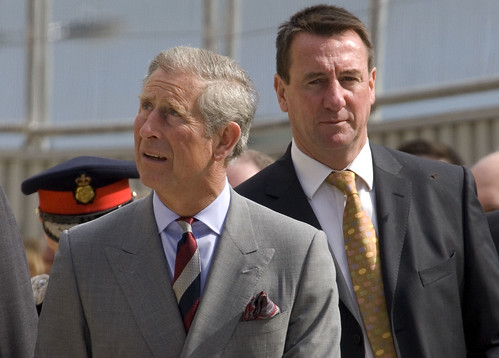
Prince Charles and the "Monstrous Carbuncle"

Earlier this week I was surprised to open the door and find a royal messenger holding a letter from Prince Charles. Of course I assumed it was my invitation to be knighted as “Best American Blogger in Britain,” but alas it was for my flatmate, who is head of the resident’s association in my building. That position probably doesn’t do much to account for why he gets letters from Prince Charles, but allow me to explain.

I live across from the Chelsea Barracks, a moderately-sized British army barracks that was sold and vacated last year. It now stands empty, with only two garish dormitory towers and a military chapel left as a reminder of its former use. The towers haven’t been torn down yet because of an ongoing conflict between the buyers - the Qatari royal family - and the neighborhood residents. Qatari Diar bought the property from the Ministry of Defence for £959 million, making it Britain’s most expensive residential development site in history at £70.3m per acre.

The Qataris have hired famed architect Richard Rogers to develop a modernist residential community that would be 50% affordable housing. The proposed projects would include tall buildings that would block the sunlight of neighboring buildings like mine (apparently the courtyard would be put permanently in shadow).

Earlier this year it was reported that Prince Charles wrote to Qatar Emir Sheikh Hamad bin Khalifa Al-Thani asking for Rogers’ design to be scrapped in favour of a more traditional scheme devised by classicist Quinlan Terry. Prominent London architects were outraged and called on the Prince to but out. But given that the site is right next to the Royal Chelsea Hospital and Sloane Square, many in this posh traditionally conservative area have been horrified by the though of a modern development towering over the venerable Chelsea.

The prince was then invited to speak at the to speak to the Royal Institute of British Architects last night, exactly 25 years after a highly controversial speech he made there 25 years ago blasting modern architecture and shooting down an idea to build an extension to the National Gallery at Trafalgar Square that resembled Paris’s Pompidou Centre. He famously likened the idea to seeing a “monstrous carbuncle on the face of a much-loved and elegant friend". That plan was scrapped quickly after those comments, and London modernist architects have never forgiven him for it. That’s why many were surprised that the Prince, who is often described as being inappropriately activist for a British royal, was invited back this year, and several architects boycotted the speech. You can judge for yourself in hindsight how a Pompidou Centre would have looked in Trafalgar Square.

This is where my flatmate entered the scuffle. Suspecting the Prince would make for a welcome ally in the residents' quest to stop the skyscraper development, so he sent him a letter. Surprisingly the prince wrote back quite fast, and the response came on Monday, one day before he was slated to speak to the institute. Though many thought he might take the opportunity of his speech to lambast the Chelsea Barracks development plan, we could tell from his letter on Monday that he had no such intention. The letter said that the prince's letter to the Qatar royal family was leaked to the press and was not meant to be public, and essentially that the prince was going to stay out of the controversy. Sure enough, last night saw a contrite, milder prince who even apologized for his remarks 25 years ago.

So, it looks like no prince ally for the Chelsea residents, at least not for now. And it remains to be seen whether the prince's contrition will heal his rift with the architects. But the war between classicists and modernists is far from over The modernists insist the classicists are trying to build fairy tale villages, and the classicists say modern architecture is cold and quickly outdated. Personally, I like them both.

As for the prince, he spent most of his speech actually railing about how new buildings should be eco-friendly. When it comes to pet issues, it's clear this "activist prince" moved on from architecture to climate change long ago.

Tuesday, 12 May 2009

Welcome to the New World of Eurovision

After a dramatic year of threatened boycotts, banned songs and host storm-offs, Eurovision 2009 in Moscow is at long last upon us. With a new voting format and a politically sensitive location, this Saturday’s finals could prove to be one of the more interesting in a long while.

Last year’s finals
in Belgrade were the last straw for many who had grown frustrated with tribal voting patterns that seemed to have completely shut out Western Europe from ever possibly winning the phone-in public voting final round. The Slavic countries of Eastern Europe have tended to vote for each other since they entered the song contest after the end of the Cold War, and for some this pattern explained why Russia’s sub-par entry-on-ice from Dima Bilan handily won last year (though admittedly none of the 2008 entries were very good). Long-time British Eurovision host Terry Wogan – a veritable institution for Eurovision in the UK - was so exasperated last year with the voting pattern that he quit his hosting job live on air!

The system’s critics alleged that the voting had turned completely political rather than recognizing “talent” (talent being a subjective word when it comes to Eurovision!). Its defenders argued that if Western Europe wanted to be competitive in the song contest again, it needed to field real entries rather than joke acts that seemed to deliberately mock the contest, such as Ireland’s singing puppet last year and Britain’s Scooch in 2007.

Fearing an eventual withdrawal of the founding Western European countries from the contest (which France, Germany, Spain and the UK do pay for after all), Eurovision has changed the voting format this year to be 50% from a public vote and 50% from a panel of music industry experts in each country. So, for instance, the winner of the UK’s vote package will be decided by a combination of the results of the public phone-in vote and the decision of a British music industry panel who are charged with disregarding the nationality of the acts and looking only at talent. We won’t know until Saturday whether these panels will also fall into patterns of national prejudice, but people seem to be confident that they won’t. This year the odds-makers have picked Norway as the favourite to win, with Alexander Rybak’s folksy song “Fairy tale”.

“We Don’t Want a Putin”

Of course last year’s voting patterns aren’t the only controversial aspect of this year’s contest in Moscow. Ongoing tensions between Russia and the west have made this year’s location uncomfortable to say the least. After Russia’s invasion of Georgian-occupied territory in August, several estates including Latvia, Estonia and Poland announced they would boycott the Moscow Eurovision. Since then they seem to have softened their stance, as they are all now taking part. Georgia was also supposed to take part, but their entry was deemed too political and was banned by the European Broadcasting Union, which runs the show. The song that won the Georgian finals, “We Don’t Wanna Put In” by Stephane & 3G, seemed to deliberately parody a popular pop song in Russia by The Putin Girls called “We Want a Man Like Putin” (no joke, watch it it’s hilarious). The Georgia song also contained the thinly veiled lyrics “We don’t wanna put in, the negative move, it's killing the groove” in the chorus. The ban on the song is the first time the EBU has ever blocked an entry to the song contest for political reasons. But it was clear the organisation was worried about offending this year’s host, especially when Putin himself may be in the audience.


Of course the publicity the song has received from the controversy is probably more valuable than actually appearing on Eurovision. The song is bizarrely number two in the UK's Music Week pop chart at the moment. It’s also getting radio play across Europe.

The Songs

It looks like Russia’s Channel One is pulling out all the stops for the Moscow show, which kicked off last night at Moscow's Manezh Exhibition Centre. Reportedly it’s going to be the most expensive show in Eurovision’s history, though the actual budget won’t be revealed until after. Comparisons are obviously being made to the over-the-top Beijing Olympics in China, another international showcase event by an emerging BRIC power.

As previously mentioned, the hands-down favourite this year with the bookies is Norway, but Greece, Turkey and Ukraine are considered to have a good shot as well. Much of the talent this year is made up of female ballad singers, and there is (sadly) little of the tongue-in-cheek camp of the past two contests. The UK’s entry, “My Time” is a light theatrical ballad penned by Andrew Lloyd Webber and sung by previously unknown Jade Ewan (though UK entrants are almost always previously unknown, and almost always still unknown afterwards!).

However on the continent they often field entrants who are already famous singers. France’s entry Patricia Kaas is a well-known Gallic chanteuse who has sold millions of records. Malta’s entry Chiara is a sensation in her home country and this will be her third try for the Eurovision crown (she narrowly lost to Israeli transsexual Dana International in 1998).

Beyond the ballad belters there are also a number of orchestral folksy entries. Front-runner Norway will have a set or violins, Estonia is featuring a six-piece female string group, and Slovenia even has a string quarter with barely any vocals. Sweden and Bulgaria are both featuring operatic singers.

After receiving much criticism for its puppet entry last year (it didn’t help that Dustin the Turkey puppet was featured as a mascot for the ‘no’ vote in the Irish referendum on the EU Reform Treaty),

Ireland has gone with a more serious entry this year with a girl rock band – who I saw perform at a Eurovision preview party in London a few weeks back and loved. Perhaps this year’s entrant is reflective of Ireland’s newly humble attitude toward Europe?

Sadly there’s only a few high camp entries in this year’s lineup. Turkey's entry “Dum Tek Tek” has been the most commercially popular, as it’s scantily-clad dancers were deemed “too sexy for TV” by Turkey’s authorities. Spain’s Soraya and Ukraine’s Svetlana Loboda will both feature scantily clad go-go boys (Ukraine’s was also at the preview – it was a little raunchy!). Strangely it is last year’s host Serbia that is providing the only comic entry, with an accordion-backed funny tale about materialism called Cipela.

The semi finals will be held tonight and Thursday, and the final will be held Saturday night, all at 8pm CET. The show airs in most every country in Europe on the national broadcaster, but sadly not in North America. But never fear, you can watch the show live on the Eurovision 2009 web page!

Thursday, 7 May 2009

The Greenest Way to Travel

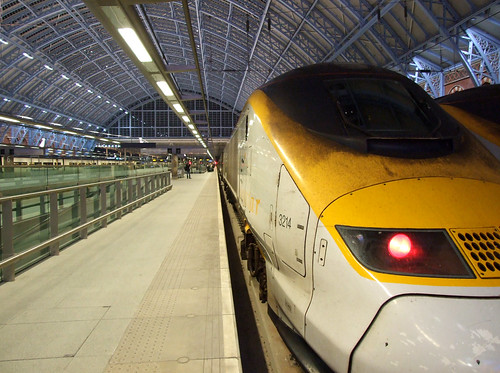
I’m on the Eurostar at the moment heading back from a few days working in Brussels, so I thought it would be appropriate to write about this news item I just saw come across my RSS feed. While airlines still struggle to find any way to reduce their carbon emissions, it seems Eurostar is achieving reductions at a remarkable rate. Last week it announced it has achieved its target of a 35% per passenger reduction in emissions (from a 2007 baseline) two years early, and has now lowered its 2012 target for emissions reductions.

The train company, which carries passengers under the English Channel between London, Paris and Brussels, credited increased passenger numbers, a switch to nuclear energy supply for the Channel Tunnel and a series of on-train energy efficiency measures with the early success of its Tread Lightly initiative.

The results were released in a new sustainability report which also featured the results of a survey of over 1,500 travellers in the UK, France and Belgium showing that demand for high-speed rail continues to rise sharply. More than 40% of respondents said they regard the environment as a priority when making travel decisions.

A journey on the Eurostar train generates just one-tenth of the carbon dioxide emissions of an equivalent flight, with a return journey between London and Paris generates 6.6kg of CO2 per passenger compared with 102.8kg per passenger by air. In fact Eurostar estimates that since the advent of the Chunnel Eurostar travellers have emitted an estimated 40,000 tonnes of carbon less than they would have if they had gone by plane.

Of course none of this takes into account the enormous convenience of taking a train rather than a plane. When I take the Eurostar I breeze into the station a cool 15 minutes before my train departs, and since I can leave and arrive in city centres there’s no time loss getting out to distant airports. Add to that avoiding the hassle of checking luggage and the low occurrence of delays, and I think it’s clear why I always prefer to take a train even if it will end up being longer than the air journey.

How do you say ‘high-speed’ in English?

Despite these enormous advantages, the fact remains that once I cruise into London at super velocity, that is where my high-speed journey ends. The UK has no true high-speed rail lines apart from the one coming from the continent, and even those high-speed compatible tracks south of London were just completed in 2006 (before then the Eurostar trains could only go at true high speed once they crossed into France). If I needed to continue on from London to cities as close as Manchester or Edinburgh the most efficient thing to do might be to take a plane. The fact that people are flying from Manchester to London is pretty absurd, but with the British rail system in a dilapidated and neglected state, there really isn’t any good alternative.

Even so, the trains across the pond in North America make the British trains look like marvels of modern technology. The rail network in the US has been largely abandoned, left to rot over decades as the government made a conscious decision to subsidize gas prices rather than invest in public transportation. There isn’t any proper high-speed rail line in the US - Acela in the northeast certainly doesn’t count, slower than a car at 60mph because of track limitations, costing about twice the price of a normal train just to save about 20 minutes.

Last month President Obama unveiled a plan for developing high-speed rail lines in ten travel corridors in the US as part of the stimulus package, a plan that would both create jobs and update the nation’s crumbling rail network. Republicans mocked the inclusion of high-speed rail plans in the stimulus, deriding it as a waste of taxpayer money. I don’t know how to explain that logic, but I do know that the reality is it will be many, many years before any of these project are ready and functioning. In fact it’s been estimated that it would take 20 years for the US to get to where continental Europe is today in the area of high speed rail. It would take less time in the UK, but it would still be a long wait. In fact just about anywhere where the population speaks English, trains are creaking along quite inefficiently. Yet whether it’s on a TGV, ICE, AVE or Thalys, You can go from Holland to Germany to France to Spain all at ground speeds of up to 200mph/321kph.

The fact is that air travel is a necessity in a globalized world, and it can’t be limited without a viable alternative. Such an alternative may not exist for long-haul flights, but one certainly does for short-haul flights, particularly for those in densely populated areas like Western Europe or the Northeast US. High speed rail may be expensive (around $20 million per mile), but as the Eurostar and other lines has shown, the project can easily make the money back, and saving thousands of tons in carbon emissions in the process.

Wednesday, 6 May 2009

Cameron Set to Leave Europe's Centre-Right

The European Parliament elections traditionally have a low level of interest in the UK, but David Cameron’s decision to form a new European grouping with far-right parties in Brussels may make next month’s elections a little more interesting.

The details are still being worked out, but it looks certain that Cameron will push ahead with a plan to take the Tories out of the European parliament’s centre-right grouping, the European People’s Party (EPP), and form a new eurosceptic party. The plan would unite the Tories with several far-right parties across Europe, one of which warns that homosexuality will cause the “downfall of civilisation.”

It’s a strange move considering that the Tories are not a far-right party but rather a centre-right one, and that some of the European parties they will be joining with more closely resemble philisophically the British National party (BNP) than themselves. It is even more strange considering the Tories are probably poised to take over the British government next year, and yet they are bolting from the EPP which is composed of the governments of Europe’s most important countries including the parties of Germany’s Angela Merkel and France’s Nicolas Sarkozy.

According to The Independent on Sunday, separation talks with the EPP have been completed and 20 MEPS from seven countries have signed on, giving the new grouping enough members to receive EU funding as a party. That grouping will include the Polish Law and Justice Party (PiS), the party of the infamous Kaczynski twins who until recently were president and prime minister of the country. That party has banned gay rights marches for being "sexually obscene” and a prominent member has warned that Barack Obama's victory would mean "the end of the civilisation of the white man". The grouping will also reportedly include a Latvian hardline nationalist party.

So what do all these parties have in common? Seemingly, only that they don’t think the EU should exist. The only problem is that Tory party is hardly of one mind on that subject. Cameron pledged to leave the EPP in his 2005 campaign for the Tory leadership, winning over the Conservative right wing and giving him the edge to defeat David Davis. So Cameron could be in hot water if he reneges on his promise. On the other hand many Tory MPs and MEPs are very worried about this decision to leave the EPP, fearing it will leave the Conservatives as an isolationist party outside the mainstream of Europe.

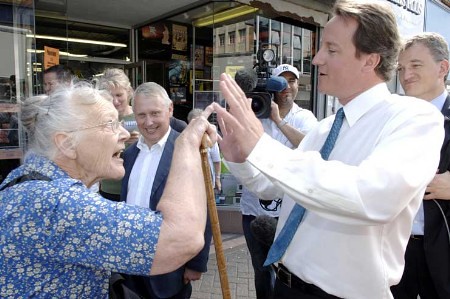
At the event launching the Conservative’s 4 June election campaign yesterday, Cameron was clearly trying to make the upcoming vote a referendum on Gordon Brown’s handling of the economic crisis. “With every Conservative vote, the message will be simple, 'Enough is enough - you're the past'," he sad at a community centre in north-east England, referring to Gordon Brown. "With every day that passes, this government is running our country into the ground. Borrowing eye-watering amounts of money, presiding over social decline, letting our politics descend into the quagmire.”

Labour would be wise to quickly educate voters about Cameron’s plans for the far-right European alliance, reminding them that though they may be dissatisfied with Labour, they may be cutting off their nose to spite their face by casting a vote that could indirectly create a new far-right block in Europe. However, considering the reticense of any British politician to talk about Europe (It was telling that Cameron’s speech today focused almost entirely on domestic issues in the local elections rather than the EP), I think it’s unlikely Labour will be able to get this message out clearly over the next month.

Tuesday, 5 May 2009

Weekend in Andalucía

This weekend was a bank holiday both in the UK and on the continent, putting me in the enviable situation of having a four-day weekend since I work for a London-based publication reporting on Europe (May 1st is May Day on the continent, but the UK always takes the first Monday in May off instead). I used the occasion to take a trip to Andalucía with my friend Lori, taking in the Costa del Sol, Malaga and Granada.

The region of Andalucía in southern Spain is stunningly beautiful, and steeped in history as it was the last bastion of Muslim power in Western Europe before the momentous conclusion of the reconquista in 1492. Having been under Muslim rule for about seven centuries, this fault line of Europe has historically been the stuff of legends. Moorish castles are scattered throughout the landscape and on the hills above the main cities, while the reconquista brought with it massive, intimidating cathedrals from the 16th century meant to show the Andalucians who the new boss in town was.

We started out our trip on the Costa del Sol, a stretch of beach south of Malaga made notorious over the past decades as a place for British tourists to get drunk and get sunburnt. Both of us being American, we were actually quite intrigued by the prospect of doing an authentic ‘Brits behaving badly’ beach trip on the continent, so we decided to stay in the town with the worst reputation for such things, Torremolinos. But perhaps because of the recession, of maybe because of the low value of the pound, we didn’t really get what we were promised. Torremolinos was actually rather quiet, filled mostly with Spanish elderly people rather than boozed-up Brits. In fact on Friday at the beach we didn’t even hear one British accent, the tourists that seemed to be most represented there were the French (French outside of France? This trip was blowing all sorts of stereotypes!). Friday night the Brits seemed to come out of the woodwork at the bars and clubs, but even then not until very late and there weren’t as many of them as we anticipated.

Analysts have been predicting that Brits will be taking fewer trips abroad this year, opting for domestic trips instead because of the collapse in the value of the pound. If our experience in Torremolinos was any indication, this seems to be in evidence. If this continues one wonders what will happen to places like this, towns whose economies depend on British tourism. Southern Iberia is to England what Florida is to the Northeast US (both in terms of tourism and retirees, and of course plenty of uninspired architecture, pictured right). What would happen if New York and Florida had different currencies and suddenly New York’s collapsed? It wouldn’t be good news for Florida retirement homes, I can tell you that!

Saturday we headed into Malaga, a city often skipped over by tourists but one with an equal amount of interesting Moorish history to its neighbours Granada, Seville and Cadiz. It’s actually the second largest city in Andalucía after Seville, and a very happening place in terms of nightlife. Malaga also has a Moorish fortress on a hill overlooking the city, but of course it’s overshadowed by the nearby Alhambra in Granada. Still, we decided to have a look at it as a little preview of the big cheese to the North. It does boast some spectacular views, especially of the bullfighting ring below (pictured left). It’s actually much older than the Alhambra, originally built in the 8th century during a brief period when Malaga was an independent kingdom, and then added to while it was part of the larger Kingdom of Granada.

Of course we couldn’t resist the siren song of the Alhambra for long so that night we took a bus up to Granada. There are definitely two very distinct sides to Granada. When we arrived Saturday evening it seemed as if there was no one in the city over 25. It’s a big university town, and as we walked around we just saw hordes of college-age kids messing about. It was funny because we went from feeling very young in Torremolinos to feeling very old in Granada.

However the next day it was like an entirely different city. Sunday happened to be the Festival of the Crosses, when crosses made of different materials are displayed around the city and the women all wear their traditional Sevilliana (flamenco) dresses. It was definitely a very atmospheric time to be there. Walking around the narrow steep streets of the Albaicin, the city’s old Moorish quarter, hearing flamenco guitars and seeing women dancing with castanets to celebrate the holiday, was a bit surreal. We then headed to the gypsy hill, where flamenco dancers still perform in caves where many of the gypsies live.

Then it was time for the big cahuna, the massive Alhambra palace perched above the city. The complex is one of Europe’s most famous attractions, composed of an original 11th-century fortress at the front called the Alcazaba, a sumptuous palace that was home to the Nasrid rulers of Granada, opulent gardens stretched across a Cliffside, the remains of a large town within the fortress that once contained 40,000 people, and finally the anachronistic palace of Charles V, built by the grandson of Isabella and Ferdinand when he thought he would make Granada the capital of the newly united Spain (he changed his mind and moved to Valladolid, leaving the palace unused). Hugely important things happened at this palace. In the throne room in the Nasrid Palace, the last Sultan of Granada, Boabdil, held tense negotiations with the Catholic monarchs Ferdinand and Isabella. In the end the Catholic monarchs triumphed and the Christians took the fortress, the last bulwark of Islam in Western Europe, displaying the Christian flag from the bell tower at the top of the Alcazaba to signal the defeat.

Perhaps the most thrilling site in Granada for me though was the burial chamber of Ferdinand and Isabella in the cathedral (pictured right). Astonishingly the two monarchs are interned in simple lead coffins in a small space, along with their daughter (Juana the mad) and her husband Philip the Handsome. Above the tomb massive stone funerary effigies of the four of them can be found, but amusingly the one for Philip and Juana are much bigger than that for the far more famous Ferdinand and Isabella, because it was built during the rule of Charles V who was eager to establish the legitimacy of his parents. Buried here are two of the most important couplings in European history, linking the four most powerful dynasties of Europe at the time (Burgundian Valois, Habsburg, Aragon and Castile) and creating a Habsburg empire that included parts of modern-day Spain, Portugal, Austria, Czech Republic, Hungary, Italy, Germany, France, Belgium, Netherlands, Mexico, and Peru. It's amusing that the four of them are buried together, considering they all hated each other and at various times tried to have one another killed or imprisoned. And you thought you had family drama!

All in all it was a good trip, and the weather was amazing. It was a bit of a bummer stepping of the plane to a cold and rainy London. I’ll be working in Brussels the rest of this week though, so it’s just a brief stopover in Londontown really!