Wednesday, 23 September 2009

Angry Europeans and Embarrassed Americans in New York

There's no doubt about it, this week's UN climate change meeting in New York has been a humbling experience for America. Being shown up by China in the field of environmental protection isn't exactly a shining moment for the US, but it may be a harbinger of the century to come.

European diplomats at the summit are reportedly seething at US inaction, and their reaction to Obama's almost completely substanceless speech yesterday was nothing short of incredulity. But with the climate bill stalled in the US senate and the healthcare fight likely to push it off the agenda until after the hugely important Copenhagen summit in December, Obama's hands are tied. With no climate bill passed by December, the US will likely not be able to commit to the post-Kyoto framework being worked out at the December summit, considered by Europe to be the "last chance" to save the world from the effects of climate change. Though just a year ago it was thought India and China would be the biggest obstructionists to reaching a global agreement, this week it has become clear: the US may be the lone force standing in the way of fighting climate change.

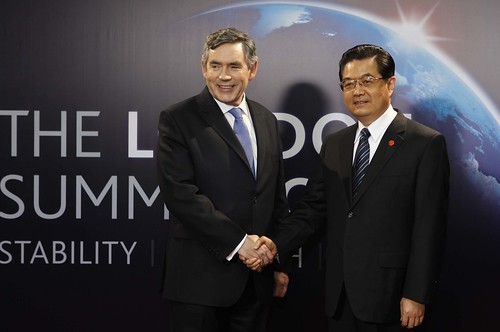
China, on the other hand, unveiled some big commitments this week. Yesterday China's President Hu committed China to getting 15% of its power from non-fossil sources by 2020, planting enough forest to cover an area the size of Norway and limiting the growth of carbon emissions as a percentage of the country's gross domestic product. I'm also hearing word that today at 2pm there will be an announcement at the New York Stock Exchange that China will launch a carbon valuation system called the "Panda Standard", where companies have a certain carbon allowance and can buy or sell credits as they need to. I've even heard that this announcement later today by China may be followed by an announcement setting up a Chinese cap and trade system like Europe's Emissions Trading Scheme (ETS). I would be truly shocked if they do announce that, but if they do it would be hugely embarrassing for the US, which still has no cap and trade system or even a voluntary standard.
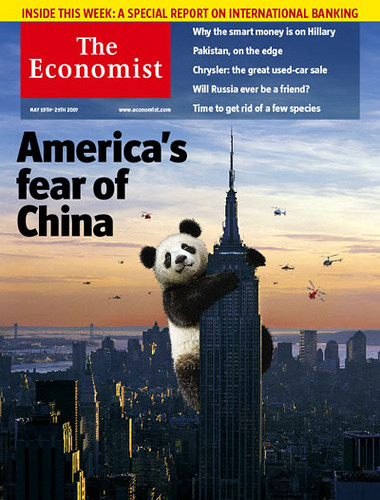
Once the Chinese government became convinced of the reality of climate change about a year ago, they have acted dramatically and rapidly with new environmental measures that now put them ahead of the US in several ways. They’ve restructured their development plans to cut down on high-emissions projects, and within two years they have phased out 54 million kw of coal-fired power capacity by small polluting power plants. Last year the issued new rules on the construction sector for the use of renewable products. They’ve poured money into the development of public transport and the promotion of environmentally-friendly vehicles. Also last year the government ordered retailers to stop providing free plastic shopping bags. China now has the world’s largest hydropower generating capacity and is currently the fourth largest wind power producer after the United States, Germany and Spain – and it’s catching up quickly. Last year renewable energy accounted for about nine percent of the country's energy total, surpassing the US.

Of course, with a top-down command economy China can afford to do these things at this speed. As Thomas Friedman has lamented, if only the US could be "China for a day". But no matter how they've attained these rapid results, the Chinese are putting the Americans to shame.

Needless to say with all the hope that was placed in Obama by Europeans, this has been a disappointing day across the pond. Newspapers over here have been questioning Obama's ability to deliver on climate change, with one particularly scathing article from the Guardian called 'Obama the Impotent' making the email rounds. The Guardian writes:
"On the campaign trail, Barack Obama promised to reverse the Bush administration's terrible ecological record. Yet so far the world has seen more symbolic gestures from the Obama administration than accomplishments. Its biggest achievement so far has been a disappointment. President Obama signed an executive order to increase US motor vehicle mileage standards – but only to a level that will push fuel efficiency by 2020 to a level that European and Japanese cars reached several years ago, and even China has already achieved."
However one consistent theme has been that the European papers are not blaming Obama himself for the inaction, but rather the government system he has the misfortune of having to lead. Writes the Guardian:
"Thwarting Obama on a regular basis is an unrepresentative senate where "minority rule" prevails and undermines what a majority of the country may want. With two senators elected per state, regardless of population, California with more than 35 million people has the same number of senators as Wyoming with just half a million residents. This constitutional arrangement greatly favours low population states, many of which tend to be conservative, producing what one political analyst has called "a weighted vote for small-town whites in pickup trucks with gun racks."
It should be no surprise that China is beginning to surpass the United States in several ways, after all this is slated to be the "China century," which will see a return to a two-superpower world with the US and China competing for power. But the fact that China is now surpassing the US in the fight against climate change should be a big wake-up call to Americans, especially liberals.

Monday, 21 September 2009

Bankers Beware: Brussels to Reveal Pan-EU Regulator

One year after the meteoric collapse of Lehman Brothers, both Washington and Brussels are preparing to unveil massive regulation overhauls that, if they come to pass, will have the extraordinary effect of putting the world’s entire financial system under the thumb of two powerful – and competing - regulatory regimes.

So far both America and Europe have failed to institute meaningful reform to the financial system that would prevent a similar financial collapse from happening again. This was almost painfully evident during President Obama’s stern speech to Wall Street last week on the one-year anniversary – full of tough words but backed by little action taken in the past year to better regulate American financial institutions.

This reality was angrily pointed out by some American commentators, who said that a regulatory overhaul should have been made central to the massive bail-outs a year ago. The Obama administration counters that regulatory reform at the height of the crisis would have destabilized a system already on the verge of collapse. This situation has been mirrored across the pond, where both national governments and the EU have resisted making significant regulatory reform so far.

But now it is clear that the financial sector is once again on stable ground. Whether this is a direct result of the massive cash infusion it was given over the past year is debatable, but given the windfall profits and massive bonuses that have begun to creep back in, it’s no longer tenable to argue that the sector is too fragile to introduce massive reform. It appears the Obama administration is set to introduce its overhaul in the coming weeks. Across the pond, it appears some consensus has finally been reached in order to create financial regulation at the EU level. If the plans come to pass it would mean that just two centralized, powerful regulatory regimes would govern basically the entire world’s financial sector, which would mean that the laissez-faire days of Anglo-Saxon capitalism are a thing of the past.

The EU proposal that will be unveiled on Wednesday will reportedly create three new supervisory authorities in the areas of banking, insurance and securities. The new authorities would supervise financial institutions and step in during emergency situations to take urgent action. They will reportedly have the power to shut down Europe’s stock markets during a crisis. The new authorities would also be able to rule on disputes involving financial institutions that operate across EU internal borders. For large recapitalisations or bail-outs, the decision would come directly from the European Commission by a simple majority vote of commissioners.

The UK has been the biggest objector during these negotiations, but reportedly they have been satisfied with a compromise deal that would require that member states be allowed invoke a clause taking that voting decision instead to the council, to be voted on by member states’ finance ministers, by a qualified majority vote.

Eventually the authorities will draw up themselves technical standards to be applied throughout the EU, which all EU and EEA financial institutions would be required to follow. The commission would then have to approve these standards. The purpose of this standardisation is to make sure everyone is playing by the same rulebook and that companies no longer have to spend millions on compliance efforts across different regulatory regimes in Europe.

A separate European Systemic Risk Board will also be created, according to EUObserver. That board would watch the financial system for risks or problems, and it can issue warnings early when it identifies problems.

Significant details of the Obama administrations plans for a regulatory overhaul have not yet emerged, but if they are as ambitious as these Brussels plans, the world could be looking at a very different regulatory environment in the near future.

Thursday, 17 September 2009

Obama Throws the Russians a Bone

In a major foreign policy move, President Obama announced today he is abandoning the Bush Administration's missile defence system plan for Eastern Europe. The plan, which would have seen long-range missiles installed in Poland and a radar system in the Czech Republic, had infuriated Russia, who saw it as a direct threat. The Bush administration had always insisted it was not meant to threaten Russia but rather to defend Europe from rogue states like Iran, but this seemed dubious to the Russians considering that the missiles themselves would have been pointed at Russia, been far more powerful than needed to take out the small-arms capability of Iran, and were to be placed just a few miles away from Russia’s border.

Obama said today that after a thorough review of the program he had decided that a more “cost-effective" system using land- and sea-based interceptors would be better suited to Iran's short- and medium-range missile threat. Though the administration stressed that this decision is “not about Russia”, the reality is that it largely is, and that’s not necessarily a bad thing. While it is true that the system Bush planned to install seemed geared more for the Cold War than for the realities of modern dangers, it is also true that it was proving to be a huge obstacle in US-Russian relations. Considering that those relations are in desperate need of improvement in order to have a peaceful world, dismantling this plan could be good for America’s security in more ways than one.

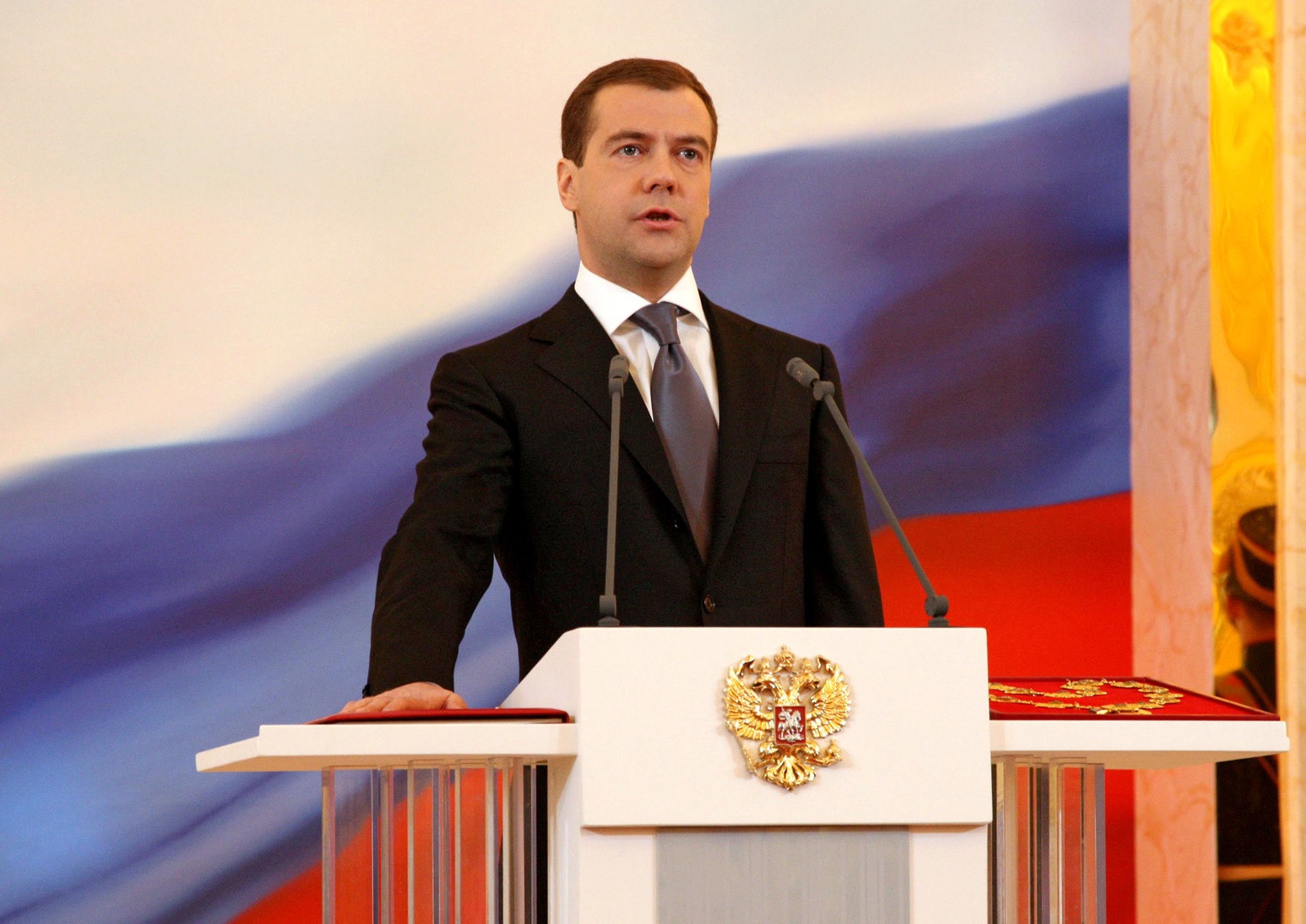
Shortly after Obama was elected Russia had made a bold move showing that they were serious about their objections to the missile system. President Dmitry Medvedev delivered a speech the day after the historic election saying that if the missile shield were installed Russia would install short-range missiles just off the Polish border in its territory of Kaliningrad, in response to the US "provocation." All indications were that they were serious about this threat, and the resulting tit-for-tat could have resulted in a missile defence arms race that no one wants to see.

Reaction from the American right was predictable, decrying Obama for “selling out” American allies (the narrative for the right seems to be that he is a lilly-livered coward abroad while being some kind of Hitler like tyrant at home). But reaction from the international community, and from Russia in particular, reflected a collective sigh of relief. Russia's ambassador to NATO called it a “breakthrough" for US-Russian relations, saying that with this obstacle removed the two countries could move ahead with talks about reducing their nuclear weapons stockpiles. NATO Secretary-General Anders Fogh Rasmussen said it was "a positive step", reflecting the fact that few in Europe were excited about this system which was ostensibly meant to protect them. The missile defence system, after all, was going to outside the scope of NATO and completely US-controlled.

And the conservative governments of Poland and the Czech Republic who had agreed these deals with the Bush Administration, although surely disappointed, were muted in their reaction. The Czech public on the other hand have expressed elation today, as the plan was very unpopular there. The Poles were more mixed in how they felt about the plan, but my Polish friend tells me the media reaction there so far hasn't been too dramatic.

So was this a big concession to Russia? As the title suggests, it was a 'bone', an easy gesture to make considering it wasn't in US defense interest to have it anyway. Essentially no one, including the US military, thought the missile defense system made any sense except the American and Polish right-wing. Iran does not have the capability to deploy or make long-range missiles, and it's never been proven that these systems being installed actually work. As Joe Cirincione told MSNBC last night, the Bush Administration was installing "a technology that doesn't work against a threat that doesn't exist".

Of course the missile defence system has just been one aspect of American foreign policy that Russia has seen as a provocation by the US. They've also seen US invitations to the nations of the caucasus and Central Asia to join NATO as an anti-Russian provocation. It's doubtful Obama will recognise the "Soviet sphere of influence" Russia is trying to claim, nor will he rule out the possibility of these nations joining. But he is unlikely to persue the NATO-expanding policy with the same irresponsible gusto that the Bush Administration did. That gusto was largely to blame for the Georgian War, an entirely avoidable conflict brought on by Georgia misinterpreting Bush's neocon rhetoric for actual promises of future military assistance.

So it seems as if everyone is happy with this announcement except the American Neo Conservatives. And as the never-confirmed limited-term ex-UN ambassador John Bolton makes the rounds today describing this as “a concession to the Russians with absolutely nothing in return” (I’ve never seen anyone get so much media exposure for themselves out of such a limited public career) you have to wonder what decade he’s living in. Altering this plan will result in a more cooperative Russia and probably in the long run a more logical defence capability for the United States.

Wednesday, 16 September 2009

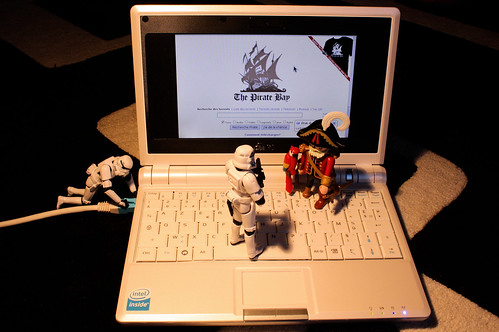
Move over Somalia, Sarko's after the cyber-pirates Now

My twitter erupted with activity yesterday as news spread that the French lower house had at long last passed the much-maligned Hadopi bill, the hugely controversial legislation that would ban people from using the internet if they are caught repeatedly downloading files illegally.

This was the third attempt to pass the measure, but the third time was the charm and since it’s already passed the French senate, Sarkozy’s piracy-busting measure will now become law. It will be the toughest anti-internet piracy legislation in the world. The slow journey of this legislation has been closely watched by other European countries and now that the precedent has been set, they will now likely enact their own similar laws.

The bill, named after the new anti-piracy government agency it will create, would permit authorities to impose a variety of penalties on people caught downloading illegally including cutting off their internet connection for a year, imposing fines of hundreds of thousands of euros, and even jailing them for two years.

It’s Official – Five More Years of President Barroso

It’s unusual for an EU commission president to serve more than one term, and many in the parliament and member states opposed him. So how exactly did the former Portuguese prime minister squeak by on re-appointment to the EU’s highest office today?

The short answer is, there wasn’t really any alternative.

Barroso is from the centre-right European People’s Party (EPP), which currently has a majority in the European Parliament and the leadership of most EU member states (including Germany, France and Italy – and though the current British government is not technically centre-right, Brown strongly supported Barroso’s re-appointment). Still, there was great concern about his re-appointment resulting in a “lame duck” commission presidency for the next five years.

Barroso’s first term as president of the EU’s executive body has been fairly lacklustre, having overseen the defeat of both the EU Constitution and the Lisbon Treaty (although the latter will likely soon pass in the Irish re-vote next month). Many have accused him of not having a “grand vision” for Europe, or even a cohesive idea of where the union should go. His tenure has been marked by a drift into Euro-stasis, a paralysation over the past five years that stands in marked contrast to the gung-ho attitude in Brussels before his tenure at the turn of the millennium.

But the fact that he was re-appointed handily despite all these misgivings (he was even able to obtain an absolute majority of 389 votes today – a big triumph for him) shows just how severe the Brussels leadership crisis is. Despite their intense opposition to Borroso’s re-appointment, the Socialists failed to come up with any candidate to oppose him. No candidate emerged from those who had misgivings on the right either, though France’s prime minister did seem to be toying with the idea for a bit earlier this month.

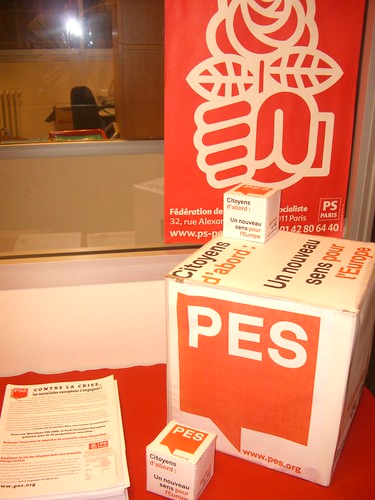
Immediately after the vote the Party of European Socialists (PES) issued this press release saying that as the second largest block in the parliament, they will insist on being given one of the “three key EU posts”. By that they appear to mean the Commission President, the High Representative (which will be empowered by the Lisbon Treaty) and the Council President (a post that will be created by the Lisbon Treaty).

But considering that they weren’t even able to field an opposition candidate for the commission presidency, who exactly are they thinking they could field for the first “president of Europe”? Tony Blair has been floated as an idea, and as a Labourite he is technically in the PES. But considering his support for the Iraq War and his role as a champion of free-market Anglo-Saxon economics, its doubtful continental PES members would be too pleased with this choice.

If Barroso’s second term does indeed turn out to be a “lame duck presidency” it will be interesting to see how this affects the development of the two new positions created by the Lisbon Treaty. Both of them have been really vaguely defined, and their remit and power will be largely shaped by their first holders. If the offices are held by two socialists in opposition to a weak or irrelevant Barroso, it could have the effect of strengthening the Council at the expense of the Commission. This could go some way in satisfying those who complain about Europe’s “democratic deficit”, as the Commission is an unelected institution.

Wednesday, 9 September 2009

New Photography page

I've updated my portfolio website with a better photography section, revamping the creaky old interface that I hadn't updated since 2003 and replacing it with a picasa album that's more focused on my travels. Picasa lets you geo-tag the photos on Google Earth which I really like, tagging them all this week was like a little trip down memory lane. Check it out if you like,
http://picasaweb.google.com/DavidKeating