Following the whirlwind events of this week, Scotland now appears to be closer to secession than it has ever been in the 300-year history of Great Britain. This week the first minister of the devolved Scottish Parliament set a date for the first referendum on Scottish independence in history. And according to polling, if the referendum were held today, Scots could very well vote to separate from the United Kingdom.
The discussion of secession has been hanging in the air for some time, ever since the secessionist Scottish National Party won a majority in the Scottish Parliament in 2007. But now with an independence referendum date set, discussion has turned for the first time toward the real practicalities of what a split would entail and the difficult questions it would present. Who does the oil in the UK's territorial North Sea waters belong to - Britain or Scotland? Who would be on the hook for the massive bailouts of Scotland's two banking giants in 2008? Would Scotland use the British pound, the euro, or a new Scottish pound?
Scottish First Minister Alex Salmond took the decision in response to a call from UK Prime Minster David Cameron to call a referendum, which the SNP had promised in their election, now. London knows that with the current economic crisis, Scots would be unlikely to be very brave at the polls. But Salmond balked, saying he would not take orders from London and setting a referendum date in 2014.
EU complications
Though there have been a lot questions asked in the British media today about what secession would mean, as far as I can tell not a lot of thought has gone into the EU implications of all this. Everyone has been asking whether or not Scotland would choose to use the euro. But there's a leap being made there. In order to use the euro, Scotland would have to be part of the EU. That is not up to them, it is up to the 27 member states. And there are plenty of member states with good reason to block Scotland's entry.
Wednesday, 11 January 2012
Friday, 6 January 2012
Azerbaijan could make this an awkward year for Eurovision
It’s a new year, and of course this week everyone’s minds are on one thing – Eurovision 2012! Ok maybe not, but an interesting article in Der Speigel this week details the way in which Azerbaijan is already engaged in a public relations push ahead of their turn to host the world’s largest non-sporting television event in May of this year.
Azerbaijan will host the contest because they won last year. But there are concerns that this could be one the most problematic year in the show’s 56-year history because of the human rights record and military conflicts of the host country. Seemingly aware of this less-than-stellar reputation, the Azerbaijanis have reportedly stepped up a charm offensive in the core members of the European Broadcasting Union – Germany, France, Spain, Italy and the UK. Of course this is all part of a larger charm offensive by the oil-rich country, particularly as the Nabuco Pipeline project moves forward.
But could this year’s contest highlight the awkward relationship between the oil-hungry West and this autocratic regime? Or, as many argue, will an international event like this help to bring Azerbaijan more into line with the West and with Democratic principles? I suspect it may be the former. Even as Azerbaijan pursues its charm offensive, there are reports circulating that they are evicting Baku residents in order to build the 25,000-seat arena that will house the show this year.
Wednesday, 4 January 2012
Is Iowa the problem, or is it the primary system?
While I was home in the US over the past few weeks I witnessed the quadrennial spectacle of the Iowa caucuses - shivering reporters in front of the capital dome in Des Moines, candidates eating corn on the cob while clutching plump cord-fed babies, the usual fare. And I was also able to witness the quadrennial griping about why the United States allows “a few hundred farmers” to pick its president.
The complaining about the Iowa caucus, where the first nominating primary for both political parties’ presidential candidates is held, is both predictable and legitimate – even if the language used sometimes smacks of regional snobbery. The Iowa caucus makes or breaks politicians running for the presidency. Barack Obama owes his presidency to winning the Iowa Democratic caucus in 2008. This year, the result of the Republican caucus will force Michele Bachman and Rick Perry to drop out of the race. And the Iowans have elevated Rick Santorum from obscurity to be the main challenger to frontrunner Mitt Romney.
But the Iowa caucus is a big deal only because it is first. And being first means presidential candidates promise Iowa all sorts of lovely things (just look at the corn subsidies of the past four decades – and you wonder why Americans have corn syrup in most of their food for no reason?). The Iowans go through outrageous lengths to make sure they are first. When South Carolina and New Hampshire tried to move their primaries ahead of them this year, Iowa moved theirs to the earliest possible day in 2012 – 3 January.
This year the criticism went perhaps a little too far. A professor at the University of Iowa (himself a transplant from New Jersey) wrote a column for The Atlantic about a much-asked question – why should a state that is not ethnically or ideologically reflective of the country as a whole be given such a prominent role in selecting the nation’s president? But he asked it in a way that was incendiary to say the least, calling Iowa a place that's "culturally backward" and teeming with "slum towns”, where the 96% white population “clings to guns and religion.”
Location:
Des Moines, Iowa
Tuesday, 3 January 2012
Protest over Ikea meatballs - welcome back to Absurdistan
I’m back in Brussels after spending the Christmas break home in the US. It was yet another trip where I spent most of the time regaling people with the insane stories of the strange place I now find myself living in. I’m pretty sure most of my American friends think I’m making this stuff up. I only wish.
After describing the impromptu general strike three days before Christmas which forced me to pay $500 to rebook my flight home, I moved on to describing to my friends the other union strikes I have witnessed since moving here. From the impromptu metro driver strike that was called after a driver claimed he was punched by a passenger (it turned out the driver had punched the passenger) to the October garbage strike in which the garbagemen went around town lighting the trash bags on fire and throwing them into the street, there’s plenty to describe. And let's not forget the time the taxi drivers blockaded Brussels Airport because an unlicensed taxi driver had been grazed by a bullet while he fled from police during a high-speed chase.
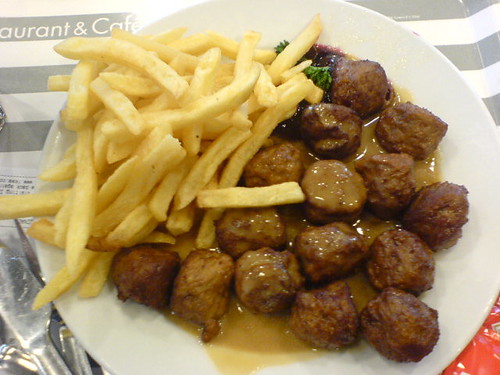
Today I learned about a whole new anecdote of insanity I could have described to my perplexed American friends. According to this story by Belgian news station RTL, the restaurant owners association in Belgium (Horeca) is busing homeless people to Ikea as a protest against their low meatball prices. When I first saw this story I assumed it had to be a joke. Clearly I’ve been in the US too long! Because I forgot that when you hear about something this absurd happening in Belgium, it’s probably true.
Friday, 16 December 2011
An itinerant decade
I came to a startling realization yesterday. 2011 will be the first year in a decade that I have not moved to a different city during the course of the year. Since 2001 I have packed up and moved to a new city at least once each year. And there has actually never been a year in my adult life where I haven’t moved to a new apartment! 2001 and 2011 have the exception of being years where I moved to a new apartment, but in the same city. I say ‘startling’ because it’s a kind of bizarre way to live one’s life, constantly moving to new cities. Of course not all of those moves were to unfamiliar cities I had never lived in before – a lot of this was moving away from New York, then returning, then leaving again. But now that I’ve managed to stay in one city for an entire calendar year, does it mean I’m settled here in Belgium? If it does, I don’t feel it. I’m in a good place in my life here – I’m enjoying what I’m doing, have an interesting job, good friends and a good apartment. So I think I’ll be here at least another couple years. But could I live the rest of my life in Belgium? Absolutely not. So when will I know when it’s time to leave?
Wednesday, 14 December 2011
This isn’t about the UK any more
The markets have returned to panic mode today as their confidence in national governments to approve the new Eurozone financial consolidation treaty wavered. Ratification has hit some bumps in the road, with Finland’s prime minister expressing dissatisfaction with the transfer of authority over national budgets to the EU on Tuesday. In Ireland, the opposition parties seem keen to force a referendum on the issue even if the country’s legal services rule that one is not required.
The euro fell below $1.30 today, its lowest point in a year. Yields on Italian bonds widened to new highs. It’s a familiar pattern we’ve seen repeated several times now: markets rally upon news of a new European Council agreement, but then crash a few days later when they look at the details and realise it’s not as strong as they’d hoped. The UK's abandonment of Europe may have been the big story on Friday, but now the more important story sets in - the markets have not been satisfied.
But there seems to be some confusion in the British media though about what this all means vis-à-vis the UK’s decision to veto the attempt at treaty change on Friday. The Spectator has run a column from the Eurosceptic think tank Open Europe scolding the British media for describing the UK as isolated as a result of the 26 vs. 1 outcome last week. There isn’t really any such divide, Open Europe insists, because many other member states support the UK’s reticence. As evidence that all is not what it seems, they run through the list of objections to the new treaty being expressed in national capitals this week.
Subscribe to:
Posts (Atom)