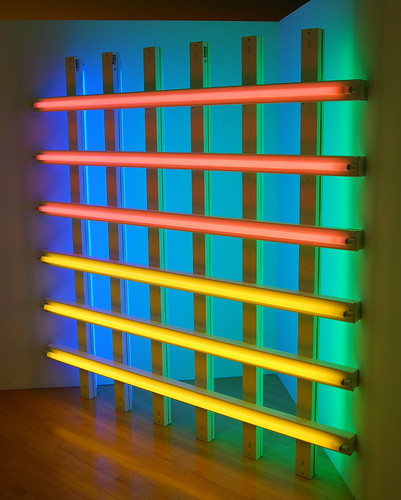
The art world is all aflutter this month after word got around that the European Commission has decided that a light installation by Dan Flavin that was on display in a London museum cannot be considered "art".
Back in 2006, an oddly-named London modern art gallery called Haunch of Venison decided to display Flavin's 1973 work Six Alternating Cool White/Warm White Fluorescent Lights Vertical and Centred along with Bill Viola's 1995 work Hall of Whispers. Both of these works had to be imported from the United States. They were shipped with the customs classification of 'works of art,' which benefit from a special EU value-added (sales) tax of 3.7%.
But when the works arrived at the UK border, Her Majesty's Revenue and Customs decided that the assortment of fluorescent lights and projectors that made up the installations were not art but rather light fittings and audiovisual equipment. They were charged the normal tax rate of 17.5%. But bizarrely, while classifying the materials as 'not art' for the purpose of their tax rate, they decided to assess the value of the components based not on their worth as light fittings and video equipment but on their market value as works of art - a huge amount of money.
Thursday, 27 January 2011
Monday, 24 January 2011
Irish government falls
Ireland is set to be the first country to see a government fall as a result of the eurozone crisis, following yesterday's announcement by the Green Party that it is deserting the governing coalition. The news has thrown Ireland into political turmoil as politicians tussle to set the date for an election whose result will be anything but certain.
In a hastily arranged press conference yesterday the leader of Ireland's Greens, an environmental party, said there had been a "breakdown in trust" between the two parties and the Greens patience had reached an end. The ruling Fianna Fail party, which has governed Ireland almost continuously since 1987, failed to get an outright majority at the last general election in 2007 and so formed a coalition government with the Green Party to put them over the edge.
But the government has been under fire over the past year because of its handling of the debt crisis. The Irish public largely blames Fianna Fail not only for presiding over the boom period of heavy borrowing and the housing bubble, but also for its decision to bail out the Irish banks by guaranteeing their holdings and for accepting an EU bailout fund with strict conditions attached. The pressure became so acute that on Saturday Prime Minister Brian Cowen (pictured above) resigned as leader of the party, though without resigning as the prime minister - a situation highly unusual in a parliamentary democracy. Apparently this was all too much for the Green Party, which announced it was bolting just 24 hours later.
In a hastily arranged press conference yesterday the leader of Ireland's Greens, an environmental party, said there had been a "breakdown in trust" between the two parties and the Greens patience had reached an end. The ruling Fianna Fail party, which has governed Ireland almost continuously since 1987, failed to get an outright majority at the last general election in 2007 and so formed a coalition government with the Green Party to put them over the edge.
But the government has been under fire over the past year because of its handling of the debt crisis. The Irish public largely blames Fianna Fail not only for presiding over the boom period of heavy borrowing and the housing bubble, but also for its decision to bail out the Irish banks by guaranteeing their holdings and for accepting an EU bailout fund with strict conditions attached. The pressure became so acute that on Saturday Prime Minister Brian Cowen (pictured above) resigned as leader of the party, though without resigning as the prime minister - a situation highly unusual in a parliamentary democracy. Apparently this was all too much for the Green Party, which announced it was bolting just 24 hours later.
Sunday, 23 January 2011
Belgian shame rally: can ideology be fought with neutrality?
Today more than 34,000 Belgians marched in a demonstration across Brussels demanding that the country's bickering politicians reach a compromise in the ongoing talks to form a government. Belgium has been without a government for 224 days now, the longest government-less period for any European country since the end of the Second World War. As the political crisis continues with no end in sight, there are increasing worries that this could finally be the end of the line for this country, which may be on the verge of splitting into separate Dutch-speaking and French-speaking halves.
I was out at the "Shame Belgium" march today and I was impressed by the very large turnout. It was particularly notable because the demonstration was not organised by unions or political parties, as is usually the case, but rather by a group of five young people via Facebook. The demonstration had no political or regional allegiance - organisers even said it didn't even have an official unionist or separatist stance. In fact the organisers even discouraged people from bringing Belgian flags, though clearly everyone chose to ignore that advice. The stated purpose of the rally was simply to demand that the politicians urgently get on with their negotiations to prevent the country descending into crisis.
Friday, 21 January 2011
Germany ends the draft
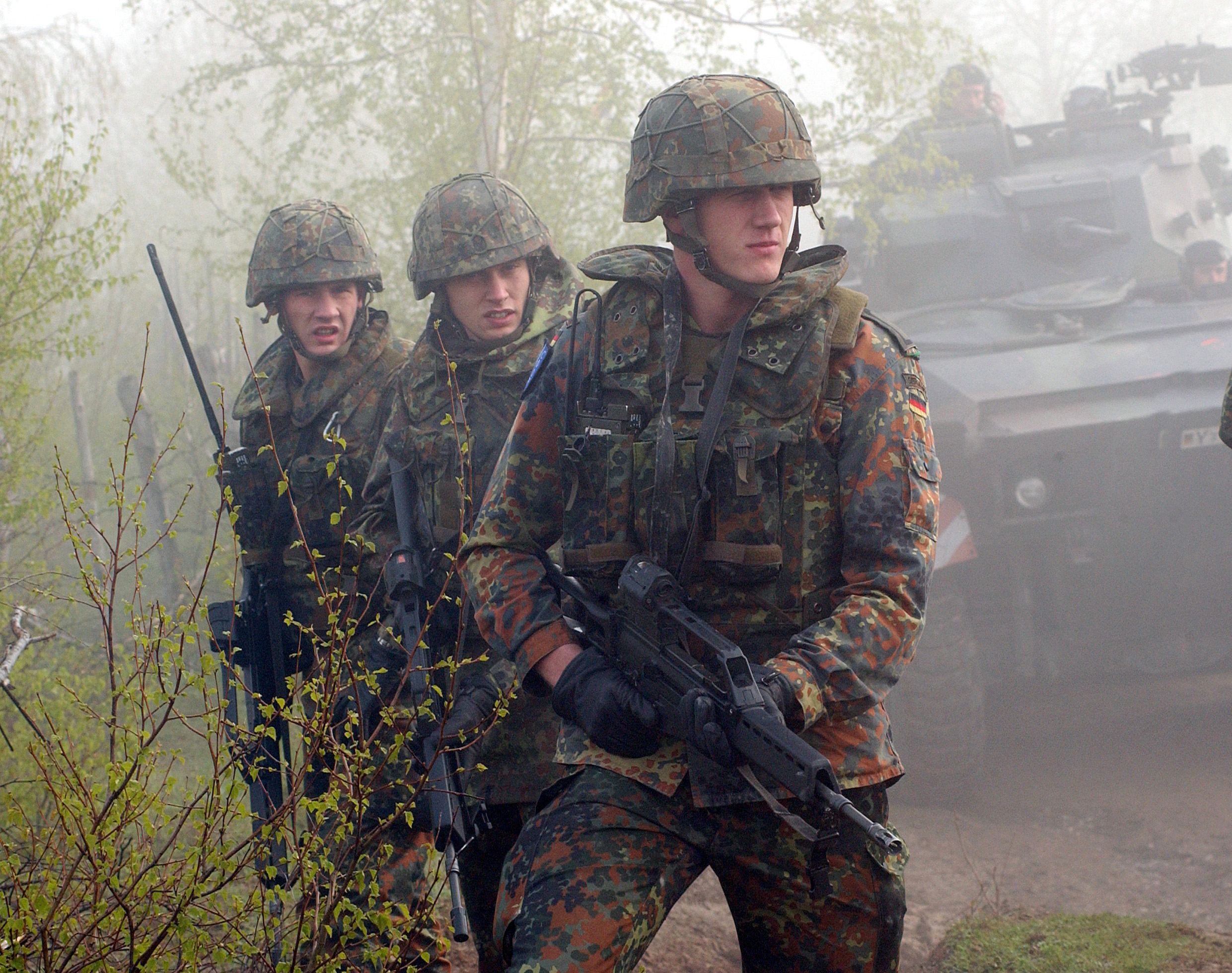
This month, with little fanfare, Germany saw the end of the military draft that has been in place since the end of the second world war. German commentators seem to be having a mixed reaction - with some saying it will end an era of shared service that will be replaced by an army where only the poorest and least educated serve. On the other hand others have said the change was long overdue, and that such a draft, particularly in modern pacifist Germany, was an antiquated idea and a perverse violation of individual freedom.
Conscription was introduced in West Germany in 1957 in an effort to ensure that the military could never again become an elitist 'state within a state' with its own political power, as existed during the Nazi period. If the military was made up of all different types of citizens – regardless of social class, ethnicity or political affiliation – it would become an extension of the state that couldn't be turned against the state (or any segment of its population).
Thursday, 20 January 2011
EU targets Europe's last dictatorship
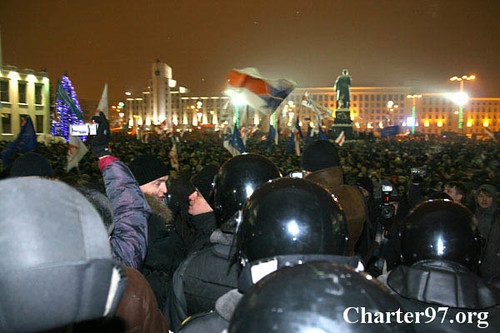
The EU is threatening to cut off relations with its Eastern neighbour Belarus and impose a travel ban on its leaders following a brutal crackdown on dissidents in the country during a rigged election last month.
It is perhaps the most crucial test of will yet for the EU's first foreign affairs chief Catherine Ashton, who is expected to issue an ultimatum to 'Europe's last dictatorship': release the political prisoners arrested during the election or fact a travel ban in the West. She will push EU foreign ministers to adopt the travel ban on 31 January, and all indications are that they will all comply. The US may then follow the EU's lead with joint sanctions.
Today the European Parliament adopted a resolution calling for the EU to impose a travel ban and asset freeze on all Belarusian officials, judges and security officers involved in the violent crackdown. They are demanding that Belarus re-run the elections in accordance with international standards before the sanctions can be lifted.
It is perhaps the most crucial test of will yet for the EU's first foreign affairs chief Catherine Ashton, who is expected to issue an ultimatum to 'Europe's last dictatorship': release the political prisoners arrested during the election or fact a travel ban in the West. She will push EU foreign ministers to adopt the travel ban on 31 January, and all indications are that they will all comply. The US may then follow the EU's lead with joint sanctions.
Today the European Parliament adopted a resolution calling for the EU to impose a travel ban and asset freeze on all Belarusian officials, judges and security officers involved in the violent crackdown. They are demanding that Belarus re-run the elections in accordance with international standards before the sanctions can be lifted.
Is David Cameron forming an Anti-European Union?
Nicolas Sarkozy's plans for a "Mediterranean Union" may be floundering, but at the other end of Europe British Prime Minister David Cameron is just getting started with plans to form a 'Northern European Union.'
The leaders of Britain, Sweden, Denmark, Norway, Finland, Iceland, Latvia, Lithuania and Estonia are all meeting in London today to discuss the potential for a grouping which Cameron is calling an "alliance of common interests". He wants to boost trade between the UK and the Nordic and Baltic countries, but also to increase the flow of ideas. These include ideas on technology and economic and social policy, areas in which Northern Europe has similarities and expertise that are not necessarily shared by many countries in other parts of Europe.
Cameron insinuated as much yesterday when he said a northern grouping could become an "avant garde" for economic growth in Europe. And of course, Northern European countries have deep historical ties as most were ruled by Denmark at one time or another. And before the EU came along the Nordics had their own attempted intergovernmental union, the Nordic Council.
The leaders of Britain, Sweden, Denmark, Norway, Finland, Iceland, Latvia, Lithuania and Estonia are all meeting in London today to discuss the potential for a grouping which Cameron is calling an "alliance of common interests". He wants to boost trade between the UK and the Nordic and Baltic countries, but also to increase the flow of ideas. These include ideas on technology and economic and social policy, areas in which Northern Europe has similarities and expertise that are not necessarily shared by many countries in other parts of Europe.
Cameron insinuated as much yesterday when he said a northern grouping could become an "avant garde" for economic growth in Europe. And of course, Northern European countries have deep historical ties as most were ruled by Denmark at one time or another. And before the EU came along the Nordics had their own attempted intergovernmental union, the Nordic Council.
Subscribe to:
Posts (Atom)