They used to say that when America sneezes, Europe catches a cold. That’s certainly what they (and I) were saying during the 2008 economic crisis, when misadventures on Wall Street and the subsequent collapse of Lehman Brothers created a disaster that quickly spread to Europe. How the tables have turned. Now the US is waiting helplessly to see if Europe can avoid a disaster that would eclipse Lehman Brothers in scale and could throw the US back into recession.
It’s a testament to just how important Europe has become to the global economy that it is now Europe’s sneeze that can give the world a cold. The EU is now a larger market than the United States, and over the past twenty years it has literally become the world’s regulator. Is it conceivable that this entire project could now collapse?
This is the question that is now being asked in the United States. When I was home last weekend I was asked by friends, “Is the EU going to fall apart?” Trying to show a bit of false confidence, I assured them that it is not. Germany is in the end going to suck it up and do what needs to be done to save the euro, I insisted, because the alternative is complete economic meltdown. The vote for the increased bailout fund today in the German parliament seems to go some way in justifying that optimism. The truth is that Europe’s problems are not insurmountable.
Thursday, 29 September 2011
Wednesday, 28 September 2011
EU banker tax? UK says no
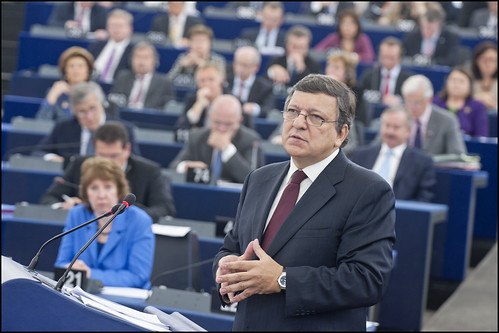
"In the last three years member states - I should say taxpayers - have granted aid and provided guarantees of €4.6 trillion to the financial sector. It is time for the financial sector to make a contribution back to society. That is why I am very proud to say that today, the Commission adopted a proposal for the Financial Transaction Tax."With these words European Commission President Jose Manuel Barroso put forward what is bound to be an enormously controversial piece of EU legislation, a transaction tax on bankers and investors who invest in stocks, bonds and derivatives. Speaking to the European Parliament in Strasbourg today for his annual 'state of the union' address, Barroso said the tax would bring in €55 billion per year, starting from 2014.
The language used by the president was clearly populist in nature, emphasising a sense of fairness and responding to a public feeling that the bankers who caused the economic crisis of 2008 have never been called to account and have not been asked to contribute to the recovery from the pain they caused. Stock markets and investment firms have made remarkable recoveries over the past few years, and executive pay has steadily risen. But at the same time the economy as a whole has suffered enormously and continues to suffer.
Monday, 26 September 2011
Sakozy loses French Senate to the Left
Small signs of hopes for the European left continue to mount. In a vote over the weekend the French Senate changed hands from Nicolas Sarkozy's centre-right UMP party to the Socialists. It is the first time that the Senate has ever been out of the centre-right's control since the creation of the current French state in 1958, and it is a stunning setback for the French president just seven months ahead of France's general election.
So is this outcome a harbinger of a wider reascendance to power for the left, not only in France but also in Europe as a whole? Like the recent centre-left victories in Latvia and Denmark, this news comes with some important caveats. For starters, French Senators are not directly elected by the French people. They are instead chosen by 150,000 local officials throughout the country. These include mayors, city councelors and regional councelors as well as members of the lower house, the National Assembly.
In terms of power the French senate is much more similiar to its British cousin the House of Lords than to its American counterpart. The real power in France, after the presidency, lies with the National Assembly. The Senate can propose law and it must sign off on law, but like in the UK with the House of Lords, they can be easily overridden by the lower house and the president. Like with the House of Lords the French senate is often considered a refuge for people who used to be important, such as former assembly members or cabinet officials.
So is this outcome a harbinger of a wider reascendance to power for the left, not only in France but also in Europe as a whole? Like the recent centre-left victories in Latvia and Denmark, this news comes with some important caveats. For starters, French Senators are not directly elected by the French people. They are instead chosen by 150,000 local officials throughout the country. These include mayors, city councelors and regional councelors as well as members of the lower house, the National Assembly.
In terms of power the French senate is much more similiar to its British cousin the House of Lords than to its American counterpart. The real power in France, after the presidency, lies with the National Assembly. The Senate can propose law and it must sign off on law, but like in the UK with the House of Lords, they can be easily overridden by the lower house and the president. Like with the House of Lords the French senate is often considered a refuge for people who used to be important, such as former assembly members or cabinet officials.
Sunday, 25 September 2011
Palestinian UN bid divides Europe
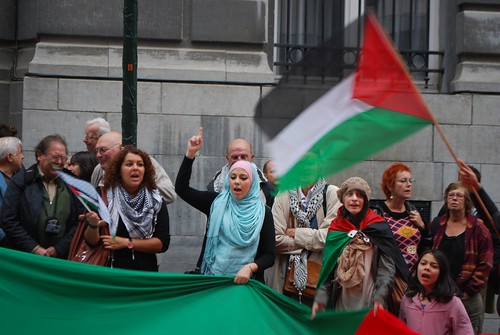
I'm at JFK about to fly back to Brussels, and all around the airport you can see signs of this week's general assembly at the United Nations. I saw several pro-Israel and pro-Palestine demonstrations scattered around the city over the past few days, mostly outside hotels where I assume diplomats and leaders were staying.
Despite the best efforts of the United States and her allies to convince him not to, Palestinian National Authority President Mahmoud Abbas went ahead on Friday with his request to have the UN recognise Palestine as a 'non-voting observer' member. The machinations around this have been described as a slow-motion "diplomatic car crash" by diplomats. Coming as it does in the middle of the 'Arab spring', the United States knows it will look bad if they use their veto in the security council to deny the request. On the other hand, their close alliance with Israel means that the US government believes it has no choice but to veto the move.
But will the US be the only one to issue the veto? And which US allies will support the bid in a full assembly vote? Europe is showing characteristic disunity on the issue. France, which also holds veto power on the security council, is supporting the Palestinian bid. Spain, Portugal, Greece, Belgium and Luxembourg have joined France with their support.
Thursday, 22 September 2011
Bike sharing coming to New York?
I’m in New York City today, I’ve come home again for a baptism that was rescheduled due to last month’s hurricane. It’s just a short trip for the weekend, so I’ve only brought a carry-on bag. Because I’m traveling light, I was able to take a bike to the train station this morning, which is always nicer than taking the tram.
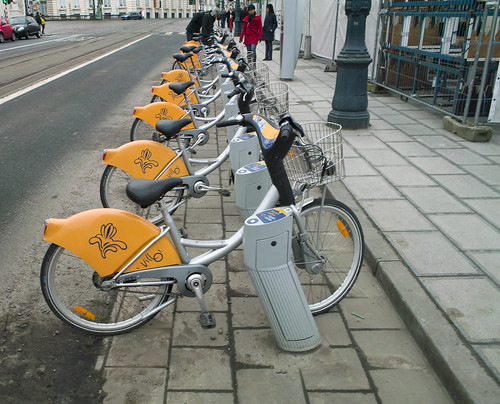
I use the Brussels bike-share scheme every day actually, it’s quite nice to have in a city with not very comprehensive public transportation. It’s quite simple really. For €30 a year I can check out a bike from any the stations scattered around Brussels and return it to a different station at my destination. It’s free as long as I return it to another station within a half hour. If I want to take it out for longer, it’s €1 for every 30 minutes. It’s particularly nice because my apartment is downhill from my office, so I take the metro to work and check out a bike to coast home.
Today I’ve learned that New York is considering implementing a similar scheme. But will it work in New York as well as it’s worked in European cities?
I use the Brussels bike-share scheme every day actually, it’s quite nice to have in a city with not very comprehensive public transportation. It’s quite simple really. For €30 a year I can check out a bike from any the stations scattered around Brussels and return it to a different station at my destination. It’s free as long as I return it to another station within a half hour. If I want to take it out for longer, it’s €1 for every 30 minutes. It’s particularly nice because my apartment is downhill from my office, so I take the metro to work and check out a bike to coast home.
Today I’ve learned that New York is considering implementing a similar scheme. But will it work in New York as well as it’s worked in European cities?
Wednesday, 21 September 2011
DADT repeal: US joins the Western world
Yesterday America's infamous Don't Ask, Don't Tell ban on gays in the military was officially repealed. It was a hard-fought battle for the Democratic Party, and the Obama administration was keen to publicize the fulfillment of one of the president's key campaign promises. It wasn't easy, and the past three years have been met with opposition and setbacks.
The level of jubilation from Democrats was incredible, but understandable considering how long they have fought to end this ban. But looking at the situation in a global context, the excitement over a rather small policy change might seem strange. After all, until Tuesday the United States was the only country in the developed world that still had a ban on gays serving in the military.
Barring gays from military service is illegal under European law, and no such ban exists in any EU state - even in ultra-Catholic Poland or Italy. In fact the only country in all of Europe to have a ban on gays in the military is Serbia. In Latin America, the only countries to have bans on gays in the military are Cuba and Venezuela. As can be seen in the map above, the divide between gay bans (in red) and no gay bans (in blue and gray) mirrors the divide between the developed and developing world. Gay service bans are common in Africa and the Middle East.
The level of jubilation from Democrats was incredible, but understandable considering how long they have fought to end this ban. But looking at the situation in a global context, the excitement over a rather small policy change might seem strange. After all, until Tuesday the United States was the only country in the developed world that still had a ban on gays serving in the military.
Barring gays from military service is illegal under European law, and no such ban exists in any EU state - even in ultra-Catholic Poland or Italy. In fact the only country in all of Europe to have a ban on gays in the military is Serbia. In Latin America, the only countries to have bans on gays in the military are Cuba and Venezuela. As can be seen in the map above, the divide between gay bans (in red) and no gay bans (in blue and gray) mirrors the divide between the developed and developing world. Gay service bans are common in Africa and the Middle East.
Subscribe to:
Posts (Atom)