Wednesday, 30 November 2011

Brussels – enter at your own risk

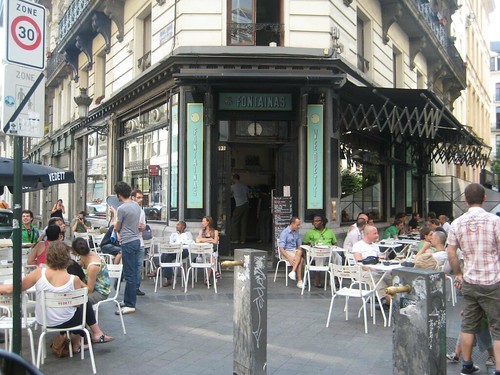
Fontainas, a cafe in central Brussels that could best be described as the headquarters of the city’s gay community, is shut down this week. Its doors have been closed since an incident Sunday night that sent a man to the hospital with severe stab wounds.

News of the attack, which has been spreading like wildfire through social media all week, seems to have left the city’s gay community shocked yet unsurprised at the same time. The storyline has become a familiar one in Brussels. Three drunk men entered the café, began hurling homophobic abuse at the people inside, and before long a violent altercation ensued. The details of what took place are still unclear, but the incident was serious enough to shut the doors of this Brussels landmark since Sunday. And although homophobic attacks are unfortunately common in Brussels city centre - an area of the city that is known for its crime and grime - this incident has still caused huge shock because the establishment is so well-known. Even the soon-to-be Belgian prime minister, who is openly gay, can often be seen there.

A movement has been growing to try to pressure the city authorities to do more to keep the city centre safe since a gay-bashing attack in June that many saw as the straw that broke the camel's back. A man was beaten by a group of young men near the Bourse (stock exchange), just next to Grand Place, because he was gay and behaving in an effeminate manner.

Monday, 21 November 2011

Europe's left has vanished from the map

It's a process that's been long in the making, but this weekend's election in Spain seemed to be the final nail in the coffin for European Democratic Socialism - at least for the moment. With the fall of the Socialist government of Jose Luis Rodriguez Zapatero in Spain, following on the heels of the fall of Socialist prime minister George Papandreou in Greece two weeks ago, the EU is now left with only two centre-left governments - Denmark and Austria.

The already dwindling left was already not in a good position, with just five centre-left governments out of the 27 EU states at the beginning of the year. Four of those governments have since fallen, including the collapse of the Slovenian government in September (new elections, which the Left is certain to lose, will be held next month). Only the Austrian government has survived, and they were joined by the Danish social democrats who won a trend-defying election in September. Cyprus, which has a communist (but in truth more nationalist) government, does not sit with the centre-right grouping in Europe.

At the same time, five governments now have provisional or technocratic governments - effectively under the control of the markets and the dominant centre-right governments of Europe. The presidencies of the three institutions of EU governance - the commission, the parliament and the council - are all held by the centre-right. The situation is unprecedented. The irony is, at this time of crisis when Europe seems to be tearing itself apart, the governments of Europe have never been so ideologically united - at least in terms of the left-right divide.

Friday, 18 November 2011

The new Italy: this is what technocracy looks like

Former EU commissioner Mario Monti, appointed as Italian prime minister on Sunday after Silvio Berlusconi was forced by the markets and EU leaders to resign, had his ‘technocrat government’ approved by the Italian parliament today.

Neither Monti nor the members of his cabinet have been elected by the Italian people. They are not politicians but instead experts in their respective fields. The 'government of experts' has been brought in because, it was thought, both within and outside Italy, the Italian political system is so broken that only unelected non-politicians could be trusted to implement the reforms EU leaders say are necessary to prevent the country’s economic collapse.

American readers may be wondering how on earth a national leader in a democracy could come into power without having been elected. It has to do with a quirk in parliamentary democracy. Members of the upper houses of many of Europe’s parliaments (their equivalents of the US Senate) are appointed rather than elected. A prime minister can come from either house, so if the parliament wishes to appoint a leader who has not been elected they simply have the president appoint that person to the senate.

Tuesday, 15 November 2011

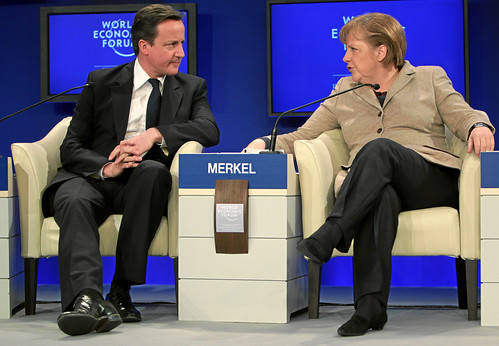
Angela and Dave fight it out over EU's future

It’s the fundamental question facing the EU today: should the union integrate, or disintegrate? In two duelling speeches yesterday the British prime minister and the German chancellor took polar opposite positions on the answer.

David Cameron’s speech, delivered just hours after Angela Merkel delivered a speech to her conservative CDU party conference calling for further European integration, appeared to be a direct response to the German chancellor. Describing himself as a Eurosceptic, Cameron said the EU had overreached in its ambitions and that the euro crisis is "an opportunity, in Britain's case, for powers to ebb back instead of flow away and for the European Union to focus on what really matters".

Merkel’s speech hours earlier had delivered the opposite message. Telling the audience that Europe faced its greatest challenge since the second world war, she said, “The task of our generation is to complete economic and monetary union and build political union in Europe step by step…that does not mean less Europe, it means more Europe.”

Considering the influence of the UK in Europe compared with the influence of Germany, it was a bit like a pygmy picking a fight with a giant. Cameron’s argument may find a sympathetic audience with the British press, but among national governments – even those in his ‘Northern bloc’ – the idea that the crisis is an opportunity to pull Europe apart is not very alluring. But whether or not the UK actually has the influence to sell Europe on the idea of downgrading the EU to merely a free trade zone, the fact is this may happen anyway. But few outside Britain would describe this as a desirable outcome.

Friday, 11 November 2011

Are we done with democracy?

It has been a dramatic week for Southern Europe, with the elected leaders of both Greece and Italy falling as a result of pressure from the markets. Both are to be replaced by unelected technocrat governments, with former EU economists being appointed to replace them. It would appear that the democratic political systems in both countries were incapable of delivering a solution to the debt crisis. The unprecedented situation has prompted uncomfortable questions. Given the North Atlantic crisis the West has found itself in and seems to be incapable of extracting itself from, is democracy failing?

This was the question being asked on the BBC's Newsnight programme Wednesday night. Italian economist Vito Tanzi said during the interview that a government of unelected technocrats can do what elected politicians cannot - tell people the truth and push through unpopular but necessary reforms. "It can do a better job of informing people what needs to be done. I think that is the problem that the Italians were told for many years that there were no problems, that nothing needed to be done when the situation was progressively getting worse. If you have this kind of government, then sooner or later you get in trouble. The technical people would know better and would tell people what the consequences are of continuing with current policies"

He was of course speaking of his friend Mario Monti, the former EU Competition Commissioner who is set to be appointed new Italian prime minister.

In Greece, it was announced yesterday that another EU official, former European Central Bank vice president Lucas Papademos, will be appointed prime minister of Greece. Neither of these men has ever been elected to any office in their home countries. But both were appointed by their countries to their EU positions, and both earned praise for their performance in those positions. Greece and Italy are joining the two EU countries which already have provisional unelected governments - Slovakia (whose government collapsed after the parliament refused to back the Greece bail-out) and Belgium.

Tuesday, 8 November 2011

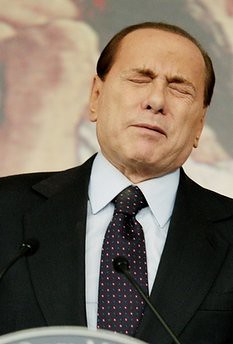
Berlusconi is finished - for real this time

This blog has predicted the imminent resignation of Italian prime minister Silvio Berlusconi many times. In fact I counted, and in the past six years the blog claimed on five separate occasions that his sex and corruption scandals were about to topple him. After all it was hard to believe that a leader facing the kind of allegations he has faced could have held on to power. But this is Italy, and the normal rules don't apply.

But now it seems that the markets have accomplished what common decency couldn't - they have forced Silvio Berlusconi out of power. Tonight the Italian leader announced he will step down.

Rumours to this effect were swirling yesterday, causing European markets to rally and the euro's value to shoot up. But then Berlusoni issued a denial of the rumours on his Facebook page (where else?) and the markets tumbled. This was a clear sign: the markets had lost any shred of faith in Berlusconi to implement the reforms he promised European leaders last month. Berlusconi has survived many things, but when it came to the all-powerful markets that seem to be calling the shots these days, he was no match.