Friday, 20 February 2009

La Crise Claims Her Second Victim

The Latvian government has become the second European administration to fall as a result of the global economic crisis, following the collapse of Iceland's government last month. Latvia's prime minister resigned today and the government folded as a result of the country's economic crisis, one of the worst in Europe.

Latvia is not in good shape, to say the least. With the country in severe recession, the economy is expected to contract by up to 12 percent in 2009, and unemployment is set to rise by 50 percent. GDP in the final quarter of 2008 fell by 10.5 percent compared to the previous year, and economists are predicting a further drop of 10 percent for this year.

The resignation follows last month's massive protests in Riga, the country's capital, which saw 40 people injured and 100 people arrested.

Latvia's situation is not isolated. The story throughout Eastern Europe is much the same. After years of boom following the east's entry into the EU, economies across the East have come to a crashing halt. Across Europe the countries that have experienced a boom in the past decade are now suffering the worst. The UK, for instance, is suffering severely while in France the effects have been less dramatic because the economy there had been performing poorly for some time before the crisis hit.

The plummeting fortunes of Eastern Europe have sparked fears that a "spring of discontent" is around the corner, a period that will see increasing violence in the young countries of the East and the collapse of several governments. Bulgaria, Romania and the Baltic states have all been hit particularly hard by the crisis. Sofia, Bulgaria has seen recent violence in which 150 people were arrested. I'll be travelling to Sofia next week to work on a story about vote buying and participate in a panel discussion organized by CafeBabel about the parliament elections. While I'm there, I'm also going to see what I can find out about the economic situation and whether the government is concerned about more dramatic protests in the near future. It will be an interesting time to be in the new EU state.

Thursday, 19 February 2009

Switzerland Opens the Bank Floodgates

Europe may be continuing to wage its battle against Switzerland and Liechtenstein over banking secrecy, but after a Swiss government decision yesterday it looks like it may have been the US that has delivered the knock-out blow to the Alpine tax haven system. Switzerland's uunprecedented decision to let UBS turn over their clients' banking details to the US could open the floodgates for governments demanding previously secret bank details, causing the whole system of secret bank accounts to come crashing down like an avalanche.

Since 1934 Switzerland has relied on a pledge of secrecy to fill the coffers of its massive banking system. According to the Swiss Banking Association, 27 percent of all privately held offshore assets are located in Switzerland. The result has been that the country's economy is heavily reliant on the banking industry, with two of the world's largest financial institutions, Credit Suisse and UBS, being the pride of the country. The US Internal Revenue Service had filed criminal charges against UBS, accusing it of helping Americans avoid paying US tax by opening Swiss bank accounts and demanding that it hand over client data. Under Swiss law UBS wasn't allowed to turn over those records, so UBS petititioned the government to allow it to do so, saying that if they didn't their very existence would be at risk. Yesterday the Swiss Financial Market Supervisory Authority said it would allow the release, throwing Swiss market analysts into a panic. Many are saying the government's decision was unnecessary and premature, and could put the whole Swiss banking system at risk.

But the pressure on Switzerland to reform its banking secrecy laws has been steadily mounting for the past several years. Germany in particular has been aggressively pursuing the issue, leading the efforts to force Liechtenstein's hand by stalling its Schengen Zone membership until it makes concessions on the issues. Last year the German finance minister even made the argument that Switzerland should be put on a blacklist of tax havens. The EU has also been looking to end what it views as a no-longer-acceptable tax island within its borders. This month the EC introduced a proposal to end anonymity for bank accounts within the EU. But since such secrecy is already illegal in most EU countries anyway, many analysts think the proposal is actually being made with the intention of extending the legislation to Switzerland and Liechtenstein, which both have bilateral treaties with the EU locking them in to many decisions made in Brussels.

But although Europe's been gunning for the tax havens for some time, it looks like it is the IRS that's delivered the knock-out punch. The Swiss government was at pains today to insist that the ruling is an isolated case and will have no bearing on such negotiations with the rest of Europe. But it's undeniable that the decision is likely to encourage the EU and individual countries to pursue similar criminal action against Swiss banks in order to force their hand. And now that the precedent has been set, it will be hard for the Swiss government to block those requests in the future. As the economic crisis continues to worsen, governments will be keen to grab additional revenue wherever they can. Some of that may now come from unpaid taxes sitting in Swiss banks.

Thursday, 12 February 2009

Pretty Blonde Spies

Today I attended my first midday briefing press conference at the European Commission. I had watched some of them on the live satellite feed before, but never had the opportunity to attend one in person. I've actually been to a lot of events and meetings in the European Quarter this week, and the coolest part is how each of the chambers is so high tech (like the hemicycle of the European Parliament building, pictured right). In the Commission's press briefing room for example, each seat has headsets for listening to the translators, who all have separate booths lining the outside of the room. Each seat also has a microphone which you can use to ask a question to the spokesperson, and when its your turn your seat lights up. The future is here!

The subject which took up the most time at today's briefing was particularly relevant for me. Yesterday the EC circulated a memo to staff telling them to beware of spies seeking to infiltrate the European Commission, which is the EU's executive branch. The note warned to be wary of non-EU nationals, and reminded them that spies could come in any form, even a "pretty trainee with long legs and blonde hair."

Despite the memo writer's obvious talent for amusing self-parody, what has caused some controversy is that it mentioned journalists in the list of people to be wary of; a list that also included lobbyists, IT experts and private agencies. At today's press conference, a reporter named Lorenzo who represents the International Press Association voiced the association's displeasure that journalists, who have a mandate to discover hidden information, would be included on this list. He demanded to know why the EC was telling their staff to be wary of journalists because they were seeking information.

The spokesman and the reporter seemed to have a good relationship so it wasn't a tense exchange, but it was clear the reporter was not happy about the memo. The commissioner insisted that the memo wasn't criticizing journalists for seeking information, but rather EC workers for possibly giving out classified information too freely. He then pointed out that recently the current commission relaxed decades-old limitations on who in the EC could speak with the media. Apparently before these rules were relaxed only official spokespeople of the EC could speak with members of the media. The spokesman said this was unprecedented for most national parliaments, but I know that's not the case in Washington or London (any member of congress or parliament can speak with the media whenever they like) so I think that was a bit of hyperbole on his part.

He also mentioned that the EC's accreditation process was one of the most liberal in the world and does not involve security checks. So far this hasn't been my experience, as I am in the process of trying to get accredited and am finding it quite difficult. I have to first become a member of a journalists' union, so I just hastily applied for membership in the NUJ, which comes with a cost of 15 pounds a month. Then I have to show that I have been a working journalist, with pay stubs and published articles, for the past two years. Then I also need to bring letters of reference from employers. Getting my press accreditation in Washington did involve a quick security check, but it was far less cumbersome than this process in whole.

So it was an interesting first day. The midday briefings take place just down the street from my French course and happen just after my class ends, so I'm going to try to pop in at least three times a week to see if anything interesting comes up. Who knows, maybe I'll even ask a question one of these days. It will be worth it just to be able to use that little microphone!

Tuesday, 10 February 2009

How do you say Schiavo in Italian?

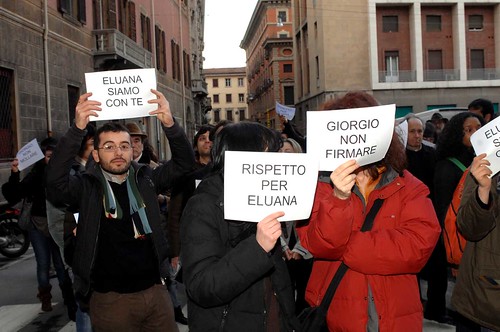
One of my favourite things about my new French class is that it's geared toward EU workers, so we discuss news and current events in class. This morning we were talking about the Eluana Englaro debate going on in Italy right now. Interestingly, when I mentioned that the situation is virtually identical to what happened with Terry Schiavo three years ago in the United States, I found that no one actually knew about the Schiavo case (I'm the only American in the class). Although it had little international relevance, the Schiavo episode was one of the biggest domestic political events of the last several years in the United States.

Scanning the Belgian, French and British papers today I have been unable to find a single mention of the Italian case's similarities with the Schiavo case. But considering that the spectacle which took place in the US senate during the Schiavo episode was one of the contributing factors to the downfall of the Republican Party, Italian conservatives may want to take a lesson and reign in their rhetoric on this issue.

Monday, 9 February 2009

The Swiss Say Yes to Europe

Brussels was breathing a sigh of relief today as the news of yesterday's Swiss referendum result reached people's desks. There had been some apprehension about the vote, which extends free-movement rules to new EU entrants Bulgaria and Romania, as opinion polls taken before the vote seemed to suggest that it would have a razor-thin margin. In the end, a massive 60 percent of voters said 'JA.' Only four of Switzerland's 26 cantons voted no.

The vote is being called a "broad yes" by the Swiss to economic collaboration with Europe, and a mandate for pro-European parties in the Swiss government to increase ties. The news is already being taken as a sign that the financial crisis may lead to a more receptive attitude toward the EU and coordinated pan-European policies. With the Irish revote on the Lisbon Treaty just around the corner, many in Brussels are hoping this is a trend that will continue. But is the vote's outcome the result of changing EU attitudes in the face of the financial crisis, or was it simply the result of a skillful vote mobilisation effort on the ground by pro-EU groups?

Switzerland has a rather unusual arrangement with the EU. While it's not a member, it has a series of seven 'special accords' with the block that make it effectively a shadow member. It isn't an official member, so it doesn't have any representation in the European Parliament or Commission, but the accords oblige Switzerland to follow many areas of EU legislation. Free movement, which allows any EU citizen to work in any EU country, is one of those areas. However, now that EU membership hassuch a change must be put to a public vote (they basically have to have a public vote for everything in Switzerland). But here's where it gets tricky. The EU has made clear that Switzerland doesn't have the right to 'pick and choose' which parts of EU law it will follow, and under the infamous "guillotine clause," if the Swiss voted no to extending free movement to Bulgaria and Romania, all of their agreements with the EU would be torn up. Considering that the vast majority of Switzerland's trade is with the EU, and that non-Swiss EU citizens make up a huge percentage of its skilled workforce, a collapse in the accords would be catastrophic for the country's economy. So one has to ask, is this really a vote for increased EU ties, or a desire to maintain the status quo? And if it's now economically impossible for the Swiss to vote against policies enacted in Brussels, isn't this really just an illusory independence anyway?


Switzerland's biggest political party, the rightist Swiss People's Party, had waged an aggressive ad campaign urging people to vote no, arguing that the two new EU entrants were too poor to be allowed unfettered access to Swiss jobs. (this photo is of one of their billboards that was on the street outside my parents' house). The issue was complicated by the fact that Switzerland has had a less than smooth history with immigration from the Balkans. During the 1990's the country took in many refugees from the former Yugoslavia as the Balkan wars raged on. Now the country has a sizable former Yugoslav population, particularly in Zurich, which hasn't integrated with the wider Swiss society and who treated with much hostility from the native Swiss population (complete with a nasty epithet that I won't repeat here). Many, particularly in German-speaking Switzerland, aren't crazy about the idea of taking in more immigrants from Serbia's neighbors in the Balkans.

A Sign of the Times?

So does the wide victory in Switzerland mean that people's fears about the financial crisis are going to make them less likely to snub the EU, for fear of the economic consequences? I've speculated that the economic turmoil in Ireland will likely make the Irish too scared to vote against the Lisbon Treaty again when the revote occurs later this year. It seems likely that the hold-up in approval by the Czech Parliament may also be resolved quickly now that the future looks so uncertain. On the other hand, many commentators have speculated that the recession could lead to an increase in populism and protectionism, which could put the European single market in jeopardy. The recent walk-outs in the UK and the one-day strike in France have certainly been a worrying sign in that direction.

For now though, Brussels has reason to be encouraged by the Swiss result.

Tuesday, 3 February 2009

May you live in interesting times

I've spent the past few days getting settled here in Brussels, and so far things have gone quite well. I've got a great apartment right in Centre Ville next to the Grand Place, and my intensive French class is fantastic. It's an advanced class and there's only seven of us, each from a different country.

Last night I had drinks with a French friend who lives here in Brussels, and we were talking about different things going on the EU these days. There wasn't a shortage of things to discuss. Toward the end of the conversation, we remarked on what a crazy time this is to be living in Brussels reporting on the EU. It feels like we're on the precipice of something, particularly in Europe. Things are about to change, we speculated, and they could possibly go in extreme directions. It looks like we've all been victims of that old purported Chinese curse, "may you live in interesting times." But to continue with the 'mangled cliches claiming to be proverbs theme', the Chinese character for crisis also means opportunity! Could the economic crisis lead to a strengthening of pan-European institutions, or could it just as easily lead to the disintegration of the entire EU project?