Normally at this time of year, politicians on both sides of the Atlantic would be preparing for their August break. But there will be no relaxing getaways this year, in what is turning into probably the most anxiety-packed summer of my lifetime.
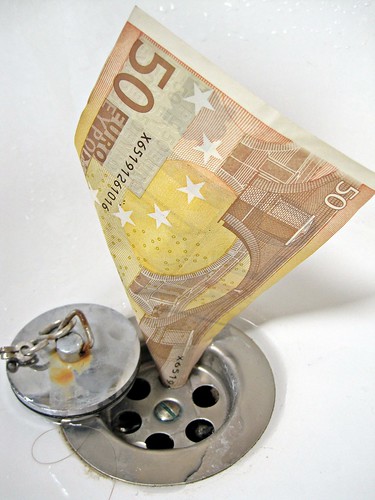
Both Europe and the US may be just days away from serious financial troubles. And if situations on either continent spin out of control, a worldwide economic panic could be ahead.
On both sides, there are obvious and straightforward solutions that could avert disaster. But in the US, the recent electoral success of a Tea Party movement that wants to see the US default on its debts has rendered the political process incapable of taking action. In Europe, the recent surge toward nationalism and a lack of political courage has rendered the EU incapable of confronting the debt crisis head on. It is a massive failure of the political systems of the Western world.
Wednesday, 20 July 2011
Thursday, 14 July 2011
Will NotW shock force rethink of British press accuracy?
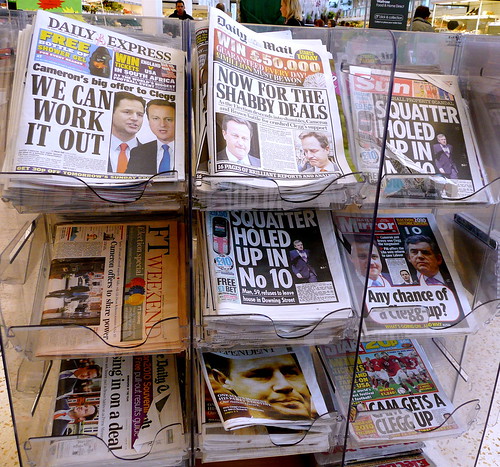
Another day, another euromyth batted about by the British tabloids. Today's little page seven gem, repeated in several papers including the Express and the Telegraph, is that Brussels is planning to force all sports players to wear the EU flag on their uniforms. And like most of the euromyths the British press peddles, this is complete nonsense.
Of course this little piece of news can't hope to compete with the big story this week, the News of the World hacking scandal and the implosion of the Rupert Murdoch media empire in Britain. Commentators are saying that this scandal will erode the public's confidence in the British media. I can't help but think – looking at stories like this EU unform nonsense – that that's probably not such a bad thing. But will this scandal really force the British public to be more sceptical toward the claims made by their printed press, particularly regarding the EU?
As I wrote about in a related post today, the current scandal is not centred around the accuracy of British journalists but rather the methodology used by them in gathering news. The allegations being made may be shocking and sleazy, but not one of them involve false reporting. Will there be a connection, in the public perception, between Murdoch's manipulation of the British political class and his manipulation of the British public? Will people start to think about how their own attitude toward things, for instance the EU, is shaped by the stories they read in the tabloid press? And will they stop being so credulous when reading these things? As I read the comments on this Daily Express article from today, I'm inclined to think little in this respect is going to change.
Why the NewsCorp scandal won't resonate with Americans
The News of the World hacking scandal has progressed with shocking speed in the UK. Yesterday it seemed to reach a fevered climax when Rupert Murdoch withdrew his bid for satellite operator BSkyB after he was ceremoniously denounced by the entire British Parliament in an unprecedented session. It marks an incredible end of an era. Murdoch is effectively being banished from Britain after having held sway over the island's media, government and even police for decades.
Now commentators are speculating that the trouble for Murdoch's media empire News Corp, which also own many papers and Fox News in the US, is spreading across the Atlantic. The shares in News Corp on the New York Stock Exchange came crashing down even before Murdoch's BSkyB bid was withdrawn, and the billionaire himself had to buy up the shares to keep the price from collapsing.
Now there are concerns that the bribery allegations in the UK could get the company into legal trouble in the US, because it is illegal for a company publicly traded in America to pay bribes to foreign officials – which includes police officers. That, combined with new allegations that Murdoch's British papers also hacked into the phones of American 9/11 victims has prompted some Democrats in congress to call for an investigation into the matter. But will the public at large share their outrage?
Wednesday, 13 July 2011
Eurozone in panic: Is Italy next domino to fall?
The Eurozone is looking at several doomsday scenarios this week after Italy emerged as the latest EU state to face serious and sudden attack by international bond and security markets. After a very public spat between Prime Minister Silvio Berlusconi and his finance minister, and with the continued political uncertainty over Berlusconi's position, the markets have decided Italy may not be safe to lend to any longer.
With the paralysis in the country's government likely to prevent decisive action to confront the crisis, some are saying Italy is perhaps days away from becoming an economic failed state. And unfortunately it is not too big to fail, but it is too big for the EU to bail out.
Such extreme rhetoric may or may not be justified, depending on who you talk to. But the risk is extreme. The countries that have so far fallen victim to the debt crisis and required an EU bailout – Portugal, Ireland and Greece – are relatively tiny and their debt makes up less than 5% of overall eurozone public debt. If worse came to worse, France and Germany could afford to buy back all of their debt combined.
Friday, 8 July 2011
Is Murdoch's influence in British politics coming to an end?
The News of the World phone hacking scandal in the UK has literally exploded this week, with fresh allegations that the Rupert Murdoch-owned paper hacked into the phones of murder victims, victims of the 7/7 terrorism attacks, relatives of dead soldiers and detectives investigating cases. Late yesterday it was announced that the 160-year-old paper will shut down as a result of the scandal, news that sent shock waves through Britain.
The allegations of bribing police officials and hacking into phones began several years ago, but the latest revelations are so distasteful that it seems to have given British politicians the resolve to publicly denounce Murdoch, something they never dared to do before. At the centre of the scandal is Rebekah Brooks, who was editor of News of the World at the time of the phone hacking but has since risen to become chief executive of Rupert Murdoch's global media empire News Corp. The company, which also owns Fox News and papers such as the New York Post in the US, controls a vast array of British tabloid papers and has long been known in the UK as a political power broker. Murdoch controls British politics, it is claimed, by threatening to use his papers to destroy any politician that doesn't give in to his demands.
But Murdopch's influence over British politics seemed to come to a climactic end this week, as one after another members of the British Parliament took to the floor and denounced not only News Corp, but also the fact that the parliament for so long has been bullied by the company. Conservative MP Zac Goldsmith said News Corp has "systematically corrupted the police and in my view has gelded this Parliament, to our shame.” Labour MP Chris Bryant said the hacking was symptomatic of the way News Corp operates around the world.
The allegations of bribing police officials and hacking into phones began several years ago, but the latest revelations are so distasteful that it seems to have given British politicians the resolve to publicly denounce Murdoch, something they never dared to do before. At the centre of the scandal is Rebekah Brooks, who was editor of News of the World at the time of the phone hacking but has since risen to become chief executive of Rupert Murdoch's global media empire News Corp. The company, which also owns Fox News and papers such as the New York Post in the US, controls a vast array of British tabloid papers and has long been known in the UK as a political power broker. Murdoch controls British politics, it is claimed, by threatening to use his papers to destroy any politician that doesn't give in to his demands.
But Murdopch's influence over British politics seemed to come to a climactic end this week, as one after another members of the British Parliament took to the floor and denounced not only News Corp, but also the fact that the parliament for so long has been bullied by the company. Conservative MP Zac Goldsmith said News Corp has "systematically corrupted the police and in my view has gelded this Parliament, to our shame.” Labour MP Chris Bryant said the hacking was symptomatic of the way News Corp operates around the world.
Thursday, 7 July 2011
Poland fires warning shot over Denmark's 'nationalist' moves
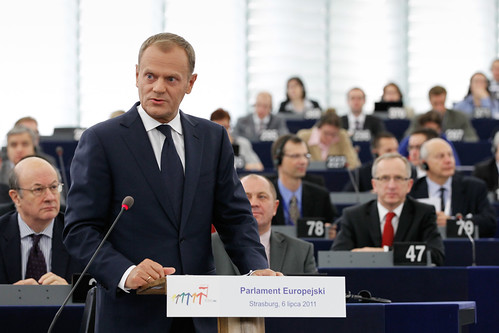
Poland is not usually known as a very pro-EU country. In fact, it has gotten the reputation as the most Eurosceptic of the new member states. But yesterday Polish Prime Minister Donald Tusk lambasted recent moves by Denmark, France and Italy to undermine the European project. He signalled he intends to halt the current slide, led by those Western countries, toward reintroducing border controls at internal EU borders.
Tusk was speaking to the European Parliament in Strasbourg to mark the start of Poland's presidency of the EU, which will last the next six months. "The answer to the crisis is more Europe," he said, not less. He indicated that he will fight against efforts to further erode EU principles, and suggested he was unhappy with the deal reached among member states last month to allow temporary internal border patrols to deal with increased immigration.
"I am against any barriers to internal free movement under the pretext of dealing with migration problems. What Denmark is doing is a concern for anybody who thinks that free movement is going to be restricted even further," he told the parliament. "Europe, with its institutions, its budget and its objectives, is not the source of this crisis. And following those who say the opposite would be a fatal mistake. Undoing the European construction at this time and turning to nationalism as an answer to the crisis would be a very big mistake."It was a fairly unusual move for the incoming presidency to take such a political stance against what other member states are doing, because the presidency is supposed to be a neutral negotiator in the council. But Poland has always marched to the beat of its own drummer when it comes to the EU.
Subscribe to:
Posts (Atom)