Sunday, 14 October 2012

Catalonia: on the precipice of secession?


I’m on a plane back to Brussels from Barcelona at the moment, still digesting the amusingly polarised reaction to Friday’s announcement that the EU has won the Nobel Peace Prize. The significance of the announcement was only heightened for me this weekend by the fact that, as the Nobel committee spoke of the achievement of the EU in keeping Europe together, I was in a country that may be about to tear itself apart.

Friday was Spanish National Day, but you wouldn’t have known it on the streets of Barcelona. The Catalans may have been happy to take the day off work, but they were clearly not in the mood to celebrate. There was no parade, no festivities and - most noticeably - not even any Spanish flags.

In fact the only way one would have known it was national day at all was that in the morning, the streets around Placa de Catalonia were filled with Police officers preparing for a planned march by secessionist demonstrators. Helicopters thundered above us, preparing for the possibility that the city would see a repeat of the massive secessionist demonstrations that took place on 11 September (Catalan National Day) that saw more than a million protestors flood the streets of Barcelona. However from what I saw, this time around the Catalans seemed to prefer ostentatious non-observance to demonstrations.

Though there were Catalan flags draped from nearly every window (perhaps left over from the 11 September celebrations), I did not see one Spanish flag except for those on government buildings.

Friday, 12 October 2012

Does the EU deserve the Nobel Peace Prize?

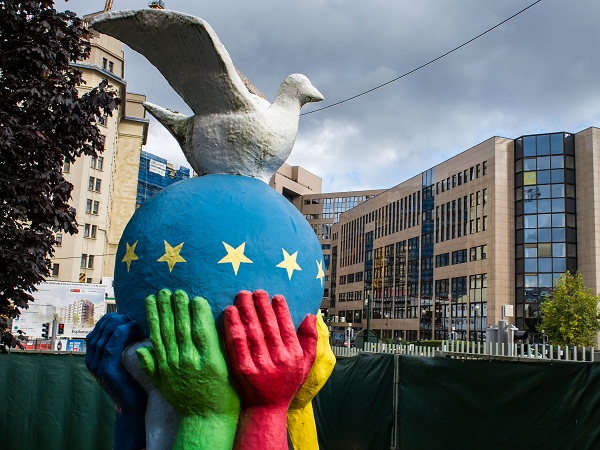
What a day to be away from Brussels! I'm in Barcelona this weekend, but awoke this morning to the news that the European Union has been awarded the 2012 Nobel Peace Prize. I'll admit, I had to do a double-take after reading that news.

This is another deliberately provocative move by the Nobel committee, following last year's selection of Barack Obama. Like last year's choice, this one is going to have its share of critics.

The Nobel committee seems to have adopted a strategy of trying to aid well-intentioned people/institutions at a time when they're down on their luck. When they chose Obama, he was in a weak position domestically, showing the scars of the healthcare fight. And obviously, it goes without saying, the EU is also in a difficult place right now. The awards seem to be almost like a pep talk - don't get discouraged, keep hope.

And yet many of the uncomfortable contradictions are still there. Many questioned how a US president currently waging a war in Afghanistan and a secret drone war in Pakistan could be awarded a prize for peace. Several EU member states are also participating in the Afghan war, including Britain and France (though France is about to pull out). Of course the Nobel Committee would likely argue that this is member states, not the EU itself.

Monday, 24 September 2012

Britain snubs Europe, goes to the dance with Canada


It shouldn’t be a surprise to anyone that UK foreign secretary William Hague has found a new way to annoy his European counterparts. But today he’s managed to bring a North American country into the fray, and for once is isn’t the one with whom he believes he has a “special relationship”.

During a visit to Canada today Hague announced that the UK is going to close some British embassies across the world and merge them with Canadian embassies. The two countries will establish joint diplomatic missions, sharing embassy offices and consular services.

The move, an attempt to save money in these cost-cutting times, might seem logical enough at first glance. But the more you delve into it the more you realize it is diplomatically and logistically bizarre. While the UK and Canada may have similar foreign policy (something irrelevant to the consular services they are merging), they are completely separate countries which share no unified visa system. The only thing they share is a queen.

Friday, 14 September 2012

EU citizens embrace the eurobots

Citizens of the European Union may have lost faith in their leaders, but they have not lost faith in robots. This according to a reassuring press release put out today by the European Commission, which boldly declares, “More than two-thirds of EU citizens (70%) have a positive view of robots.”

In fact Europeans are apparently ecstatic about these automatons, particularly those who have already had some personal experience with a robot. According to a survey conducted by the EU, 26% of Europeans would be comfortable with having a robot walk their dog. Bulgarians seem to especially love the robots, with 21% of them saying they would even trust the robots to look after their children or elderly parents.

But not all Europeans are willing to embrace the robots. The Greeks do not like these robots, not one bit. 46% of Greeks say they do not like robots, making it the most anti-robot country in the EU. Greek Cypriots are as wary as their mainland cousins, with 98% of them saying the robots need to be “carefully managed”.

Wednesday, 12 September 2012

The peril and promise of a new treaty

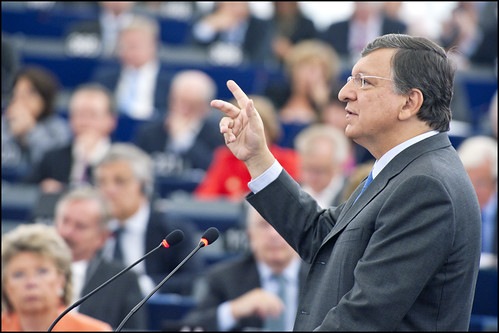
European Commission president Jose Manuel Barroso dared to use the ‘F word’ in his state of the union address here in Strasbourg today – federalism.

“Let’s not be afraid of the word, we will need to move towards a federation of nation states,” he told the European Parliament. “Today, I call for a federation of nation states. Not a superstate.” This federation, he continued, will ultimately require a new treaty, as German Chancellor Angela Merkel had suggested last week. EU leaders, still traumatized by the painful experience of ratifying the Lisbon Treaty in the last decade, have been desperate to avoid this.

“Before the next European Parliament elections in 2014, the Commission will present its outline for the shape of the future European Union. And we will put forward explicit ideas for treaty change in time for a debate.”

Barroso has been hesitant to use the word federal in the past when describing the future direction of the European Union, aware of the images of a power-grab it can conjure up in member states. But in his state of the union addresses, a yearly tradition itself created by the Lisbon Treaty, Barroso has been keen to make the European Parliament happy. He clearly thought that by finally using the F-word, he could do it.

Monday, 3 September 2012

A long-distance relationship

There are many clichés used to describe Iceland’s position in the middle of the Atlantic. Torn between Europe and North America – quite literally sitting on the fault line separating the two continents geologically – the country’s location is the most frequently used metaphor. This has been particularly true now that the country is in the process of EU accession.

While in Iceland over the past four days – a stopover on my way back to Brussels from a visit home to New York – the question of EU accession was very much on my mind. In fact I made it a point to ask every Icelander I met how they plan to vote in the coming referendum (what can I say, I’m tons of fun at a party). I planned to write some kind of blog entry on the way back reflecting people’s opinions and concerns, and here I am on the plane writing it.

It’s tempting to start trying to explain Iceland’s reluctance to embrace Europe with an anecdote about geography, since it is so far the European mainland. I could describe the intense sense of isolation I felt while out in the uninhabited lava fields away from Reykjavik. Or I could muse about the feeling of being torn in two directions which I felt while standing in the gorge separating the two continents at Pingvellier Park.