Thursday, 15 July 2010

As US spill continues, EU confused over its own drilling

As the US waits with baited breath to see if BP's latest attempt to cap the gulf oil spill will work, across the Atlantic European leaders are frantically trying to assess whether they too are vulnerable to such a spill. If the Deepwater Horizon disaster was apparently caused by a lack of oversight and regulation by the US government, things must be much more safe over here on a continent notorious for high levels of regulation, right? Well, nobody seems quite sure.

Over the past month I've attended numerous seminars, parliamentary hearings and press conferences trying to answer that question. And Europe's leaders seem no closer to answering it today than they were three months ago when this leak began. It turns out that oil drilling in the EU is remarkably uncoordinated and there is little reliable data about what is going on Europe-wide. This has infuriated green groups and politicians. This frustration was evident last night when I went to a press briefing after a meeting between the EU energy commissioner and top oil industry execs. As the oil industry representatives entered the commission there was a crowd of Greenpeace activists gathered by the front door, covered in oil and holding signs demanding an immediate moratorium on oil drilling in European waters. Unfortunately for them, by the time the oil execs arrived a sudden torrential rainstorm had washed all their oil off, leaving them shivering in their underwear and looking more like they had come to demonstrate for the rights of nudists than protest oil drilling. Still, I think the oil execs got the message.

Wednesday, 14 July 2010

Belgium and France in race to ban the burqa

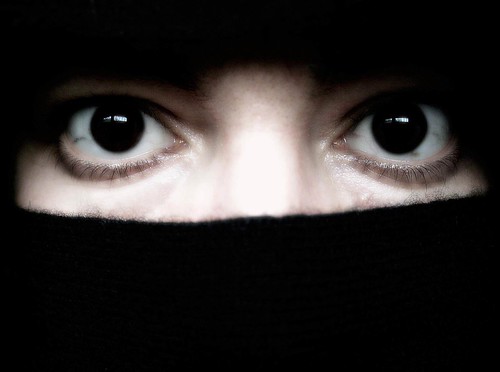
Who will emerge victorious? Belgium and France are currently falling over each other racing to be the first country in Europe to ban full face coverings. Whoever wins the race, both bans are guaranteed to eventually become law. The bans are illustrative not just of the conflict between Europeans and Muslim immigrants, but also of the ideological divide that separates continental Europe from the Anglo-Saxon world.

Both European and the Americans/British may dislike the burqa, but when it comes to how to deal with it, the English Channel and the Atlantic present a wide gulf. On the continent I don't know one person who thinks the ban is a bad idea. Yet I don't know a single American or British person who doesn't think it is a semi-fascistic disgrace.

Yesterday French MPs voted 335 to one in favour of legislation to ban face coverings in public areas. The ban does not specifically mention the Islamic burqa, a full-body garment that covers the entire face except a small slit for the eyes. Rather, it forbids anyone to cover their face in a public place. This would include costume masks or ski masks. A police officer would first ask a person to remove their face covering, and if they refuse, they can be fined €150.

Though the ban doesn’t specifically target Muslims, many Islamic groups and human rights activists are saying its main intent seems to be to send a hostile message to Muslims. They have accused French President Nicolas Sakozy of purposefully exacerbating tensions for electoral purposes. Though only a small minority of French Muslims would be affected by the ban (police figures say fewer than 2,000 of France's 2 million Muslims wear the burqa), Muslim groups have said they think the law stigmatizes all Muslims.

Tuesday, 13 July 2010

Sarko pleads his case as l'Oréal crisis deepens

The scandal that has rocked the French political class for weeks came to a dramatic climax last night, as French President Nicolas Sarkozy took to the airwaves to assure the public he is innocent of the charges leveled against him. The allegations are part of a complicated web that originally sprang from a lawsuit involving France’s richest woman, l'Oréal heiress Liliane Bettencourt.

In what the French press was calling the most important interview of his presidency, Sarkozy strongly denied, in vigorous and often aggressive terms, that his 2007 presidential campaign was partly financed by illegal donations of cash stuffed in brown envelopes from the 87-year-old heiress.

It is a scandal that has threatened to sink Sarko’s presidency, coming at a time when he is suffering the lowest poll ratings since he came to power and right before his big push to make major cuts to the French budget and raise the retirement age from 60 to 62. It is a push that has met with fierce opposition.

Monday, 12 July 2010

Libel migrates across the pond

Many of my fellow ex-pat friends have joked about the ‘reverse migration’ we see of Americans moving to Europe in search of a better, more comfortable life. But according to a recent article by the New York Observer, we may not be alone in this trans-Atlantic migration – libel lawsuits may be coming with us.

For decades it’s been a well-known fact that media lawyers in the US will frequently file lawsuits in the UK using a satellite office of the offending publication rather than suing in a US court. They are far more likely to win their case in Britain than in the US. The UK has arguably the strictest libel laws in the western world, and many media companies here keep a hefty fund on hand to make regular pay-outs to libel victims. When I first started reporting in the UK I had to attend seminars familiarising me with UK libel law, and in many ways I had to unlearn what I had learnt about libel in journalism school in the US. It’s a wholly different animal here.

Reforming UK libel law has been a priority for the Liberal Democrats, who are now a junior partner in the British government. Last week they announced that the government will bring forward a Defamation Bill next year that will aim to end the abuse of British libel law once and for all.

Friday, 9 July 2010

Are the Dutch still loyal to the King of Spain?

It's been too hot to blog! Temperatures here in Belgium have been hovering around 32°C (90°F), which I know doesn't seem like a lot for those of you sitting in 102°F in New York, but 90° is very hot for us here! Most offices here don't have air conditioning because it rarely gets this hot. It is just not the right weather for blogging.

But I thought I'd share one quick little factoid. As soon as Spain beat Germany Wednesday night in the World Cup semi-final (boo!) and I realised it was going to be a Spain-Holland final, I thought of the interesting historical implications of such a game. It wasn't until the next day though that I remembered that those historical implications are going to be brought to the fore by the Netherlands' very own national anthem (which is, by the way, the oldest such anthem in the world). When the Dutch team lines up on the field to sing their national anthem, they will sing "To the King of Spain I've granted a lifelong loyalty." Awkward! What if the Juan Carlos orders them to lose the game?

Friday, 2 July 2010

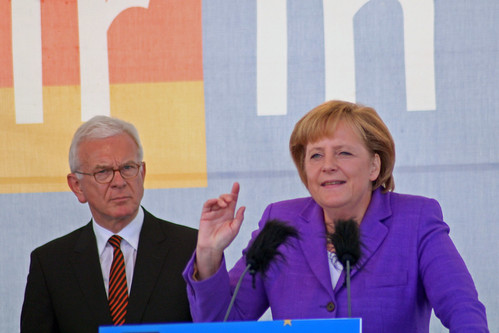
Angie takes a licking, but will she keep on ticking?

Angela Merkel may be riding high on the world stage, but at home in Germany she is in trouble. Deep trouble. Already heavily battered by her decision to provide money to Greece to prevent the euro collapsing, her current efforts to make drastic austerity cuts to the German budget caused a major revolt this week within her governing coalition.

The German parliament is this week voting to select a new president for the country. It's a largely ceremonial position, roughly equivalent to the Queen of England bar for the fact that nobody outside of Germany would know who their president is. Ordinarily the leader of the party in power selects the president, because he or she controls the majority of votes in the parliament. Merkel's selection was Lower Saxony governor Christian Wulff, perceived by the public as a rather uninspiring career politician.