Monday, 16 May 2011

IMF arrest rocks French politics

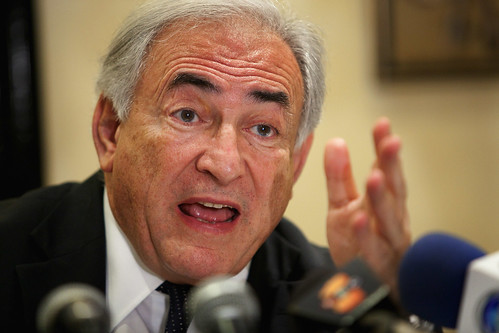
He could have been the next president of France, but instead Dominique Strauss-Kahn sits tonight in a New York City jail. Yesterday's news that the International Monetary Fund head was arrested for attempted rape has sent shock waves throughout Europe. DSK, as he is known in his native France, was set to become the Socialist candidate to challenge French president Nicolas Sarkozy in next year's election. Opinion polls had indicated that he could defeat the French president. Now with DSK out of the picture, France looks set for another five years of Sarkozy.

The French Socialist party has been in disarray for years now, without a clear leader who could defeat Sarkozy. Strauss-Kahn ran for president in 2007, but lost his party's nomination to Segolene Royal (who eventually lost to Sarkozy). After Sarkozy won he nominated Strauss-Kahn to head the IMF, undoubtedly to remove a formidable political enemy from the country. DSK's time at the IMF has been considered successful, as he has navigated the fund through a difficult period of economic crisis and debt bailouts in Europe.

The French media today has been all DSK all the time. It's a political earthquake that has sent the entire country spinning. Some of the media coverage has conjured up conspiracy theories, while others are blaming the "Anglo-Saxon world" for persecuting their poor misunderstood Gallic hero. Some die-hard Socialists are convinced that the whole thing is a set-up by Sarkozy's UMP. The fires of their conspiracy theories have been fanned by the fact that apparently the news was tweeted by a young UMP activist even before the arrest took place. Many have suggested that the maid making the accusation was set up as a honey trap. A poll this week found that 57% of French people believe Strauss-Kahn was set up, and the figure shoots up to 70% among Socialists.

Sunday, 15 May 2011

Eurovision leaves Europe

After two years in Western Europe, Eurovision will return to the East next year – as far East as it could possibly go. Azerbaijan was the surprise winner of the Eurovision Song Contest Saturday night, meaning next year the contest will be held in the Caspian Sea coast city of Baku. It is located just 150km (93 miles) from the Iranian border.

It will be an awkward host city given that the country is in an ongoing conflict with its neighbour Armenia which has sometimes spilled over into the contest, most notably in 2009 when people in Azerbaijan who had voted for Armenia were interrogated by the police. Azerbaijan was almost banned from the contest as a result, but the European Broadcasting Union decided to only give them a fine.

Many people were left scratching their heads Saturday night asking, "Erm, where is Azerbaijan again?". Depending on which definition you use, this will be just the third time that the Eurovision Song Contest will not be hosted outside Europe, following the contests in Israel in 1979 and 1999. The border between Europe and Asia is generally taken to be the Caucasus Mountains, which Baku is technically just South of. It will be the first time the ESC will go to a region with several active military conflicts - the Caucasus is home to disputed territories and ongoing military conflicts in Chechnya, South Ossetia and Nagorno-Karabakh just to name a few. It will be the second time an ESC will be held in a Muslim country, following the final in Istanbul in 2004. That contest, incidentally, was hosted in the European side of that city, west of the Bosphorus Strait.

Friday, 13 May 2011

A return to walls in Europe

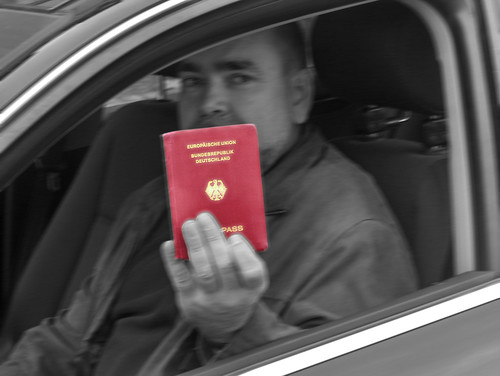
There's something rotten in the state of Denmark, and the rot is spreading fast throughout the European Union. Brussels is in shock today following yesterday's announcement by Denmark that it will reintroduce border controls with neighbouring Sweden and Germany.

The move is a violation of the bloc's Schengen passport-free rules and a worrying sign as EU ministers meet in Brussels today to discuss possible changes to the Schengen rules. The plan would set up the first border control between Sweden and Denmark in more than 50 years.

The move is no doubt intended as a pre-emptive strike ahead of today's negotiations, a message to the EU that if the ban on internal border controls isn't loosened member states are going to ignore it and unilaterally re-impose passport checks. Denmark likely feels confident enough to take this bold unilateral move because of the letter sent to the European Commission by Nicolas Sarkozy and Silvio Berlusconi two weeks ago.

The letter demanded that member states be allowed to reimpose internal EU borders in "exceptional circumstances." They believe that the current increase in migrants trying to come to Europe from North Africa qualifies as one of these circumstances. Denmark clearly feels that this letter from two large member states gives them cover to unilaterally impose their own border control. It is the first country ever to reimpose permanent border checks in the history of the Schengen Zone, and there is now fear of a 'chain reaction' that would see the reintroduction of controls at all internal borders.

Wednesday, 11 May 2011

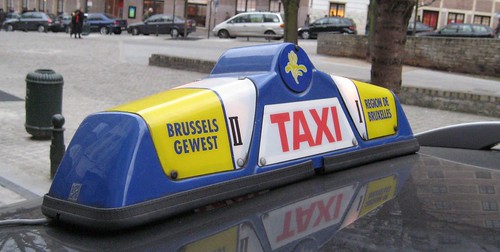
Taxi drivers blockade Brussels Airport

In this land of the surreal, nothing surprises me any more. So it hardly phased me this morning when I read in the local paper that last night 200 taxi drivers blockaded Brussels Airport because an unlicensed taxi driver had been grazed by a bullet during a high-speed police chase. 'Still, something isn't right about this story,' I thought. But I figured I must have been not understanding the French article correctly.

But no, it turns out the story really is that bizarre. Last night police were making routine checks for unlicensed taxi drivers near the airport (who are notorious for swindling tourists by charging them three times the normal fare when they pull up to their hotel). According to the local paper La Derniere Heure, when the police signalled for one 28-year-old driver to stop he instead accelerated to speed away. The police officer jumped on the hood of his car, but the driver still didn't stop.

The police officer was then carried 2km (1.2 miles) along the road, clinging to the car for dear life. He fired into the car toward the dashboard, smashing the screen and forcing the driver to stop. A fight erupted and the police officer fired a shot that grazed the driver's shoulder. They then took him into custody.

Lost in translation?

Portugal's Eurovision performance last night at the first semi-final in Dusseldorf raised more than a few eyebrows. In the midst of what many see as a German-imposed austerity drive forced on Portugal after they had to take a €78 billion bailout from the EU and IMF, their Eurovision entry performed a song dressed as protestors and chanting slogans, right in the belly of the beast. It was a bit of an awkward moment, especially considering political messages are supposed to be banned from the Eurovision Song Contest.


According to the group, the song was apparently supposed to be a sort of celebration of Portugal despite all of its bad news. Entitled "A Luta é Alegria" (The Struggle is Joy), it calls on the Portuguese to not give in to feelings of despair or rage at the restrictions being imposed on them. The message, I imagine, was intended to be like the old expression 'keep calm and carry on' used by the British during World War II. "There’s no point in tightening the belt, there’s no point in complaining," they sang. "There’s no point in frowning and rage is pointless, it won’t help you. Many people wish to silence you. Many people want you to feel resentful. Many people want to sell you the air itself."

Friday, 6 May 2011

Europe uncomfortable with US Bin Laden celebrations

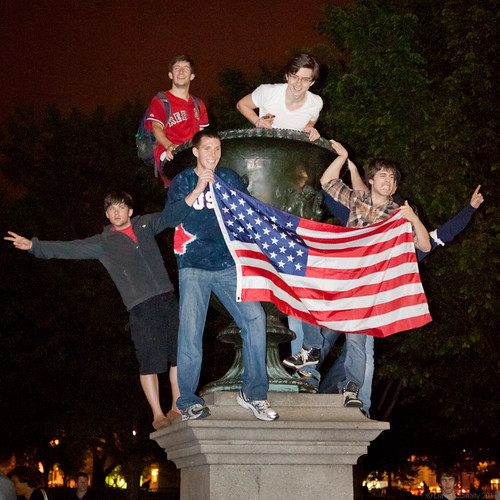
I've had a rather surreal experience this week watching reaction to the news that Osama Bin Laden was killed by American forces. On Monday morning I woke up and opened Facebook (before anything else, naturally), and saw a string of cryptic statuses chanting things like "USA! USA!" or "I'm so proud to be American today". But for whatever reason none of them said what had actually happened. So I had to open up Google News to learn what had inspired these rather unlikely chants from my "liberal elitist" friends in New York City.

The news was, of course, that Osama Bin Laden had been killed. The announcement by President Obama Sunday night prompted sudden exuberant celebrations in cities across America, the biggest outside the White House and in Times Square. It was reminiscent of the Victory Day celebrations at the end of World War II, a cathartic celebration unleashing a decade of angst Americans had felt since the 9/11 attacks. I found the magnitude of the celebrations a little surprising, but perhaps I had underestimated the effect that America's inability to capture Osama Bin Laden has had on the US psyche. A profound sense of anxiety and humiliation seems to have been lifted from Americans' minds with this killing. And both the left and right are jubilant over it. The American media seems to have regarded these celebrations as a universal good, heralding the way they have brought left and right together and united Americans in the same way that they were united after 9/11. The question does not seem to be asked whether Americans can be 'unified' in a counter-productive instinct.