Friday, 30 October 2009

Little Support for 'President Blair'

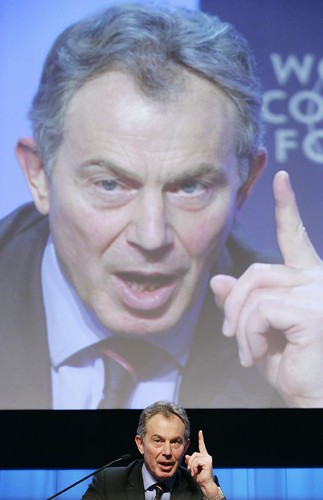
The big European Council meeting is wrapping up this afternoon, and it looks like two definite conclusions are emerging: the Lisbon Treaty will shortly be signed by Czech president Klaus and Tony Blair will not be the first “president of Europe”.

Sources at the council
meeting are saying that almost all EU leaders are now unfavourable toward the prospect of Blair getting the presidency - most notably the leaders of Portugal, Spain and Greece (basically the only socialist governments in the EU other than the UK) and Angela Merkel, the main power broker as the leader of the largest EU country. It looks like the only leader supporting Tony Blair is his former rival, Gordon Brown. How bitterly ironic.

The British media has run with this story today
, effectively proclaiming the idea of a Blair presidency dead. In fact the story has been so widespread, and Downing Street so willing to publicly accept defeat, that I can’t help but wonder if this is an attempt by New Labour to feed this story to the media in order to take Blair out of the “frontrunner” status. Frontrunners are notoriously handicapped when it comes to getting nominated for EU positions. It may be that Blair now thinks the best way of getting the position is by appearing to be out of the race.

Much of the British media has been focusing on Blair’s role in Iraq and economic policies that stoked the financial crisis as the reason so may on the continent are opposed to his presidency. But I can tell you the biggest objection I hear coming from Brussels is there mere fact that he is British. They say the presidency should not go to someone from a country that is not really a fully participatory member of the EU – considering that it doesn’t use the euro, is not in the borderless Schengen zone, is the only country to receive a rebate from its EU financial contributions and has opted out of the charter of fundamental human rights.

Interestingly it would appear that the socialists are not backing Blair because they’ve made the political calculation that David Miliband is the only socialist who stands a chance of getting the new foreign policy chief position. And since both new positions can’t go to Brits, they want to squash talk of Blair right now in order to get Miliband in the running early. And his very pro-European speech earlier this week certainly ingratiated him to many on the continent.

So it looks like we’re back to square one, though Blair could conceivably pull it off. There is a lot working against him, but in the end the powers that be in continental Europe may decide that the appeal of having a “heavy hitting” president outweighs the baggage that Blair would bring to the position with him.

Tuesday, 27 October 2009

Miliband: UK Must Drop the 'Hubris and Nostalgia'

UK Foreign Secretary David Miliband delivered a stunningly pro-European speech yesterday, laying out a plea for the UK to stop being “lost in hubris, nostalgia or xenophobia” and instead become a leader within the EU.

It was probably the most pro-Europe speech from a British politician in two decades, and was a dramatic departure from New Labour’s characteristic avoidance of the Europe issue. It was an almost shockingly honest levelling with the British public – thee hallmark of a politician on the way out (He’s probably already accepted the fact that Labour will lose the UK general election next year). Today the British press was speculating over whether the speech was an audition for the newly created position of EU Foreign Minister, for which Miliband’s name has been circulating as an idea should Tony Blair not be nominated as the new President of the European Council.

Miliband made a clear case for why it is in the UK’s national interest to be part of a strong EU. It is a given that the 21st century will be dominated by two superpowers: China and the United States. Miliband stressed that the UK would be lost and forgotten in this new world if it tried to go it alone, but a strong EU would be an important, equal competitor/partner with these two. Speaking in London, he said:

“The choice for Europe is simple. Get our act together and make the EU a leader on the world stage, or become spectators in a G2 world shaped by the US and China. I think the choice for the UK is also simply stated: we can lead a strong European foreign policy or – lost in hubris, nostalgia or xenophobia – watch our influence in the world wane.”

There was no talk of “red lines” or the ‘us-versus-them’ rhetoric that has dominated the Europe discussion in the UK. There was also no glorification of the largely imaginary “special relationship” between the UK and US as an alternative to European integration, in fact there was an acknowledgement that the current US administration would prefer the UK to be more cooperative with its EU partners.

Miliband also called out the Tories on the false promise they have been offering the British public - that it is possible for the UK to ‘go it alone’ without the EU and still be prosperous. Miliband implied that Tory leader David Cameron knows full well that a British ‘divorce’ from the EU is not only unwise, it is also realistically impossible.

"The truth is that there is a deception here at the heart of [the Conservative’s] policy – a deception of the country that you can hate Europe as it exists today and remain central to European policy making,"

A Tough Sell

Some of the British press reaction today to Miliband’s speech has been hostile. It is, after all, a tough pill for the Brits to swallow. I don’t begrudge the British for being resistant to the idea of giving up some national sovereignty. It’s natural for any area or group to want to be completely independent – especially since the advent of the nation state in the 19th century. The question is whether complete independence is feasible or productive. In theory, I would love the idea of having an independent New England, my home region in the US. I don’t feel much of an affinity with vast swathes of America, especially the South, and I instinctively like the idea of New England not having to be linked with them, instead being allowed to set up its own national laws. But I also recognize that there are practical benefits to being part of a large union, and that New England would not be a very relevant or wealthy power all by itself.

What the British public don’t seem to realise is that this isn’t a choice – it’s a necessity. It’s not an option for Britain to maintain its current standing in the world alone – it currently punches too far above its weight now as a result of being a former great power, but it will lose its relevance (including the inevitable loss of its seat on the UN Security Council) in a century dominated by the US and China. At the same time, relying on the so-called “special relationship” (a term I’ve never heard used in the US) is no longer an option either. Barack Obama has signalled that the US no longer sees the UK as a significant partner separate from Europe, and he would actually prefer that the UK work fully as part of the EU and stop obsessing over its relationship with the US.

And as The Independent’s Mary Dejevsky notes today, the “special relationship” was always a one-way ‘vassal state’ arrangement, and it no longer makes sense for either party in the 21st century. “Identifying our national interests so closely with those of the United States placed us in the demeaning position of having to change our foreign policy whenever the US elected a new administration, even though our own government was the same,” she writes.

If the UK wants to be a relevant, important country going forward it has only one option – to be a big player in a cohesive, strong EU. As foreign secretary, David Miliband understands this. Yet he has been the only Foreign Secretary in living memory with the courage to say it.
Of course Miliband’s words would be more encouraging were he not about to be ousted from power by British voters next year. If polling data is to believe the Brits will vote in a new government that is the most Eurosceptic of any since the UK joined the EU. As Dejevsky notes, Cameron is swimming against the tide of history, his only European allies on the margins.

Still, there is reason to believe that Cameron’s anti-Europe rhetoric is only a show, a cheap populist pantomime in order to win votes before settling into a more real politik stance once he gets into office. Who knows, the future could follow the old ‘Only Nixon could go to China’ rule and Cameron could end up being far more cooperative with Europe than Labour was. I attended a policy talk in Brussels back in March where economist Simon Titley was actually predicting that it would be the Tories who will introduce the euro in the UK.

Perhaps this is just wishful thinking on the continent. The fact is nobody knows what Cameron will do in regards to Europe, but if his actions match his campaigning rhetoric then the UK is in trouble. New Labour may not have been very courageous or honest with its Europe stance so far, but as the saying goes, perhaps its better the devil you know.

Sunday, 25 October 2009

Brussels - Europe's Pseudo Political Exile?

The European Commission is a strange animal - a massive maze of overlaping departments, constituencies and nationalities. Given that it can be difficult to wrap your head around, I often feel that the perception of "democratic deficit" in the EU has a lot to do with the public's lack of understanding of what the European Commission - the EU's executive branch - is. So I thought this weekend's news from Germany might make a good anecdote for explaining some of its idiosyncrasies.

News is emerging this weekend that German chancellor Angela Merkel will replace Germany's Social Democrat commissioner Günter Verheugen with Conservative Guenther Oettinger. This is a natural consequence of the election result last month, when Merkel's Conservatives got enough votes to kick the Social Democrats out of her coalition government. As they say, elections have consequences. The voters of Germany cast their lot with the Conservatives, and so they will now have a Conservative German commissioner in the EC, hand-selected by Merkel.

Though the commissioners aren't directly elected, they are nominated by the national governments which people elected - so contrary to common belief they are, indirectly, accountable to voters. If (or when) Labour is voted out of power in the UK next year, the Tories will remove the current British commissioner (Baroness Ashton) and replace her with a Tory when the next commission ends after its five-year term.

Another recent election which changed the governing party was in Greece, where the Socialists ousted the Conservative government. For this reason Greece's commissioner, Environment Commissioner Stavros Dimas, will likely be exiting stage left very shortly.

So there's your Democracy. However, there's another aspect of this Germany news which highlights a not-so-reaffirming aspect of the Commission.

Guenther Oettinger is the premier of the southern state of Baden-Wuerttemberg, and has been mired in some controversy in the past. In April of 2007 he gave a eulogy for one of the previous premiers of Baden-Wuerttemberg named Hans Filbinger. Filbinger served in the legal department of the Nazi regime and his involvement with them was an ever-present source of controversy throughout his career after the war (thought he contends he was made to cooperate with the Nazis against his will). In his eulogy, Oettinger played down Filberger's Nazi past and for this he was widely criticised. He even received a public scolding from Angela Merkel for it.

So immediately after news emerged of this pick there were rumblings of discontent - not so much for the fact that Merkel was putting someone with this controversial background into the position, but for the fact that it appeared like Merkel was trying to quickly shuffle a high-ranking CDU politician who had "misbehaved" out of sight. The Social Democrats came out with a statement today accusing Merkel of "withdrawing a beleaguered premier from circulation," according to M&C.

Now, failing to mention someone's decades-old loose Nazi connections in a euology may not seem like a big transgression, but in Germany it was a notable affair. So it seems as if this could be yet another instance of a national government 'sweeping problems under the rug' by sending problematic politicians to Brussels where they remain out of sight, and yet still relatively powerful.

It reminds me of what happened to Peter Mandelson in the UK four years ago. Mandelson is a hugely powerful politician who was intrumental in the rise of Tony Blair, but a series of scandals eventually made it untenable for Blair to keep him in the British cabinet, and he was shuffled off to a political exile in Brussels in 2004. Now during that time as Trade Commissioner Mandelson was hugely influential, but in the British press it was as if he had disapeared. Finally last year, when Gordon Brown's troubles were growing especially daunting, Brown made a shock move by bringing Mandelson back from Brussels and putting him in his cabinet. Speaking at this year's Labour Party Conference, Mandelson made it sound like he had been locked in a dungeon in Brussels for four years, and had at last been let out to see the light of day again.

That's the rather bizarre thing about commissioners. They are very powerful and they set the policy for Europe, yet once they are in Brussels they often disapear from the front pages of their nation's newspapers. It's a bizarre form of modern political exile in Europe, a way for governments to quickly push someone out of the spotlight who is much needed and talented, but also controversial. From some early political reaction in Germany, it appears that the appointment of Oettinger may be that kind of move.

For some people, like Mandelson, they could never be satisfied with power without prestige. For others, it may suit them fine. I don't know anything abotu Oettinger to say into which camp he falls.

But I do think that this practice of trying to 'hide' ministers in Brussels does a disservice to helping people understand how the EU works and who the people are that are running it. In the end I think what many in Europe call a "democratic defecit" is actually an attention defecit. The commissioners feel unelected and unaccountable because nobody ever hears about them. But in reality, the decisions people make at the ballot box do have an impact on the composition of the European Commission, even if it is a few steps removed down the line.

Friday, 23 October 2009

Race-Focused 'Question Time' Ignored Griffin's Europe Role

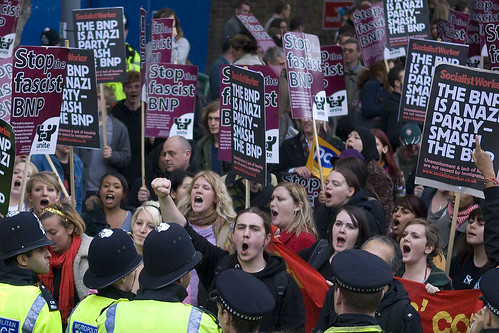
It was the dramatic conclusion of a month-long drama – Nick Griffin, the controversial leader of the whites-only British National Party, appeared on revered public affairs program Question Time last night amidst massive protests outside the studio, and the largest audience in the programme’s history glued to their TV sets at home.

There’s been much written today about what went on last night, but for me what was most interesting was what was not said on last night’s program. Almost unitarily focused on race, host David Dimbleby went out of his way to avoid any discussion of the institution Griffin was actually elected to in June, the European Parliament. I found this bizarre considering it was that election which the BBC says necessitated Griffin’s appearance on the programme in the first place. If it’s the June election that changed the equation in the BBC’s mind, why was the program unitarily focused on things that were said and done well before June 2009?

The level of public attention this program and the build-up to it received has been astounding. Griffin is the leader of the far right British National Party, which has advocated for an “all-white Britain.” His own extremist history has included membership in the violent Neo Nazi group National Front in the 1970’s, denying the holocaust and advocating the criminalisation of homosexuality, the deportation of British Muslims and the denunciation of multiculturalism. He has in the past professed admiration for both the Klu Klux Klan and Adolf Hitler.

Normally a person with such extreme views would not be featured as a guest on a major British public policy show, but the BNP has a significant electoral success in June, garnering one million votes in the European Parliament election which netted them two seats in that body, their first elected positions ever (Griffin and his deputy took up the seats). The BBC said now that Griffin has been elected to a national position by the British public, it cannot justify refusing to allow him on the broadcaster’s main programs – since it has a mandate as an unbiased public institution.

This sparked a huge outcry, culminating in a massive protest yesterday at BBC Television Centre during the taping of the episode. The show itself ended up being rather predictable. Both the other panellists and the audience took turns berating him for his racist views, and Griffin gave blathering incoherent responses that showed he is essentially a rather confused idiot. The program quickly turned into a game of cat and mouse – with Griffin working hard to project an image of a new moderated mainstream BNP which isn’t overtly “racist,” and the panellists and audience reminding him of all the racist things he’s said in the past, which he repeatedly denied saying.

Of course his excuses for why he had “changed his mind” about many of the odious things he’s said in the past were as inept as they were implausible. He twisted, laughed and clapped bizarrely as he was confronted by his past statements. And he seemed completely unprepared when presented with a quote from before the June election, on video, in which laid out a plan to pretend to moderate his beliefs on race and religion in order to make the BNP palatable and get it into office. Surely, if you’re planning some kind of Machiavellian coup like that, you probably shouldn’t talk about your plans on video!

The main aim of both the BBC and the panellists seemed to be to highlight Griffin’s racist views for the BNP voters at home who don’t consider themselves to be ‘racist’ but voted for them as a “protest vote.” The BNP has tried to gloss over their racist foundations with pamphlets full of images of British flags, happy families, proud soldiers and Churchill, Churchill, Churchill. The Tory representative, Baroness Sayeeda Warsi (herself British Asian), seemed to actually be making a concerted effort to steal away those “protest vote” BNP voters over to the Tory side. (Incidentally, I thought she and the Tories were the clear winners from last night’s show. She did a great job, though I was a little creeped out by her efforts to woo BNPers to the Conservative bosom).

Race-Baiting

But throughout it all Dimbleby was hell-bent on keeping the conversation focused on race and sexuality, as Griffin’s previous statements on those subjects are repugnant to the vast majority of British people. But the newly politically calculating Griffin refused to be drawn in, saying very few overtly offensive things during the conversation. In fact the most offensive thing he said was probably that Islam is an “evil” religion, a view I suspect many in Britain share (even many on the left). Throughout the whole discussion I kept thinking what some BNP-voter up in the East Midlands would be thinking watching this – a bunch of smug West Londoners seemingly putting racist words in the mouth of Griffin while he just sat there and said very little. For people who already feel alienated from the political system, this probably just played right in to their admiration of Griffin as an ‘underdog standing up for the working class’.

The fact is that outside its positions on race and sexuality, much of the BNPs political platform are grievances shared by an increasingly large swathe of the British public – xenophobic attitudes toward the EU, immigration and resource sharing. But Dimbleby was intent on steering the conversation away from those issues so the program could highlight Griffin’s differences with mainstream British opinion rather than the overlap. He didn’t want to highlight the aspects of the caged monster shared with the stone-throwing audience. But if Griffin’s opinions are supposedly so uniformly vile to the British public, how did he attract a million votes in the last election?

The omission was evidenced by the almost absurd non-inclusion of any discussion about the body Griffin was actually just elected to, the European Parliament. Toward the beginning of the program a questioner tried to ask Griffin about Europe and Dimbleby shut him down. “We’re talking about race!” he bellowed. “We’ll get to that later.”

Of course they did not get to that later. Clearly Dimbleby considered this to be an irrelevant question. Nevermind the fact that that Griffin is now representing the UK in the European Parliament!

The fact is probably many in the audience probably agreed with Griffin’s opinion that the EU is dangerous and tyrannical, and after all, finding commonalities between Griffin and the British public was not what this show was all about. No no, let’s stay focused on race so we can all boo and jeer Mr. Griffin’s medieval views (views which, by the way, have now been largely erased or covered over in the official BNP party platform). God forbid any of the audience, or on the panel, should look in the mirror to see how their assumption of British superiority over the rest of Europe, their subtle xenophobia rather than overt racism, informs their attitude toward European integration. That probably wouldn’t have been very comfortable for them, seeing their opinions mirrored in the spittle-flecked ramblings of a far-right nationalist.

It’s puzzling to see how, while Griffin has been a unitary obsession of the British media over the past month, his new position in Brussels has been almost completely ignored. The most egregious example came yesterday in this article from the Guardian, which called on the Question Time panel to grill Griffin about his views on climate change (he denies its existence except when warning of overpopulation). Of course the show should have asked him about climate change (they didn’t, as it’s not race-related). Griffin is now on the European Parliament’s Environment Committee, meaning he has a sizable influence over environmental policy affecting the UK (the majority of which comes from Brussels), far more influence than the vast majority of MPs in Westminster. Yet the Guardian article manages to not mention Griffin’s position on the Committee even once, even though the whole purpose of the article is to rail about Griffin’s views on climate change.


I don’t mean to be a one-trick pony here, but it really irked me that this very significant development – that Griffin is now representing Britain in the EU and has a particular influence on environmental policy, was completely ignored. Perhaps there was good reason to focus on Griffin’s racism since he is so keen to gloss over it. And perhaps it was better not to delve into an actual policy discussion with him for fear of legitimising his position. But from my vantage point it was just yet another example of the British public’s steadfast determination to ignore the existence of the EU at all costs.

The British Tancredo

But perhaps I’m too hard on the British. After all I have to say, as an American I’ve actually been quite impressed and heartened by the energetic resistance to the rise of Griffin’s ideology. Much of the BNP’s current platform (the cleaned-up version that omits the group’s overtly racist origins) is nearly identical to the platform of mainstream Republican politicians in the US. Griffin’s immigration policy, as expressed on Question Time last night, is very similar to that of Republican Congressman Tom Tancredo, who was a major contender for the 2008 Republican presidential nomination. That’s not to mention the BNP platform’s similarities to right-wing American television commentators like Glenn Beck and Lou Dobbs. And Griffin’s current stated view on homosexuality, though it was condemned by the representatives of all three major UK parties on the Question Time panel, would easily be at home in the Republican Party’s official platform. So it’s nice to see that I live in a country where these kinds of views, so common in my home country, are so reviled.

Also, Britain should keep in mind that it is hardly the first European country to send far-right politicians to the European Parliament, France beat them to that by many years. In fact the experience of France with far right Front Nationale leader Jean Marie Le Pen (also of the European Parliament) has been repeatedly brought up as a cautionary tale by British commentators. An invite by the French broadcaster for Le Pen to appear on the French equivalent of Question Time was equally controversial, and resulted in a doubling in the size of the party. Le Pen eventually rode that wave of popularity all the way to victory in the 2002 presidential race, when a fluke in the 1st round voting meant that the second round was a one-on-one contest between him and French President Jacques Chirac. There are fears that Griffin’s appearance on Question Time could lead to a similarly meteoric rise in the UK, but I just don’t see that happening.

By the way, the BBC has a great article here about how the media deals with far-right parties across Europe. It’s a very interesting side-by-side comparison, and I think helps to set all this within a larger context.

Of course, that would require some thinking about Europe, which as we learned last night, the Brits are loathe to do.

Thursday, 22 October 2009

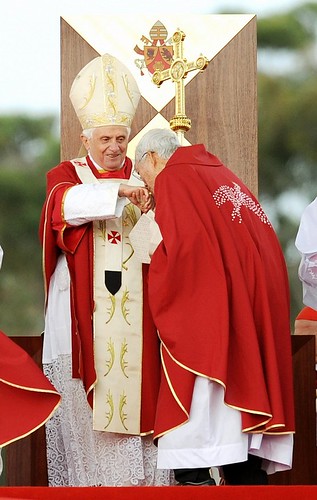
The Pope makes a bid for Anglicans

The Anglican Church has been in pandemonium this week, with everyone trying to make sense of the surprise announcement on Tuesday that the Roman Catholic Church is making a bid for their members. According to many religion commentators, the historic invitation from the Vatican is very likely to tear the Anglican Communion (which includes Episcopalians in the US) apart. But considering the opposing sides of the church have been at each other’s throats for a decade now, perhaps this open hand from Rome is just what it needs to facilitate an amicable divorce.

The Vatican announced that it is going to make special arrangements for protestant Anglicans to defect and join the Catholic Church as full members, while still being able to preserve their Anglican traditions and practices including – most significantly – the right for priests to be married.

Many media outlets, including this really interesting article from the BBC, have billed this as a historic and unprecedented decision. Historic it may be, but not exactly unprecedented. Most of the media has failed to note the fact that the arrangement will be similar to that accorded to the Eastern Catholic Churches, the ancient Christian sects of the Middle East which are in full communion with the Catholic church yet retain their own customs, including different baptism rites and the right of priests to marry.

Wednesday, 21 October 2009

US Alarmed by Cameron’s Europe Moves

It looks like worries about a future Tory government aren’t limited to Paris and Berlin. Reports are circulating today that US Secretary of State Hillary Clinton expressed concern last week during her visit to Europe over David Cameron’s increasingly combative stance toward the EU, saying the US is worried that the “direction of travel” from what will most likely be the next governing party of the UK could lead to a rupture between Britain and the rest of Europe.

Her concern is not in isolation. The Obama administration has been increasingly questioning the wisdom of Tory leader David Cameron’s recent hostile moves toward Europe, including his decision to take the Tories out of the main centre-right grouping in the European Parliament to form a new alliance with hard-right Eastern European parties and his antagonism toward the Lisbon Treaty. The Times reports today that the US Ambassador to Britain has also been voicing alarm over Cameron’s Europe plans, and that Jewish groups within the Democratic Party are expressing alarm over Cameron’s new ties to anti-Semitic politicians in Poland.

The concerns are further evidence that the Obama administration considers the so-called “special relationship” (a term I’ve never heard used in the US, though it is used almost obsessively in the UK) to be obsolete, and would prefer a united Europe to deal with in foreign policy. This is a sea change from the previous US administration, which notoriously used the idea of the “special relationship” to drive a wedge between the UK and Europe in the run-up to the Iraq war. As The Times notes,

“[Obama] believes that Britain should be at the heart of Europe — a position that has been put in doubt by French and German anger over Mr Cameron’s decision to sever ties with the federalist centre right grouping in the Strasbourg Parliament. Mr Obama is enthusiastic about the idea of a permanent EU president to replace the revolving chairmanship of the EU council, a measure opposed by the Conservatives.”
Wheras the Bush administration was hostile toward the EU and seemed to repeatedly seek to undermine it, the Obama administration has so far been an enthusiastic supporter, as demonstrated by Hillary Clinton’s speech in Brussels earlier this year. In fact I think I could without hyperbole call Obama a European federalist. He wants a strong, united Europe as a partner in combating terrorism, dealing with the financial crisis and providing a counterweight to China.

The administration’s reported comments seem to suggest that Obama has little patience for European leaders who cow-tow to old instincts of nationalism and divisiveness. And he has also demonstrated impatience with some of the more archaic, slow-moving aspects of the EU, and is likely eager for the streamlined reforms the Lisbon Treaty will bring about. Of course this is just speculation, but it’s what his administration’s statements and behaviour seem to suggest.