Monday, 30 November 2009

Zapatero: the left’s last hope?

Spain’s rather shy, gentle prime minister Jose Luis Zapatero has never been one to seek out the limelight. But with the EU’s top jobs now all handed out, Zapatero has become the lone Socialist voice at the top level of the EU. In fact, the Spanish prime minister may be the last hope of relevance for European Democratic Socialism in the coming decade. Given his personality, this is likely a position he does not relish.

In the last week the European Council has chosen the first people to occupy the much anticipated President and Foreign Policy High Representative positions, and European Commission president Jose Manuel Barroso has unveiled the faces and portfolios of the new commissioners. Looking at the line-up one thing is clear: the next five years will see an EU dominated by the centre-right.

The Commission presidency, which will likely remain the most powerful position following the council’s decision to go with a low-profile presidency pick, is still occupied by the centre-right former Portuguese prime minister Barroso. Former Belgian prime minister Herman Van Rompuy, chosen as the first Council President (or “EU president” if you like), is also a Conservative. Baroness Ashton of the British Labour party was chosen to be the first foreign minister, but though she is technically in the Socialist camp, New Labour hardly fits comfortably in that grouping and she will be significantly to the right of most Western European Socialist parties. Even if she weren’t, she has already signalled she intends to maintain a low profile.

With the commission announcement on Friday it was clear that the most important positions had all gone to people from conservative parties. Centre-right Frenchman Michel Barnier got the all-important Internal Market position, for which Nicolas Sarkozy could barely contain his glee over the weekend. Denmark’s centre-right Connie Hedegaard got the newly-created Climate Change assignment, while Centre-right German Gunther Oettinger got the very important Energy post. Conservatives took the Industry, Development, Regional Policy, Health, Budget and Agriculture posts. So what did the Socialists and Liberals get? Something called “Digital Agenda”, Enlargement, Research and Innovation and Maritime Affairs to name a few. Nothing too flashy. It seems to me the only very important DG the Socialists got is Competition. That went to Joaquin Almunia, Zapatero’s colleague in Spain.

Following the pan-European conservative victory in the June European Parliament elections, which made the centre-right the largest party in parliament, that body also has a conservative president in Jerzy Buzek of Poland. This means the presidents of all three branches of EU government – the Commission, the Council and the Parliament – are all from the centre-right.

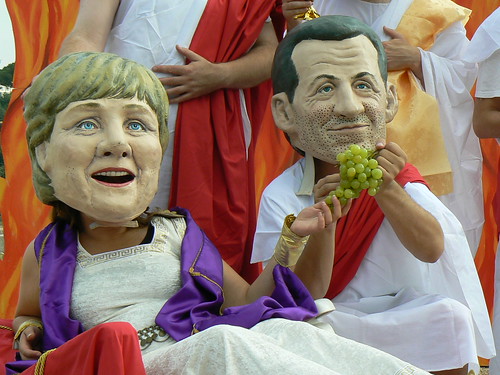
Wanted: a Sarkozy for the left

Contrary to what had been widely reported in the English-language press (I myself was guilty of the misunderstanding as well), the new Council presidency is not replacing the rotating council presidency that is held by a country. Here’s where it gets a little confusing. The European Council is actually made up of many different councils, each focusing on a different subject area. So for instance, there is a council of finance ministers that meets periodically with the finance ministers from each member state. Likewise for environment, agriculture or trade. Those meetings will still be chaired by the country holding the rotating EU presidency. And starting January 1st, that country will be Spain.

However the European Council of national leaders, when all the prime ministers/presidents meet, will no longer be chaired by the rotating country presidency. That all-important group will be chaired by Mr. Van Rompuy. This will take much of the pomp and ceremony out of the rotating presidency, but will leave it intact with practical power. Of course the question remains, how much power will it have? That detail will largely be settled over the coming months by Messieurs Von Rompuy and Zapatero.

It will be a critically important power struggle waged by two low-key, soft-spoken men. The Lisbon Treaty theoretically gives both men significant powers. Van Rompuy can call special summits of EU leaders, draw up the agenda of the meetings, decide on whether to hold a vote and decide if people outside the EU can attend the meetings. However Zapatero will be running the day-to-day running of the council, and the power over the details could end up eclipsing the power over the big picture. In addition the monthly general affairs council, which is extremely powerful, will still be chaired by Spain.

Zapatero has made statements in the past that he does not intend to role over and allow the rotating presidency to be sidelined. There may be ever-increasing pressure from his Socialist colleagues elsewhere in Europe for Zapatero to assert himself even further, considering he and Almunia appear to be the lone continental Socialists in positions of power anywhere in Brussels.
Of course all of this reflects the will of the voters, who have consistently elected conservatives to office in national elections over the past few years with the exception of Iberia and Greece.

Following UK election in April where the Conservatives will likely win, all three of the main EU countries will be under Conservative governments. In this kind of environment, does Zapatero stand a chance of maintaining a place at the table for European socialists? He’s hardly proved himself to be much of an internationalist in the past. Speaking only Spanish, he has largely relegated himself to focusing on Spain’s domestic issues rather than pushing for a Socialist agenda on the European stage. In this way he is almost the polar opposite of his zealous conservative counterpart Nicolas Sarkozy in neighbouring France.

Perhaps Zapatero could defy all expectations and emerge from his shell to become a sort of “Sarkozy of the left”. As the saying goes, cometh the hour cometh the man. Is this the mild-mannered Spanish leader’s time to shine?

Sunday, 29 November 2009

Switzerland Declares War on Architecture

In a shocking result, 57% of the Swiss have voted to ban mosques with minarets in their country. Both the majority of cantons and the majority of people have voted to ban the mosques, reflecting the increasingly xenophobic mood of Swiss politics.

The vote follows the win of the anti-immigrant Swiss People’s Party (SVP) two years ago. Now the largest party in Switzerland’s parliament, the SVP strongly backed the constitutional ban, saying that minarets (the tall slender towers on traditional mosques) are a sign of militant Islam and a threat to Switzerland. However the rest of the political parties in government opposed the ban and warned that it was not only unnecessary, but also sending a hostile message to the country’s minority populations.

Of course in Switzerland it doesn’t matter that the majority of the government strongly opposed a ban, it is easy for citizens to put virtually anything to a national referendum for people to vote on. And with a saturation of posters like the one above, it’s relatively easy to whip up hysteria about what is essentially a non-issue.As demonstrated time and time again, referendums can never be counted on to protect the rigthts of minorities.

Switzerland has 4 minarets in the entire country, an incredibly low number for a Western European country. This is the result of two factors – the Muslim population is fairly small at 400,000, and planning applications for minarets are almost always refused by local authorities.

The campaigners for the ban have insisted that minarets are a symbol of militant Islam. SVP member of parliament Ulrich Schluer said "A minaret is a political symbol. It is a symbol for introducing, step-by-step, Sharia rights also in Switzerland, parallel to the Swiss law which is a result of Swiss democracy. And this is the problem. It is nothing against Muslims."

The reality of course is that the vast majority of Switzerland’s Muslims are either fellow Europeans from the Balkans or immigrants from Turkey. They’re not exactly coming from hotbeds of Islamic extremism. In fact Switzerland probably has one of the lowest penetrations of Islamic extremism in Western Europe, considering that immigration from geographic areas where Islamic extremism is a problem – North Africa, the Middle East, Pakistan and Indonesia – is very restricted. So it’s hard to see how such a drastic measure as changing the constitution to ban a piece of architecture is necessary.

Essentially it’s an imaginary solution to an imaginary problem. There is no Islamic extremism problem in Switzerland, and even if there were, how on earth would getting rid of minarets solve it?

The media has been making a lot of comparisons to the French head scarf ban in public schools, but I don't really think this is an apt comparison. The argument was made that the veil disrupted learning and encouraged hostility by providing visable markers of difference between students. There were also safety and practicality questions raised about students being allowed to cover their face in school. This Swiss minaret ban is entirely different, as there is no legitimate practical issue that this resolves - it's entirely symbolic. Muslim calls to prayer are already not allowed in the country because of blanket noise ordinances, so the presence of a minaret really has no practical effect on the population. A girl wearing a veil in a classroom arrguably has a very real effect on the learning environment for her, her teacher, and other pupils.

In any event, this is a dismaying result for a country that seems to be sliding into increasing xenophobia and nastiness. There is a debate to be had about Islam's place in Europe and in European law, but this largely symbolic vote has no practical effect other than alienating Swiss muslims. Perhaps even more importantly, it sends a troublingly hostile message to the world at large.

***Added 30/11/09: Analysis following the vote has found that the ban is most likely illegal under European and international law. I’ve heard a few comments in the UK about how the vote will be ok because Switzerland is not part of the EU. Actually Switzerland is a member of the Council of Europe and is party to the European Convention on Human Rights and subject to the European Court of Human Rights. Grahnlaw has a good entry summing up the various legal analysis, and the overall conclusion is that the ban is contrary to Switzerland’s obligations under European human rights law and will require corrective measures.

Wednesday, 25 November 2009

Brussels Defends the Pirates

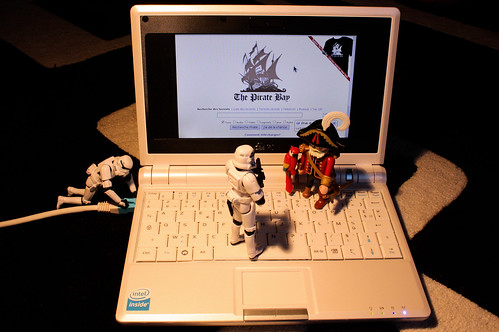
A new front is being opened today in French President Nicolas Sarkozy’s war against internet file-sharing. Yesterday the European Parliament voted on a telecoms package containing ‘right to internet’ provisions which could challenge new French and British laws that would cut off internet access for persistent illegal downloaders.

As I write this entry the Swedish presidency and the parliament’s president are signing the massive overhaul of Europe’s telecom industry in Strasbourg. Among other things it will improve cooperation between European telecom regulators, strengthen privacy protection by allowing users to opt in to the use of cookies, and push broadband rollout across the EU to achieve 100% coverage by 2013. But the lion’s share of attention to the bill has been devoted to its provision for “internet freedom” – the first time such a right has been enshrined in law anywhere in the world.

That provision was largely a response to efforts begun by Sarkozy earlier this year to introduce a French law dubbed “HADOPI” that would cut off internet access to people who persistently download music illegally. In the next few weeks the UK is expected to unveil its Digital Economy bill that will do the same. Spain and Ireland have also been considering introducing such measures. Civil libertarians have been lobbying the EU to introduce some kind of measure to protect EU citizens from an internet ban imposed by their national government.

The European Parliament took up the cause, but in the end it was forced to make a big compromise with the member state governments in order to get the telecoms package to pass. Though the original version of the legislation had mandated that any order for cutting off someone’s internet must go through a judge, the language had to be watered down to simply say internet can be restricted “only after a fair and impartial procedure including the user's right to be heard.” Of course, what constitutes a fair and impartial procedure seems to have been left up to the member states.

Lisbon Treaty’s Effect

Protests over the French and British bills have grown louder over the past few months. In the UK, an e-petition against it has so far collected 11,000 signatures. In France, the extensive Francophone blogosphere has been virtually illuminated with rage over the HADOPI bill. And noises from Spain that they will follow suit have elicited a quick and sharp response from top EU officials. Yesterday EU telecoms chief Viviane Reding warned that the EU would take action against Spain if the government moves to cut the internet access of content pirates.

Needless to say, these protestors are disappointed with the outcome of the parliament’s compromise. But this controversy has been an interesting illustration of how the Lisbon Treaty is going to change situations like these. This is a classic parliament-versus-council issue, where the MEP representatives of the people step in to override member states who they believe have overstepped their authority. It is exactly the kind of role the parliament was devised to fulfil. Because of the way the EU has worked up until now it has historically been difficult for the parliament to win these types of battles, since every provision they introduce needs the approval of the European Council, which is composed of the heads of EU countries.

However with the entry of the Lisbon Treaty into force next week, the parliament will get new increased legislative power over the other two branches of EU government. This, rather than the new position of President of the European Council which the media has focused on, is really the more consequential change heralded by the treaty. By some estimates the parliament’s power will effectively double next week. For the first time the parliament will get a say over the budget, judicial cooperation, immigration, structural funds, public services, transport, farm policy, energy security, intellectual property and personal data protection.

If this telecoms package was working its way through parliament just a few months later (or if the Lisbon Treaty had been ratified earlier), the compromise on internet freedom may not have been necessary. It’s an interesting illustration of the ramifications of the treaty, a reality which I think national governments haven’t fully woken up to yet. This internet cut-off issue certainly has legs, and my guess is this isn’t the last time the issue will be brought up by parliament. But in the future, the parliament may have the heft to force the council to accept guarantees of internet rights.

Vienna - Back to the Start

It’s interesting visiting a city again after a ten year absence. I’m on a bunpy flight back to London at the moment, after a very nice few days in Vienna. I hadn’t been there since I went on a trip with my high school band in 1998. Vienna was actually the first city I had ever visited in Europe. Given that this city was my first ‘introduction’ to this continent, it was interesting to go back there now that I’ve lived in Europe several years and have travelled extensively through it. Needless to say, my impressions were far different this time around.

I don’t remember much about that first visit – actually the main impression I remember from it was of a city full of sex. I was just 17 at the time and I remember me and the other high schoolers being amazed when we turned on our TV the first night in the Vienna hotel and saw – get this – breasts! We couldn’t get over it, there were breasts on a main Vienna network! Then we looked out of our window and saw a real live prostitute – or at least a person who we convinced ourselves was a lady of the night. Exploring the city I remember us seeing a few scattered sex shops and thinking truly Vienna was some kind of throbbing sex-obsessed mecca.

It’s amusing to look back on because in reality, Austria is one of the most conservative countries in Europe, and Vienna is known as one of the continent’s more staid and prudish major cities. But to some band geek teenagers from conservative America, it seemed pretty wild!

During the year I lived in Prague in 2002 I kept meaning to take a train down to Vienna but I never made it, which was a shame because I was there studying Central European history. Much like Prague, Vienna is a city reflecting many different eras of European history, from the glory days as capital of the enormous Habsburg empire to its awkward cold war role as a supposedly neutral zone. Because if this Cold War confusion Austria has never really had a period of national soul-searching about its Nazi past, unlike Germany. It remains a staunchly conservative country with an especially hostile attitude toward foreigners. It maintains the toughest asylum rules in Europe and getting a visa to work there is notoriously difficult.

Vienna is a bit like Prague on steroids. It's jam-packed with massively intimidating counter-reformation architecture. But thought it may look like Prague architecturally, the vibe is very different. Miraculously spared the ravages of Soviet domination through sheer luck, Austria is a prosperous country that maintains the third highest GDP in the EU. Despite the fact that it was once part of the same country as its Central European neighbours to the North and East, Austria today bears much more resemblance to Switzerland than to Hungary or the Czech Republic. The two Alpine countries are both beautiful, efficient, prosperous and, above all, uncompromisingly conservative. Austria had to be dragged kicking and screaming into the EU in 1995, and public approval ratings of Brussels remain among the lowest in continental Europe. Obsessed with its Catholic Habsburg heritage, Austria is also one of the more religious countries in Europe.

Over the past few days I couldn’t help continuously comparing Vienna to Zurich, where my father lives. Though the ethos and culture may be very similar, of course the size of Vienna dwarfs that of Zurich, as does the monumental scale of its public buildings. Switzerland, after all, was never the centre of an empire. The Habsburgs left some monumental mementos from the days in which they ruled over nearly 70 million Europeans. It’s often been said that if Martians came to Earth, they would mistake Vienna as the capital of the world.

At the same time there were plenty of reminders of the Swiss mentality, particularly in all the Christmas markets around the city serving Gluhwine. It made me excited that I’ll be in Zurich next weekend for a Thanksgiving dinner at my dad’s house. Zurich at Christmastime is beautiful, and the gluhwine aint half bad either!

Over the weekend I was able to do the three main tourist attractions – the Belvedere, St. Stephan’s Dome, and the Hofburg. I reluctantly went to the exhibit about Empress Elisabeth (“Sisi”) rather than the treasury, but actually I’m really glad I did. It was a fascinating exhibit about a monarch who, though legendary in Austria, I actually didn’t know that much about before. I did know quite a bit about her husband Emperor Franz Josef, and it was really interesting to see the state apartments where he conducted the business of the empire. You could see he was really consumed with the business of running the massive state. According to the tour he rose at 6am every morning and worked tirelessly until 10pm. Of course I took all this information with a dose of salt given the Austrians’ proclivity for glorifying the Habsburgs.

Perhaps the highlight of my trip though was just earlier today, when I stopped in to the crypt of the Kapuzieur Kirche, where all the Habsburgs were buried after 1633. The church itself is small and unassuming, but down in the crupt lies some absolutely massive tombs, including the largest containing the remains of Empress Maria Theresa and her husband. It’s a gigantic iron box mounted with angels and flourishes, and on top sit effigies of the imperial couple, who seem to be sitting on a bed embroiled in some kind of marital tiff. Further along are the tombs of Franz Josef and Sisi, along with their son Prince Rudolph, who died in the Mayerling suicide pact. Sisi’s tomb is decked out with the Hungarian flag and regalia, a testament to her sympathies for Hungarian independence (it is said it was she who finally convinced her husband to make Hungary a co-equal kingdom with Austria, creating the Austro-Hungarian Empire).

Of course it wasn’t all fun and games, I was in Vienna for work – attending a conference on upcoming changes to an EU law on biocides. The conference actually went pretty well, I’ve been covering the subject area for a bit so I felt comfortable talking with people there about it. This is in marked contrast to how I used to feel covering private equity conferences for my old job. It wasn’t a subject I was particularly interested in so it was hard to feign enthusiasm for it at the cocktail receptions. It’s so good to be covering politics again!

On my way to the airport today I also stopped at Donau City, Vienna’s version of London’s Canary Wharf or Paris’s La Defense. Like those two it was built in the 1970’s to form a business area outside the city centre where skyscrapers could be built with impugnity. However unlike the other two it doesn’t seem to have ever gotten off the ground. It was built around the United Nations Centre, which was constructed after Vienna was made the third seat of the UN in 1979. I have to say my heart goes out to anyone who has to work in this monstrosity, it is monumentally ugly. The whole complex just has giant grassy holes in it too. It looks like there were intended to be building sites but they never got around to it. The whole thing just looks rather small and unfinished, yet I didn’t see any construction activity going on there at all. Has Vienna just given up on its La Defense?

The trip out there at least provided an opportunity to actually see the Danube, Europe’s largest river. Oddly enough Vienna’s city centre is nowhere near the river, so it’s quite a hike to get over there. But ti was worth it to see these mighty waters flow south toward Bratislava, Budapest and Romania.

So all in all it was a good trip. I spent a near fortune though – museums in Vienna are not cheap. I’m looking forward to a few days at home back in London before Thanksgiving in Zurich next weekend.

Friday, 20 November 2009

EU Low Representatives?


The look on Catherine Ashton’s face last night said it all. Shocked, flustered and almost a little embarrassed, the largely unknown British commissioner chosen to be the EU’s first “foreign minister” said it was a sign of her surprise that she had no acceptance speech prepared. Speaking in a softly reassuring tone, she said she would pursue a “quiet diplomacy” - characteristic of her low-profile approach to politics. 

Standing beside her, the expression of the unassuming Belgian prime minister Herman Van Rompuy was equally telling. Constantly switching languages every few minutes, he spoke of his reluctant acceptance of the offer from member state leaders to become the European Council’s first president. Oscillating between English, French and his native Dutch, a portrait emerged of a man who has gained a reputation as a quiet consensus-builder, having rescued the national Belgian government from collapse two years ago. 

And with them on the podium stood a beaming European Commission President José Manuel Barroso, a clear winner from last night’s announcement. In these two very low-profile picks Barroso will not have the competition for leadership he feared from a pick like Tony Blair or Jean-Claude Juncker. Since Rompuy will largely relegate his role to being a secretary-coordinator for the European Council, Barroso will continue to be the EU’s de facto leader. And with the demise of the rotating council presidency, he no longer has the prospect of an upstart national leader stealing the show every once in awhile. 

Together the three of them have been dubbed by bloggers today as the “Troika of Boredom” - three rather unengaging and unambitious politicians who are unlikely to give the EU the respected high profile it had sought to achieve by creating these new positions. Indeed, the reaction from Brussels blogs last night and this morning has been overwhelmingly unimpressed. Many are seeing the choice of two rather weak personalities as a deliberate effort by Angela Merkel and Nicolas Sarkozy to ensure that there is no strong supranational EU figure that could challenge their authority in the council. 

As for the fourth man standing in the group, his body language made it clear where his institution is headed. Frederik Reinfeldt, Prime Minister of Sweden (which currently holds the rotating council presidency), was practically being edged off the stage. The rotating country leadership will still continue to host meetings for the Council of Ministers, but it will no longer have any symbolic leadership role.

Franco-German Stitch-Up

Though the people selected for these new EU positions are being seen as boring, the selection itself is anything but. In fact, it is incredibly important. The remit of these two positions was left very vague in the text of the Lisbon Treaty, and all along its been said that the presidency would be defined by the first person who holds the job. 

If it were a high-profile person with much political clout, the presidency could become a powerful position capable of speaking with one voice for the EU on the world stage. If it was a low-profile choice, the presidency would become merely a coordinator role, a consensus-builder who would work behind the scenes to get the different leaders of member states to reach agreement. With the selection of Van Rompuy, member state leaders have made a clear decision about which way the presidency should go. His term length may just be two-and-a-half years, but if Rompuy takes a ‘low-profile coordinator’ approach to it as expected, it would be difficult for the next president to fundamentally reshape the precedent the Belgian set. 

But is this really what EU leaders wanted? Gordon Brown may have had his differences with Tony Blair in the past, but he seems to have been legitimately insistent that Blair should get the position. Indeed, it appears the choice of Ashton was made as a compromise to Brown in exchange for his abandoning the Blair cause. Sweden’s foreign minister seemed less than enthusiastic about the choice this morning, and many in Eastern Europe have been voicing grumbling discontent with the decision today. Certainly the Socialist leaders of Spain, Portugal and Greece can’t be pleased about it, considering they got the short end of the stick. Ashton is a fairly moderate politician who has little to no foreign policy experience. 

This will be largely seen as a Franco-German stitch-up. Merkel had indicated her preference for Van Rompuy early on, and after she persuaded Sarkozy to give up his preference for Tony Blair, the two announced they would be presenting a united front in their selection. This provoked accusations of bullying, with Sweden’s prime minister saying the decision should not be made by just the French and Germans. Certainly, it is a sign of Britain’s lack of influence in Europe that even as one of the ‘big three,’ it was unable to fight against a Franco-German alliance.

“Political Pygmies”

Certainly these two new ‘high representative’ positions were not the only part or even the main part of the Lisbon Treaty. Still, they were a significant part. And after eight long years of fighting for it, this decision has many asking, “What was the point?” The intention of the positions was to give someone the authority and clout to represent the EU on the world stage and stand toe-to-toe with the US and China. These two are unlikely to be able to do that, which bounces authority back to Barroso and back to the status quo, with no united voice for Europe. 

Many federalist Europhiles found themselves in the strange position of agreeing with UKIP leader Nigel Farage last night. Bizarrely, he told the BBC, "We've got the appointment of two political pygmies. In terms of a global voice, the European Union will now be much derided by the rest of the world."  But…isn’t that exactly what UKIP wants? The cognitive dissonance is even more impressive than usual on this one. 

For their part, the Tories praised the decision to go with a low-profile person rather than Tony Blair, with shadow foreign secretary William Hague saying, "I am very pleased that those of us across Europe who said that the president should be a chairman, not a chief, have won the argument.” 

Both the Tories and UKIP were also quick to point out that Baroness Ashton has actually never been elected to anything in her life. She spent most of her career working for a charity run by Prince Charles before being appointed as leader of the House of Lords in 2007 by Gordon Brown. When Peter Mandelson left his “Brussels exile” to return to Westminster in 2008, she took his place as EU Commissioner for Trade, where she’s served for about a year. Trade Commissioner is one of the most important roles in the EU and involves a lot of negotiation with foreign trade bodies (particularly those in the US and China). However it doesn’t necessarily involve any areas of foreign policy outside of trade. 

For his part, Van Rompuy is being lauded by his supporters as someone who united the warring Flemish and Frencophone factions of the Belgian parliament and brought the national government back from its year-long long shutdown in 2008. He reportedly took that job reluctantly after being asked by the Belgian king, who pleaded with him for 90 minutes. He had been set for retirement, and had already been on a long hiatus from politics. Merkel and Sarkozy have argued that his skills as a quiet consensus builder make him perfectly suited to coordinate the diverse member states of the EU. 

But it’s unclear whether this skill will translate to a European level. The disagreements in Belgium are between two parties, not 27. And authority in Belgium has been so devolved to the regions of Flanders and Wallonia by this point that the national government barely does anything at all – as evidenced by the fact that it was barely noticeable when the national government shut down for about a year. Is it that impressive that he was able to bring back to function a body that is largely symbolic by this point anyway? The EU may have it’s problems but it is by no means dysfunctional and is not about to shut down.

Realism

Perhaps the consensus reached last night appropriately reflects the fact that many Europeans are not ready for the notion of an “EU President.” The Liberal Democrats in the UK had an interesting interpretation of the decision yesterday, telling the BBC that the decision would expose the stupidity of the Eurosceptic British media referring to the Lisbon Treaty as if it was solely designed to create a powerful EU presidency for Tony Blair. Foreign affairs spokesman Ed Davey said,
"With low-profile appointees, no-one can take seriously any longer the Eurosceptic deception that these positions would challenge the supremacy of nation states acting together when they agree."
From the perspective of the UK and Scandinavia, where the prospect of an “EU President” was most unpopular, this may be true. But what about the many other Europeans who wanted the EU to speak with a stronger, more coherent voice on the world stage? Who now will have the clout to stand up to the United States in situations like the Iraq War? Who now will bring trade power to bear in negotiations over climate change? The decision to choose low-profile people may allay some of the fears expressed in the British media, but does it do so at the expense of offering a solution to the problem the Lisbon Treaty was trying to solve? 

Time will tell how these two will use their roles, but it looks like the wild card is more likely to be Ashton than Van Rompuy. She is younger, newer, and there is less known about her political stances on foreign policy issues (she by the way has a very left-of-centre husband I understand). Van Rompuy is unlikely to surprise anyone and will probably stick to a low-profile role. But it she wants to, the Baroness could shape the EU's foreign policy positions to be far more powerful than the presidency. 

That is, if she is so inclined.

Wednesday, 11 November 2009

The Sun Overplays its Hand

I’m loath to write about this, as I’m effectively jumping on the same bandwagon I’m about to deride. But given the intense level of media attention “handwritingate” has received over the past three days, it seems it may be impossible to ignore.

I first realized I was eventually going to have to write about this nonsense on Monday, as I was watching a live announcement on SkyNews from UK environment minister Ed Miliband (David’s brother) on a planning approval overhaul that will make it easier for the UK to build nuclear and coal plants. As the speech ended, the 24-hour British news network (owned by Rupert Murdoch’s News Corp) carried about three minutes of the ensuing parliamentary debate, then cut back to the studio. Ah good, I thought, now we’ll hear some analysis of what this announcement means. But no analysis came, in fact there was no mention of the speech we had just seen at all. Instead, the station delved into hour 13 of its non-stop coverage of the fact that UK prime minister Gordon Brown has bad handwriting.

Basically the story goes like this: there have been an extraordinary number of British casualties in Afghanistan over the past few months, attracting increasing public discussion about whether the UK should still be involved in the fight there and whether the troops are properly resourced. Apparently, possibly out of political calculation but more likely out of genuine concern, Gordon Brown has started writing personal handwritten letters to the families of the fallen soldiers. Seems like a nice gesture right? Only problem is the prime minister has horrible handwriting, owing to the fact that he is blind in one eye.

One mother named Jacqui Janes received such a letter from Mr Brown offering condolences for the loss of her son and found it sloppy and riddled with what are either spelling mistakes or illegibilities, depending on your perspective. She was most offended by the fact that the prime minister had appeared to spell her name with an ‘m’ instead of an ‘n’, addressing the letter to “Mrs. James”.

Janes rung up The Sun newspaper, which recently publicly switched its support from New Labour to the Conservatives, and the paper ran with it, making it a lead story two days in a row. The rest of the British media have followed suit, even the venerated BBC. The furore forced the prime minister to personally call the woman to apologise. Janes proceeded to emotionally berate Brown, tape recording the phone conversation and giving (some have speculated selling) it to the Sun, which then released it. Here is the audio below, though I warn it feels like something you shouldn't listening to. (Incidentally, and as awkward as it is to point out, a lack of equipment most likely had nothing to do with her son's death). Brown has since had to address the issue publicly twice in news conferences.


Of course the Sun is also owned by Rupert Murdoch’s NewsCorp, so it is under the same umbrella as another news organisation famous for this kind of thing across the pond – Fox News. The formula works like this: the media outlet picks up a fairly trivial but emotionally charged story, runs it relentlessly as a campaign against the government, and encourages reader/viewer outrage on the subject. It then reports on the viewer outrage, continuing coverage for several more days. Other media outlets worry that they are missing a major story (after all it must be a major story if the Sun/Fox are devoting so much time to it) so they run it as well. Pretty soon the issue is dominating all the front pages, be it manufactured outrage over bad handwriting or created controversy over a presidential address to school students.

However here in Britain there are already signs of pushback against this tried-and-true Newscorp strategy. Much of the readers’ comments under the web version of the original story were defending Brown, perhaps prompting the Sun to block commenting on their subsequent story.

Other papers have begun to note that the Sun risks overplaying its hand in its vigorous crusade against Gordon Brown, which is being fought with all the intensity the newly-converted usually display. The Standard, The Guardian and The Mirror have all been pointing out that much of the public has been disgusted with the Sun’s naked (and rather clumsy) attempt to exploit a grieving mother for its own ideological gain. Even many who dislike Brown are defending him from this rather crude attack.

Given his incredibly low approval rating, the Sun surely sees Gordon Brown as an easy target. And it is a reflection of Brown’s weak position that the paper could so easily bring him to his knees and force three separate grovelling apologies in just three days. However they may have underestimated the British public’s tolerance for cheap shots or blatant manipulation on this occasion. This kind of thing may work across the pond, but in Britain News Corp should perhaps tread a bit more carefully with these kinds of tactics.

After all, as evidenced in the screengrab to the right, perhaps people in glass houses shouldn't throw stones!