Thursday, 10 December 2009

Obama's troublesome shadows


Barack Obama won’t be the only high level American politician flying to Copenhagen next week. Shadowing him at the talks will be a determined group of US congressmen who have one mission: to convince the gathering that like Al Gore after Kyoto, Obama will not be able to have his commitments confirmed by the US congress after Copenhagen.

Senator James Inhofe, who once called climate change the “greatest hoax ever perpetrated on the American people,” will be leading a group of Republican congressmen to deliver just that message. Climate change legislation is currently struggling in the US senate and it is by no means certain that it will pass. Polls show the number of Americans who believe climate change is caused by man is actually decreasing, falling to its lowest point in three years in October. With the entire House of Representatives and many senators up for reelection next year, it could be a tough sell to convince conservative Democrats to back legislation with teeth - particularly those from coal states. Many in congress have said they will fight any effort by the Environmental Protection Agency to bypass congress by regulating GHG emissions under the Clean Air Act.

The Republican lawmakers at the summit next week won’t be just a sideshow distraction, they will be a reflection of political reality. Much of the American media coverage to the summit has been sceptical, with the hacked email scandal receiving a large amount of attention. An editorial by potential 2012 Republican presidential candidate Sarah Palin calling on the US to boycott Copenhagen saw wide circulation on Tuesday.

Certainly the US won’t be the only country with opposition parliamentarians grumbling in the background next week – the Australian government faces some of the same challenges. But given that the US is key to any successful outcome, the American opposition may receive quite a bit of attention, particularly at home.

Tuesday, 8 December 2009

Dutch drop objection to Serbia in EU


Serbia moved a step closer to joining the EU today as the Netherlands withdrew its objection to the accession.

The EU had been in an 18-month deadlock over whether to grant Serbia free trade and association, which is a precursor to membership. The Dutch, who are hosting the international criminal court proceedings against Serbs accused of genocide during the Balkan civil wars, had insisted for more cooperation from Serbia in tracking down war criminals first.

Serbia had argued it legitimately couldn’t find the accused, which seemed doubtful considering many of them were walking around the country in broad daylight. However Serbia recently arrested two key leaders, and apparently that was enough to satisfy Dutch concerns. Though the Dutch foreign affairs minister said the tribunal still needs more cooperation from Serbia.

Thursday, 3 December 2009

France and Britain go to war over regulator

A war is looming between Britain and France, and Nicolas Sarkozy has his missiles pointed squarely at the City of London.

The French president made some unusually undiplomatic comments this week gloating over his Agriculture Minister, Michel Barnier, being appointed as European Commissioner for the internal market. That position is one of the most important in the EU, especially as the world recovers from the shock of the economic crisis.

He boldly and defiantly blamed the economic collapse on the “free-wheeling Anglo-Saxon” (aka British and American) economic model, saying, “I want the world to see the victory of the European model, which has nothing to do with the excesses of financial capitalism." He said the fact that a Frenchman had been appointed, while the EU had refused to even consider a Brit for the position - despite Gordon Brown’s pleading - reflected how discredited the Anglo-Saxon model has become. The bravado was an indication that Sarko intends to push Barnier hard to create a pan-EU financial regulator based on the continental European economic model that would have power over the City of London (London’s financial centre).

It was a remark seemingly calculated to elicit the most fury possible across the channel, and boy did it work. UK Chancellor Alistair Darling almost immediately put pen to paper to fire back in an editorial in the Times, saying:
"National supervisors, such as the FSA, must remain responsible for supervising individual companies…The reality is the real competition to Europe's financial centres comes from outside our borders. And that London, whether others like it or not, is New York's only rival as a truly global financial centre."
Darling signalled that he would go into Wednesday’s meeting of European finance ministers with an uncompromising stance against a pan-EU regulator that could supersede the British authorities. And thus the first Franco-British battle for economic reform commenced.

The first skirmish

The European Commission has drawn up plans for three new supervisory authorities to oversee banks, insurers and investment firms. In addition a separate body, the European Systemic Risk Board, would oversee the wider stability of the European financial system as a whole. Though the national regulators would be involved with it, it would be led by the European Central Bank. This last part would be highly controversial in Britain since it does not use the Euro and is currently not beholden to the bank in any way.

Yesterday’s meeting appears to have been a draw. Both Germany and France went in pushing hard for powerful EU supervisory bodies, but by all accounts Darling was equally fierce in his opposition to them. French finance minister Christine Legarde came out saying they had found a compromise, adding “Not everyone was on the same wavelength.”

Darling came out of the meeting insisting he had negotiated a guarantee that the EU regulator could not supersede national regulators, and it could not force states to pay up for taxpayer bailouts.

But in essence both his guarantees and Legarde’s calming words are premature. The ministers only agreed on the most general of outlines for the plan yesterday, and much still has to be worked out. The thought from some in parliament is that the big ‘macroeconomic’ authority and three ‘microeconomic’ groups are being split up as a purposeful distraction. Guy Verhofstadt, the leader of the Liberals in the parliament who favours a strong authority, indicated after the meeting that the parliament will attempt to bypass this “trick” by voting on both bodies as one. He said after the meeting:
"This "forced agreement" is difficult to understand. Member States are repeatedly saying they want a single market for financial services, but now that the time has come to agree on the basic principle of creating supra-national supervisory authorities, some of them appear totally reluctant". Moreover, by separating micro-prudential supervision from the macro-prudential one, Council tries to impose its own views and its own agenda. But the European Parliament as co-legislator will play its full role and has already decided to consider the proposals on micro and macro prudential supervision as a whole."
What comes out of this is anybody’s guess. A column in today’s Wall Street Journal suggested that the Square Mile was overreacting and taking Sarko’s bait, and the paper seems confident that in the end the city will not be regulated from Brussels. But if I were a betting man, I wouldn’t be putting my money on Britain winning this fight.

The UK already has dimished influence in Brussels because of its lack of engagement. And with a weakened government that will be preoccupied in the coming months with an election it is sure to lose, I don’t see them as being a very difficult foe to vanquish.

This is a shame really. As badly as financial reform is needed, Darling is correct to say that London is the leading financial centre of Europe and should have a significant say in new regulatory structures, regardless of the sins the city and its hedge funds have committed in the past to get us into this mess. One should keep in mind that Merkel and Sarko’s push for a strong EU financial regulator with power over the city is not entirely altruistic. Part of their motivation is a desire to scale down the city’s prominence in the European financial sector and give more power to Frankfurt and La Defense.

But as some commentators have pointed out, if the EU overegulates without some reform from its trading partners, there is a risk that financial services companies will flee Europe altogether. Rather than moving from Britain to France and Germany, they could be more likely to high tail it over to Switzerland.

And speaking of Switzerland, I’m about to get on a plane to fly there. My dad is having a belated Thanksgiving dinner. I’m wondering if the minaret ban vote will come up during the dinner conversation with his Swiss colleagues. It could be an interesting night!

Monday, 30 November 2009

Zapatero: the left’s last hope?

Spain’s rather shy, gentle prime minister Jose Luis Zapatero has never been one to seek out the limelight. But with the EU’s top jobs now all handed out, Zapatero has become the lone Socialist voice at the top level of the EU. In fact, the Spanish prime minister may be the last hope of relevance for European Democratic Socialism in the coming decade. Given his personality, this is likely a position he does not relish.

In the last week the European Council has chosen the first people to occupy the much anticipated President and Foreign Policy High Representative positions, and European Commission president Jose Manuel Barroso has unveiled the faces and portfolios of the new commissioners. Looking at the line-up one thing is clear: the next five years will see an EU dominated by the centre-right.

The Commission presidency, which will likely remain the most powerful position following the council’s decision to go with a low-profile presidency pick, is still occupied by the centre-right former Portuguese prime minister Barroso. Former Belgian prime minister Herman Van Rompuy, chosen as the first Council President (or “EU president” if you like), is also a Conservative. Baroness Ashton of the British Labour party was chosen to be the first foreign minister, but though she is technically in the Socialist camp, New Labour hardly fits comfortably in that grouping and she will be significantly to the right of most Western European Socialist parties. Even if she weren’t, she has already signalled she intends to maintain a low profile.

With the commission announcement on Friday it was clear that the most important positions had all gone to people from conservative parties. Centre-right Frenchman Michel Barnier got the all-important Internal Market position, for which Nicolas Sarkozy could barely contain his glee over the weekend. Denmark’s centre-right Connie Hedegaard got the newly-created Climate Change assignment, while Centre-right German Gunther Oettinger got the very important Energy post. Conservatives took the Industry, Development, Regional Policy, Health, Budget and Agriculture posts. So what did the Socialists and Liberals get? Something called “Digital Agenda”, Enlargement, Research and Innovation and Maritime Affairs to name a few. Nothing too flashy. It seems to me the only very important DG the Socialists got is Competition. That went to Joaquin Almunia, Zapatero’s colleague in Spain.

Following the pan-European conservative victory in the June European Parliament elections, which made the centre-right the largest party in parliament, that body also has a conservative president in Jerzy Buzek of Poland. This means the presidents of all three branches of EU government – the Commission, the Council and the Parliament – are all from the centre-right.

Wanted: a Sarkozy for the left

Contrary to what had been widely reported in the English-language press (I myself was guilty of the misunderstanding as well), the new Council presidency is not replacing the rotating council presidency that is held by a country. Here’s where it gets a little confusing. The European Council is actually made up of many different councils, each focusing on a different subject area. So for instance, there is a council of finance ministers that meets periodically with the finance ministers from each member state. Likewise for environment, agriculture or trade. Those meetings will still be chaired by the country holding the rotating EU presidency. And starting January 1st, that country will be Spain.

However the European Council of national leaders, when all the prime ministers/presidents meet, will no longer be chaired by the rotating country presidency. That all-important group will be chaired by Mr. Van Rompuy. This will take much of the pomp and ceremony out of the rotating presidency, but will leave it intact with practical power. Of course the question remains, how much power will it have? That detail will largely be settled over the coming months by Messieurs Von Rompuy and Zapatero.

It will be a critically important power struggle waged by two low-key, soft-spoken men. The Lisbon Treaty theoretically gives both men significant powers. Van Rompuy can call special summits of EU leaders, draw up the agenda of the meetings, decide on whether to hold a vote and decide if people outside the EU can attend the meetings. However Zapatero will be running the day-to-day running of the council, and the power over the details could end up eclipsing the power over the big picture. In addition the monthly general affairs council, which is extremely powerful, will still be chaired by Spain.

Zapatero has made statements in the past that he does not intend to role over and allow the rotating presidency to be sidelined. There may be ever-increasing pressure from his Socialist colleagues elsewhere in Europe for Zapatero to assert himself even further, considering he and Almunia appear to be the lone continental Socialists in positions of power anywhere in Brussels.
Of course all of this reflects the will of the voters, who have consistently elected conservatives to office in national elections over the past few years with the exception of Iberia and Greece.

Following UK election in April where the Conservatives will likely win, all three of the main EU countries will be under Conservative governments. In this kind of environment, does Zapatero stand a chance of maintaining a place at the table for European socialists? He’s hardly proved himself to be much of an internationalist in the past. Speaking only Spanish, he has largely relegated himself to focusing on Spain’s domestic issues rather than pushing for a Socialist agenda on the European stage. In this way he is almost the polar opposite of his zealous conservative counterpart Nicolas Sarkozy in neighbouring France.

Perhaps Zapatero could defy all expectations and emerge from his shell to become a sort of “Sarkozy of the left”. As the saying goes, cometh the hour cometh the man. Is this the mild-mannered Spanish leader’s time to shine?

Sunday, 29 November 2009

Switzerland Declares War on Architecture

In a shocking result, 57% of the Swiss have voted to ban mosques with minarets in their country. Both the majority of cantons and the majority of people have voted to ban the mosques, reflecting the increasingly xenophobic mood of Swiss politics.

The vote follows the win of the anti-immigrant Swiss People’s Party (SVP) two years ago. Now the largest party in Switzerland’s parliament, the SVP strongly backed the constitutional ban, saying that minarets (the tall slender towers on traditional mosques) are a sign of militant Islam and a threat to Switzerland. However the rest of the political parties in government opposed the ban and warned that it was not only unnecessary, but also sending a hostile message to the country’s minority populations.

Of course in Switzerland it doesn’t matter that the majority of the government strongly opposed a ban, it is easy for citizens to put virtually anything to a national referendum for people to vote on. And with a saturation of posters like the one above, it’s relatively easy to whip up hysteria about what is essentially a non-issue.As demonstrated time and time again, referendums can never be counted on to protect the rigthts of minorities.

Switzerland has 4 minarets in the entire country, an incredibly low number for a Western European country. This is the result of two factors – the Muslim population is fairly small at 400,000, and planning applications for minarets are almost always refused by local authorities.

The campaigners for the ban have insisted that minarets are a symbol of militant Islam. SVP member of parliament Ulrich Schluer said "A minaret is a political symbol. It is a symbol for introducing, step-by-step, Sharia rights also in Switzerland, parallel to the Swiss law which is a result of Swiss democracy. And this is the problem. It is nothing against Muslims."

The reality of course is that the vast majority of Switzerland’s Muslims are either fellow Europeans from the Balkans or immigrants from Turkey. They’re not exactly coming from hotbeds of Islamic extremism. In fact Switzerland probably has one of the lowest penetrations of Islamic extremism in Western Europe, considering that immigration from geographic areas where Islamic extremism is a problem – North Africa, the Middle East, Pakistan and Indonesia – is very restricted. So it’s hard to see how such a drastic measure as changing the constitution to ban a piece of architecture is necessary.

Essentially it’s an imaginary solution to an imaginary problem. There is no Islamic extremism problem in Switzerland, and even if there were, how on earth would getting rid of minarets solve it?

The media has been making a lot of comparisons to the French head scarf ban in public schools, but I don't really think this is an apt comparison. The argument was made that the veil disrupted learning and encouraged hostility by providing visable markers of difference between students. There were also safety and practicality questions raised about students being allowed to cover their face in school. This Swiss minaret ban is entirely different, as there is no legitimate practical issue that this resolves - it's entirely symbolic. Muslim calls to prayer are already not allowed in the country because of blanket noise ordinances, so the presence of a minaret really has no practical effect on the population. A girl wearing a veil in a classroom arrguably has a very real effect on the learning environment for her, her teacher, and other pupils.

In any event, this is a dismaying result for a country that seems to be sliding into increasing xenophobia and nastiness. There is a debate to be had about Islam's place in Europe and in European law, but this largely symbolic vote has no practical effect other than alienating Swiss muslims. Perhaps even more importantly, it sends a troublingly hostile message to the world at large.

***Added 30/11/09: Analysis following the vote has found that the ban is most likely illegal under European and international law. I’ve heard a few comments in the UK about how the vote will be ok because Switzerland is not part of the EU. Actually Switzerland is a member of the Council of Europe and is party to the European Convention on Human Rights and subject to the European Court of Human Rights. Grahnlaw has a good entry summing up the various legal analysis, and the overall conclusion is that the ban is contrary to Switzerland’s obligations under European human rights law and will require corrective measures.

Wednesday, 25 November 2009

Brussels Defends the Pirates

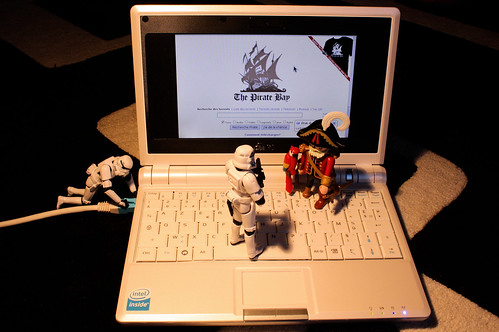
A new front is being opened today in French President Nicolas Sarkozy’s war against internet file-sharing. Yesterday the European Parliament voted on a telecoms package containing ‘right to internet’ provisions which could challenge new French and British laws that would cut off internet access for persistent illegal downloaders.

As I write this entry the Swedish presidency and the parliament’s president are signing the massive overhaul of Europe’s telecom industry in Strasbourg. Among other things it will improve cooperation between European telecom regulators, strengthen privacy protection by allowing users to opt in to the use of cookies, and push broadband rollout across the EU to achieve 100% coverage by 2013. But the lion’s share of attention to the bill has been devoted to its provision for “internet freedom” – the first time such a right has been enshrined in law anywhere in the world.

That provision was largely a response to efforts begun by Sarkozy earlier this year to introduce a French law dubbed “HADOPI” that would cut off internet access to people who persistently download music illegally. In the next few weeks the UK is expected to unveil its Digital Economy bill that will do the same. Spain and Ireland have also been considering introducing such measures. Civil libertarians have been lobbying the EU to introduce some kind of measure to protect EU citizens from an internet ban imposed by their national government.

The European Parliament took up the cause, but in the end it was forced to make a big compromise with the member state governments in order to get the telecoms package to pass. Though the original version of the legislation had mandated that any order for cutting off someone’s internet must go through a judge, the language had to be watered down to simply say internet can be restricted “only after a fair and impartial procedure including the user's right to be heard.” Of course, what constitutes a fair and impartial procedure seems to have been left up to the member states.

Lisbon Treaty’s Effect

Protests over the French and British bills have grown louder over the past few months. In the UK, an e-petition against it has so far collected 11,000 signatures. In France, the extensive Francophone blogosphere has been virtually illuminated with rage over the HADOPI bill. And noises from Spain that they will follow suit have elicited a quick and sharp response from top EU officials. Yesterday EU telecoms chief Viviane Reding warned that the EU would take action against Spain if the government moves to cut the internet access of content pirates.

Needless to say, these protestors are disappointed with the outcome of the parliament’s compromise. But this controversy has been an interesting illustration of how the Lisbon Treaty is going to change situations like these. This is a classic parliament-versus-council issue, where the MEP representatives of the people step in to override member states who they believe have overstepped their authority. It is exactly the kind of role the parliament was devised to fulfil. Because of the way the EU has worked up until now it has historically been difficult for the parliament to win these types of battles, since every provision they introduce needs the approval of the European Council, which is composed of the heads of EU countries.

However with the entry of the Lisbon Treaty into force next week, the parliament will get new increased legislative power over the other two branches of EU government. This, rather than the new position of President of the European Council which the media has focused on, is really the more consequential change heralded by the treaty. By some estimates the parliament’s power will effectively double next week. For the first time the parliament will get a say over the budget, judicial cooperation, immigration, structural funds, public services, transport, farm policy, energy security, intellectual property and personal data protection.

If this telecoms package was working its way through parliament just a few months later (or if the Lisbon Treaty had been ratified earlier), the compromise on internet freedom may not have been necessary. It’s an interesting illustration of the ramifications of the treaty, a reality which I think national governments haven’t fully woken up to yet. This internet cut-off issue certainly has legs, and my guess is this isn’t the last time the issue will be brought up by parliament. But in the future, the parliament may have the heft to force the council to accept guarantees of internet rights.