Along with the pomp of the Bastille Day celebrations this weekend in Paris, the city will see another grand occasion: the first meeting of the “Mediterranean Union,” Nicolas Sarkozy’s pet project that he has made the centrepiece of France’s EU presidency. But the way Sunday’s meeting is being discussed, you’d think it was nothing more than a Camp David-style retreat. So is it the inaugural meeting of a new international body, or lip service to an idea that has failed to take flight?
Sarkozy’s vision of an alternative union has been watered down so much it is now almost unrecognizable from what he proposed during the French election campaign. What was originally intended to be a full-blown union offered as an alternative to the EU has now become a loose association that will be managed by the EU itself. It’s not surprising then that the union is now being labelled ‘Club Med,’ suggesting it is just a diplomatic association which will exchange pleasantries. Press reports looking ahead to Sunday’s meeting have focused almost entirely on the diplomatic aspect, noting that some of the world’s most bitter enemies will be sitting at the same table for the first time, including the leaders of Israel and Syria. Little is being said of what the union is supposed to accomplish because no one is quite sure at this point – the projects it has announced so far are little more than feel-good cooperation initiatives on things like cleaning up pollution and sharing solar panel technology.
Friday, 11 July 2008

Thursday, 10 July 2008
Merkel: Not so fast, Obama

Obama is expected to draw huge crowds in speeches in the three main European capitals, an unprecedented phenomenon for someone who is only a candidate. But then again, this is no usual election. However it would be incorrect, as some US media outlets have put it, to say that Obama enjoys huge “popularity” in Europe. I think a more accurate description would be “curiosity.” It’s safe to say that Europe isn’t enthused about a John McCain presidency (in the UK Obama is preferred over McCain five to one), but they do know what they would be getting with one. In many ways it would be a continuation of the Bush administration foreign policies, and that doesn’t get anyone here very excited. McCain would likely continue to push NATO’s missile defence plans and adopt a hard line on Iran. But at the same time he would likely be a more willing partner than his predecessor on the environment, and may be more prepared for trade concessions with Europe than Bush as well.
Monday, 7 July 2008
The Ray Lewis fiasco
 When it comes to bad judgment, it’s looking like there will be few recent decisions in British government that will rival the Conservatives’ choice to appoint Ray Lewis as deputy mayor of London, holding him up as a shining example of the “new Conservative party.”
Last week’s whirlwind of accusations, denials and subsequent resignation have been a source of embarrassment for the new mayor, and may be a sign of things to come for the office, which was meant to be a showcase for what a Conservative government could do nationally in the UK.
It all started on Thursday, when Channel 4 first informed the mayor by phone that they were preparing a piece on Lewis after several Anglican Bishops informed the station that in the 1990’s, Lewis had been disrobed as an Anglican priest because of sexual and financial misconduct. They said Lewis had borrowed money from several parishioners – an act in itself rather inappropriate – and then left the country without paying it back.
Friday, 4 July 2008
Betancourt's rescue: the view from Europe
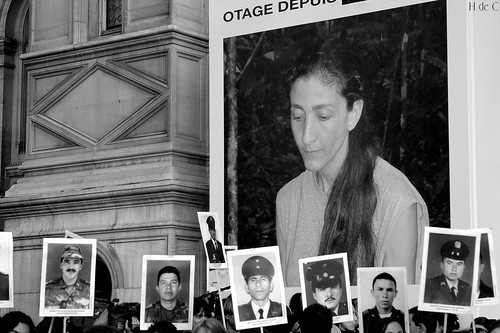 The reaction to the dramatic rescue of Colombian hostage Ingrid Betancourt and 14 others this week has received some unusual coverage in the European press, quite different from that in the US. If one didn’t know the back story behind this situation they might think the coverage downright bizarre.
Betancourt is due to arrive in Paris at any moment to greet French President Nicolas Sarkozy. The meeting is largely required by political necessity, as Sarkozy and his predecessors had made the release of Betancourt one of France’s top diplomatic priorities, and Sarkozy has been working tirelessly for a diplomatic solution between the Colombian government and FARC, the leftist guerilla militia that took her hostage. Betancourt is a dual French and Colombian citizen.But the pleasantries that will be exchanged at the Elysee Palace tonight mask an embarrassing reality for France: in the end it was not France’s tireless diplomatic efforts that rescued Betancourt but a US-backed military operation in which France had no involvement whatsoever. That has to be a tough pill for the country to swallow.
The Colombian government, a US-backed rightist regime that has fiery relations with leftist governments in neighboring countries, was never a natural partner for France to be working with in the first place. But given that Betancourt - a former Colombian presidential candidate for an ecological party - is a French citizen, France felt a duty to find a solution to her captivity. But France’s tactic was chiefly diplomatic, trying to negotiate a settlement between FARC, which has historically been backed by the Leftist governments in Venezuela and Ecuador, and the Columbian government, treating FARC as a political group rather than a terrorist organization and putting faith in Venezuelan president Hugo Chavez to act as a mediator with them. Instead, the United States (which had three citizens as hostages alongside Betancourt) swooped in and coordinated a military rescue with Colombia's president Álvaro Uribe in an operation that even had Israeli operational assistance.
Wednesday, 2 July 2008
Sarko to the rescue
 Can Sarkozy save Europe? This was the question being asked in France over the weekend, featured in big bold letters in Sunday’s Le Parisien. As France took the helm of the rotating European presidency yesterday, it seemed as if the only person who would confidently answer yes to that question was M. Sarkozy himself.
For the moment, the French president and the French capital were brimming with euroconfidence yesterday, with the Eiffel Tower lit up with the EU colours and stars, and with Sarkozy listing off a laundry list of ambitious goals that he’s had planned for this presidency for some time. The energetic and ambitious new French president has been urging a shakeup of European institutions for some time, demanding that the union focus on issues popular with the public in order to re-establish legitimacy and that it change its monetary policies to combat inflation.
But Sarkozy’s day in the spotlight was overshadowed by the tumultuous events around him. After the Irish ‘no’ vote France’s time on the EU throne will not be as Sarkozy envisioned it. Instead of strengthening and reforming the union, he will likely spend the next six months desperately trying to save it. As the president outlined his ambitious policy agenda yesterday, he was being upstaged by comments from Poland’s president Lech Kaczynski, saying that for him to ratify the treaty after the Polish parliament passes it would be “pointless”. Both Lech and his twin brother Jaroslaw, who was until recently prime minister of the country until he was voted out, have been deeply unfriendly toward the EU, while the new prime minister, Donald Tusk, is pro-EU.
Tuesday, 1 July 2008
Tories consider blocking Welsh, Scottish votes
Quite a conundrum now affects the United Kingdom, ten years after devolution first gave constituent countries their own parliaments. Scotland, Wales and Northern Ireland all now have their own separate governments, legislating on matters that affect only their territory. But England, the constituent country where the vast majority of British people live, doesn't have such a local legislative body.
The result is that the national parliament in Westminster still makes the decisions that affect only England, but doesn't make decisions that affect only Scotland or Wales. And since the national parliament has elected representatives from Northern Ireland, Scotland and Wales, this means that in theory the people in those areas have more representational power. Scots get a say in local decisions in England, but the English don't get a say in local decisions in Scotland.
It might seem that the natural solution would be to give England a local government. But there is very little support for this amongst the English population. There have been attempts to start local elected assemblies for different regions of England, but after the first one attempted was voted down in a local referendum in the North East in 2004, all the other plans were abandoned. The only area in England with a local government now remains London.
The result is that the national parliament in Westminster still makes the decisions that affect only England, but doesn't make decisions that affect only Scotland or Wales. And since the national parliament has elected representatives from Northern Ireland, Scotland and Wales, this means that in theory the people in those areas have more representational power. Scots get a say in local decisions in England, but the English don't get a say in local decisions in Scotland.
It might seem that the natural solution would be to give England a local government. But there is very little support for this amongst the English population. There have been attempts to start local elected assemblies for different regions of England, but after the first one attempted was voted down in a local referendum in the North East in 2004, all the other plans were abandoned. The only area in England with a local government now remains London.
Subscribe to:
Comments (Atom)