Friday, 20 November 2009

EU Low Representatives?


The look on Catherine Ashton’s face last night said it all. Shocked, flustered and almost a little embarrassed, the largely unknown British commissioner chosen to be the EU’s first “foreign minister” said it was a sign of her surprise that she had no acceptance speech prepared. Speaking in a softly reassuring tone, she said she would pursue a “quiet diplomacy” - characteristic of her low-profile approach to politics. 

Standing beside her, the expression of the unassuming Belgian prime minister Herman Van Rompuy was equally telling. Constantly switching languages every few minutes, he spoke of his reluctant acceptance of the offer from member state leaders to become the European Council’s first president. Oscillating between English, French and his native Dutch, a portrait emerged of a man who has gained a reputation as a quiet consensus-builder, having rescued the national Belgian government from collapse two years ago. 

And with them on the podium stood a beaming European Commission President José Manuel Barroso, a clear winner from last night’s announcement. In these two very low-profile picks Barroso will not have the competition for leadership he feared from a pick like Tony Blair or Jean-Claude Juncker. Since Rompuy will largely relegate his role to being a secretary-coordinator for the European Council, Barroso will continue to be the EU’s de facto leader. And with the demise of the rotating council presidency, he no longer has the prospect of an upstart national leader stealing the show every once in awhile. 

Together the three of them have been dubbed by bloggers today as the “Troika of Boredom” - three rather unengaging and unambitious politicians who are unlikely to give the EU the respected high profile it had sought to achieve by creating these new positions. Indeed, the reaction from Brussels blogs last night and this morning has been overwhelmingly unimpressed. Many are seeing the choice of two rather weak personalities as a deliberate effort by Angela Merkel and Nicolas Sarkozy to ensure that there is no strong supranational EU figure that could challenge their authority in the council. 

As for the fourth man standing in the group, his body language made it clear where his institution is headed. Frederik Reinfeldt, Prime Minister of Sweden (which currently holds the rotating council presidency), was practically being edged off the stage. The rotating country leadership will still continue to host meetings for the Council of Ministers, but it will no longer have any symbolic leadership role.

Franco-German Stitch-Up
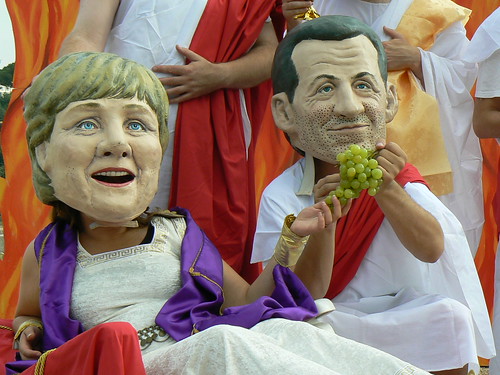
Though the people selected for these new EU positions are being seen as boring, the selection itself is anything but. In fact, it is incredibly important. The remit of these two positions was left very vague in the text of the Lisbon Treaty, and all along its been said that the presidency would be defined by the first person who holds the job. 

If it were a high-profile person with much political clout, the presidency could become a powerful position capable of speaking with one voice for the EU on the world stage. If it was a low-profile choice, the presidency would become merely a coordinator role, a consensus-builder who would work behind the scenes to get the different leaders of member states to reach agreement. With the selection of Van Rompuy, member state leaders have made a clear decision about which way the presidency should go. His term length may just be two-and-a-half years, but if Rompuy takes a ‘low-profile coordinator’ approach to it as expected, it would be difficult for the next president to fundamentally reshape the precedent the Belgian set. 

But is this really what EU leaders wanted? Gordon Brown may have had his differences with Tony Blair in the past, but he seems to have been legitimately insistent that Blair should get the position. Indeed, it appears the choice of Ashton was made as a compromise to Brown in exchange for his abandoning the Blair cause. Sweden’s foreign minister seemed less than enthusiastic about the choice this morning, and many in Eastern Europe have been voicing grumbling discontent with the decision today. Certainly the Socialist leaders of Spain, Portugal and Greece can’t be pleased about it, considering they got the short end of the stick. Ashton is a fairly moderate politician who has little to no foreign policy experience. 

This will be largely seen as a Franco-German stitch-up. Merkel had indicated her preference for Van Rompuy early on, and after she persuaded Sarkozy to give up his preference for Tony Blair, the two announced they would be presenting a united front in their selection. This provoked accusations of bullying, with Sweden’s prime minister saying the decision should not be made by just the French and Germans. Certainly, it is a sign of Britain’s lack of influence in Europe that even as one of the ‘big three,’ it was unable to fight against a Franco-German alliance.

“Political Pygmies”

Certainly these two new ‘high representative’ positions were not the only part or even the main part of the Lisbon Treaty. Still, they were a significant part. And after eight long years of fighting for it, this decision has many asking, “What was the point?” The intention of the positions was to give someone the authority and clout to represent the EU on the world stage and stand toe-to-toe with the US and China. These two are unlikely to be able to do that, which bounces authority back to Barroso and back to the status quo, with no united voice for Europe. 

Many federalist Europhiles found themselves in the strange position of agreeing with UKIP leader Nigel Farage last night. Bizarrely, he told the BBC, "We've got the appointment of two political pygmies. In terms of a global voice, the European Union will now be much derided by the rest of the world."  But…isn’t that exactly what UKIP wants? The cognitive dissonance is even more impressive than usual on this one. 

For their part, the Tories praised the decision to go with a low-profile person rather than Tony Blair, with shadow foreign secretary William Hague saying, "I am very pleased that those of us across Europe who said that the president should be a chairman, not a chief, have won the argument.” 

Both the Tories and UKIP were also quick to point out that Baroness Ashton has actually never been elected to anything in her life. She spent most of her career working for a charity run by Prince Charles before being appointed as leader of the House of Lords in 2007 by Gordon Brown. When Peter Mandelson left his “Brussels exile” to return to Westminster in 2008, she took his place as EU Commissioner for Trade, where she’s served for about a year. Trade Commissioner is one of the most important roles in the EU and involves a lot of negotiation with foreign trade bodies (particularly those in the US and China). However it doesn’t necessarily involve any areas of foreign policy outside of trade. 

For his part, Van Rompuy is being lauded by his supporters as someone who united the warring Flemish and Frencophone factions of the Belgian parliament and brought the national government back from its year-long long shutdown in 2008. He reportedly took that job reluctantly after being asked by the Belgian king, who pleaded with him for 90 minutes. He had been set for retirement, and had already been on a long hiatus from politics. Merkel and Sarkozy have argued that his skills as a quiet consensus builder make him perfectly suited to coordinate the diverse member states of the EU. 

But it’s unclear whether this skill will translate to a European level. The disagreements in Belgium are between two parties, not 27. And authority in Belgium has been so devolved to the regions of Flanders and Wallonia by this point that the national government barely does anything at all – as evidenced by the fact that it was barely noticeable when the national government shut down for about a year. Is it that impressive that he was able to bring back to function a body that is largely symbolic by this point anyway? The EU may have it’s problems but it is by no means dysfunctional and is not about to shut down.

Realism

Perhaps the consensus reached last night appropriately reflects the fact that many Europeans are not ready for the notion of an “EU President.” The Liberal Democrats in the UK had an interesting interpretation of the decision yesterday, telling the BBC that the decision would expose the stupidity of the Eurosceptic British media referring to the Lisbon Treaty as if it was solely designed to create a powerful EU presidency for Tony Blair. Foreign affairs spokesman Ed Davey said,
"With low-profile appointees, no-one can take seriously any longer the Eurosceptic deception that these positions would challenge the supremacy of nation states acting together when they agree."
From the perspective of the UK and Scandinavia, where the prospect of an “EU President” was most unpopular, this may be true. But what about the many other Europeans who wanted the EU to speak with a stronger, more coherent voice on the world stage? Who now will have the clout to stand up to the United States in situations like the Iraq War? Who now will bring trade power to bear in negotiations over climate change? The decision to choose low-profile people may allay some of the fears expressed in the British media, but does it do so at the expense of offering a solution to the problem the Lisbon Treaty was trying to solve? 

Time will tell how these two will use their roles, but it looks like the wild card is more likely to be Ashton than Van Rompuy. She is younger, newer, and there is less known about her political stances on foreign policy issues (she by the way has a very left-of-centre husband I understand). Van Rompuy is unlikely to surprise anyone and will probably stick to a low-profile role. But it she wants to, the Baroness could shape the EU's foreign policy positions to be far more powerful than the presidency. 

That is, if she is so inclined.

Wednesday, 11 November 2009

The Sun Overplays its Hand

I’m loath to write about this, as I’m effectively jumping on the same bandwagon I’m about to deride. But given the intense level of media attention “handwritingate” has received over the past three days, it seems it may be impossible to ignore.

I first realized I was eventually going to have to write about this nonsense on Monday, as I was watching a live announcement on SkyNews from UK environment minister Ed Miliband (David’s brother) on a planning approval overhaul that will make it easier for the UK to build nuclear and coal plants. As the speech ended, the 24-hour British news network (owned by Rupert Murdoch’s News Corp) carried about three minutes of the ensuing parliamentary debate, then cut back to the studio. Ah good, I thought, now we’ll hear some analysis of what this announcement means. But no analysis came, in fact there was no mention of the speech we had just seen at all. Instead, the station delved into hour 13 of its non-stop coverage of the fact that UK prime minister Gordon Brown has bad handwriting.

Basically the story goes like this: there have been an extraordinary number of British casualties in Afghanistan over the past few months, attracting increasing public discussion about whether the UK should still be involved in the fight there and whether the troops are properly resourced. Apparently, possibly out of political calculation but more likely out of genuine concern, Gordon Brown has started writing personal handwritten letters to the families of the fallen soldiers. Seems like a nice gesture right? Only problem is the prime minister has horrible handwriting, owing to the fact that he is blind in one eye.

One mother named Jacqui Janes received such a letter from Mr Brown offering condolences for the loss of her son and found it sloppy and riddled with what are either spelling mistakes or illegibilities, depending on your perspective. She was most offended by the fact that the prime minister had appeared to spell her name with an ‘m’ instead of an ‘n’, addressing the letter to “Mrs. James”.

Janes rung up The Sun newspaper, which recently publicly switched its support from New Labour to the Conservatives, and the paper ran with it, making it a lead story two days in a row. The rest of the British media have followed suit, even the venerated BBC. The furore forced the prime minister to personally call the woman to apologise. Janes proceeded to emotionally berate Brown, tape recording the phone conversation and giving (some have speculated selling) it to the Sun, which then released it. Here is the audio below, though I warn it feels like something you shouldn't listening to. (Incidentally, and as awkward as it is to point out, a lack of equipment most likely had nothing to do with her son's death). Brown has since had to address the issue publicly twice in news conferences.


Of course the Sun is also owned by Rupert Murdoch’s NewsCorp, so it is under the same umbrella as another news organisation famous for this kind of thing across the pond – Fox News. The formula works like this: the media outlet picks up a fairly trivial but emotionally charged story, runs it relentlessly as a campaign against the government, and encourages reader/viewer outrage on the subject. It then reports on the viewer outrage, continuing coverage for several more days. Other media outlets worry that they are missing a major story (after all it must be a major story if the Sun/Fox are devoting so much time to it) so they run it as well. Pretty soon the issue is dominating all the front pages, be it manufactured outrage over bad handwriting or created controversy over a presidential address to school students.

However here in Britain there are already signs of pushback against this tried-and-true Newscorp strategy. Much of the readers’ comments under the web version of the original story were defending Brown, perhaps prompting the Sun to block commenting on their subsequent story.

Other papers have begun to note that the Sun risks overplaying its hand in its vigorous crusade against Gordon Brown, which is being fought with all the intensity the newly-converted usually display. The Standard, The Guardian and The Mirror have all been pointing out that much of the public has been disgusted with the Sun’s naked (and rather clumsy) attempt to exploit a grieving mother for its own ideological gain. Even many who dislike Brown are defending him from this rather crude attack.

Given his incredibly low approval rating, the Sun surely sees Gordon Brown as an easy target. And it is a reflection of Brown’s weak position that the paper could so easily bring him to his knees and force three separate grovelling apologies in just three days. However they may have underestimated the British public’s tolerance for cheap shots or blatant manipulation on this occasion. This kind of thing may work across the pond, but in Britain News Corp should perhaps tread a bit more carefully with these kinds of tactics.

After all, as evidenced in the screengrab to the right, perhaps people in glass houses shouldn't throw stones!

Tuesday, 10 November 2009

Miliband says there’s no place like home

It would appear David Miliband decided to click his ruby slippers three times yesterday in Berlin, definitively turning down the new position of EU ‘foreign minister’ and opting to return home to a troubled government in the UK.

Of course this could all just be a ruse to take him out of the ‘frontrunner’ status, a notorious handicap when it comes to getting EU appointments. But all indications are that his conversation with the head of Europe’s socialist group yesterday in Berlin was genuine – he will not take the new high representative position if offered. Given that it appears Tony Blair is now out of the running for the position of EU president, it looks like there will be no Brits filling either of these two new roles. Given the UK’s lack of participation within the EU, there will be many on the continent who feel this result is appropriate.

Miliband had gained increased attention after a remarkably pro-Europe speech he delivered two weeks ago, saying the UK needed to abandon its ‘hubris and nostalgia’ and engage fully with the EU, working to reform it and make it strong. Given that this kind of talk is so rarely heard from a senior British politician, many Socialists in Europe were so elated they immediately began pushing for Miliband to take the foreign minister post.

However there was always some trouble with this logic. Miliband’s words were so encouraging precisely because he was such a senior politician delivering a pro-Europe speech in the UK. Take him out of the UK, and the beneficial aspect of that is nullified. David Miliband may have a moderately high profile in Britain, but its doubtful that his presence in Brussels would have focused British media attention on the EU in the way that Tony Blair being there would have. As I’ve written about before, a posting to Brussels is often considered a ‘banishment’ in the UK, and politicians sent there quickly disappear from the British media landscape. Having a pro-European in Brussels rather than in Westminster won’t do much to change the UK’s attitude toward the EU.

There was also a question on the mind of continental Socialists as to what sort of benefit he would bring for them as foreign minister. Though New Labour is part of Europe’s socialist grouping it is certainly at the more centrist, Atlanticist end of the spectrum. Miliband is after all a committed Blairite, which taints him with the brush of the Iraq War legacy. There were concerns that an EU foreign policy under Miliband would too often acquiesce to the plans of the United States, rather than offering a strong alternative. Then again, given that the governments of Europe will be dominated by conservative parties next year, it’s difficult to see how a far-left Socialist foreign policy chief could bring Europe to a consensus.

Miliband is still viewed by many as the last great hope for the dying Labour party, and there will be many within Labour who are relieved at today’s news. Many would have seen Miliband’s move to Brussels as a rat fleeing a sinking ship, given that Labour is almost guaranteed to lose the upcoming UK general election next year. In fact there are many who think Miliband is Labour’s last hope, and that the only way the party can win the upcoming election is if he leads a revolt against Gordon Brown and stands as Labour’s leader instead.

Given the widespread loathing of the British Conservative party in Europe these days, there were probably many on the continent from both the left and the right who thought their best hope was to keep Miliband in the UK and hope that he can somehow deal a miracle defeat to David Cameron. Of course if Labour does lose and Miliband becomes the head of the opposition, it's hard to see what benefit his pro-European views will bring then. It's all a bit up in the air, but one thing is certain - you haven't heard the last of David Miliband.

Friday, 6 November 2009

Dangerous Democracy

In a crippling blow to the gay rights movement in the United States, citizens of the state of Maine voted in a referendum to repeal a law passed by their own elected legislature granting marriage rights to same-sex couples. It was a reminder of the reality of referendums: easily manipulated by campaigns of misinformation, public votes rarely yield progressive results, and have historically voted against protecting the rights of minorities. Out of 31 public referendums held on the gay marriage issue in the United States, every single one has voted against allowing the unions.

The success of Maine’s ‘question 1’ follows the bitter disappointment of gay rights activists following the yes vote on California’s ‘proposition 8’ a year ago, which struck down the gay marriage rights that had been granted in that state only months earlier. Though the ‘no’ campaign in Maine was fought by the same anti-gay rights groups using almost identical advertising (warning that gay marriage would mean the teaching of homosexuality in public schools), there was one significant difference between the two referendums. While gay marriage was granted in California by a ruling of the state’s supreme court, marriage rights had been passed by an act of the legislature in Maine, endorsed by the state’s governor.

This is noteworthy because one of the main arguments of opponents of same-sex unions is that they keep being granted by “activist judges” in state courts “overriding the will of the people.” But while that argument could be made in California, that has largely not been the case in the states of New England, which have enacted same-sex unions through legislative action. So in Maine, the referendum actually overturned an act passed by legislators who had been elected to represent the voters. Maine's moderate governor even campaigned against question one. To me, this is an almost painful example of how absurd these large-scale referendums are.


In talking about this issue with British friends over the past few days, they’ve all been in agreement that this Maine marriage referendum is a disgrace. After all, what is the point of having a representative democracy if people can challenge anything they do just by rounding up a few thousand signatures? In a republic, citizens elect representatives and pay them to become educated on the issues and make responsible decisions in their stead. They choose these people to act on their behalf precisely because they do not have the time or, largely, the intellectual acumen to make these decisions for themselves. Having the public make these decisions by referendum results in a ‘tyranny of the majority’, as James Madison put it, which doesn’t have the foresight to make the best decisions for the country and will rarely protect the rights of minority groups. The Brits have nodded their heads in firm agreement.

Yet these are the same British friends who have been incensed by the fact that they have not been able to vote in a public referendum on the Lisbon Treaty, a complicated foreign policy document that was instead passed by their elected representatives in parliament. They’ve been outraged that after successive ‘no’ votes in referendums in France, Holland and Ireland, the treaty has still come to pass. Never once have they questioned the wisdom of having those referendums in the first place. Their assumption has seemed to be that public votes will always result in the best policy. Nevermind the fact that the Lisbon Treaty is a complicated and rather dull international agreement that tightens up the functioning of a union that already exists.

These British friends have tended to disregard the fact that every parliament that has voted on the issue, made up of representatives who have the time and capacity to educate themselves on what the treaty really is, has passed it (which must mean something, right?). They seem to have not thought about the near certainty that publics will cast referendum votes based on national issues (such as their satisfaction or dissatisfaction with their national government), xenophobia or misinformation rather than on the realities of the actual question being put to a vote.

Favoured by Populists and Dictators

Referendums rarely result in progressive policy or well-informed decisions. Exit polling after the first Lisbon Treaty referendum in Ireland revealed that the majority of ‘no’ voters did so either based on the fact that they didn’t know enough about the treaty or based on misconceptions about it.

In Switzerland, where there is a referendum on just about everything since they are guaranteed by the Swiss constitution, women didn’t have the right to vote nationally until the 1970’s (referendums kept voting universal suffrage down). The country’s politics are well known for their near-glacial pace.

Besides Switzerland, referendums have also historically tended to be pursued vigorously by dictators such as Adolf Hitler and Benito Mussolini. Both men frequently used plebiscites to disguise oppressive policies in a veneer of populism. Largely as a result of Hitler’s enthusiasm for them, Germany does not allow referendums to take place on a national level.

So where have referendums not been used? Well funny you should ask. They are not allowed in the handful of US states that still have gay marriage, such as my home state of Connecticut. If they were allowed in Connecticut, I think it’s likely that it could have been struck down there as well. And Connecticut is one of the most progressive states in the country.

The UK is one of the countries were referendums are specifically given no validity, and I would argue that's a good thing. Although Acts of Parliament may permit referendums to take place, they cannot be constitutionally binding and can be overturned by a subsequent act of parliament. The only referendum proposal to ever be put to the entire UK electorate was in 1975, asking the British if they wanted to continue membership in the European Economic Community, progenitor to the EU.

Whatever their opinion of Britain’s membership in the EU, I would urge my British friends to acknowledge that referendums are not a wise way to make policy. If they really want the UK to disengage with the European union, they’re free to vote for representatives who will reflect that stance. But they voted in Tony Blair’s New Labour three times on a moderately pro-European platform, so they can’t complain when this is the result of the parliamentary vote.

They should really ask themselves why it is that a majority of MPs, who have the time to educate themselves on these things, supported adoption of the Lisbon Treaty. Rejecting the treaty would have been a very radical move, especially after obtaining all of the opt-outs Britain negotiated. If the British public want to elect representatives who would make such radical decisions, they’re free to do so. But they should stop and ask themselves if this is really what they want.

Thursday, 5 November 2009

France: ‘Autistic’ Tories will Castrate UK

One could argue that there’s perhaps no better vote-getter for the Tories than having the French call them names, but the rather un-PC reaction from the continent to David Cameron’s speech yesterday deserves more that just a bemused reaction in Britain. It’s a reflection of how deeply concerned the continent is about a future Tory government.

I was at a conference in Copenhagen on Tuesday when the news broke that Czech President Vaclav Klaus had finally signed the Lisbon Treaty, following a Czech court ruling that the treaty did not violate Czech sovereignty. As soon as someone announced the news the room broke into applause – which is significant because this was an industry conference, not a gathering of EU policy-makers.

The capitulation by the Czech president meant that UK conservative leader David Cameron would have to abandon his crusade to put the treaty to a public referendum in the UK. He had made a “cast-iron” guarantee that the Tories would offer the British public a referendum on the document if the Tories were elected, but he had never addressed what he would do if the treaty went into effect before the Tories came into power. On Wednesday Cameron hastily arranged a speech acknowledging the obvious: now that the treaty has been ratified it is no longer a treaty, but EU law – making a referendum at this point essentially meaningless. At the same time he said he would work to "unravel" much of the treaty through negotiations over the coming years and would seek new "opt-outs" for Britain from EU policy.

In fact, a ‘no’ vote on the treaty would at this point mean a ‘no’ vote to the EU, and the implication of such a result would be that Britain must exit the union – something Cameron knows would be a disaster for the UK. His decision to abandon his plans for a referendum is less an active policy choice that an acknowledgement of reality.


The reaction to Cameron’s speech in the British press has been strangely schizophrenic. The right-leaning papers have focused on Cameron’s “capitulation to Europe” and a supposed “abandonment” of the Eurosceptic wing of the party. The Telegraph ran this headline yesterday: “David Cameron tells Eurosceptics: get over it,” followed by an interpretation that Cameron has rejected the Tory Eurosceptics by putting Europe low on the agenda. They point to the resignation of the two most rabidly anti-Europe MEPs, Daniel Hannon and Roger Helmer, from their front-bench positions in protest over Cameron’s decision.

On the other hand the left-leaning papers have focused on the nonsensical nature of Cameron’s speech yesterday, highlighting the fact that Cameron is still being antagonistic toward Europe yet he is not being clear in exactly what he wants from it. They point out that the UK already has many of the opt-outs Cameron said he would ask for in the coming years, including not being part of the Charter of Fundamental Rights (Brown already negotiated a UK opt-out to that part of the treaty). And they have recounted the baffled reaction of many leaders on the continent to the content of Cameron’s speech. Cameron’s promise to renegotiate employment law is almost laughably absurd, the continental politicians said, considering there is almost no chance Britain's European partners would approve an opt-out as it would be seen as giving the UK an unfair advantage in attracting foreign investment. And his promise that “never again” would a treaty pass without a public referendum in Britain is an empty gesture considering the Commission has already said it will not attempt any further institutional reform for at least a decade and probably much longer.

But it was the furious reaction from the French government to Cameron’s speech which the left-leaning papers focused on the most. In a stunning abandonment of diplomatic niceties, France’s Europe Minister Pierre Lellouche came out with a remarkable condemnation of the Tories, saying he was conveying French President Nicolas Sarkozy’s “sadness and regret” over the path Cameron has chosen to take. Lellouche told the Guardian:

"It's pathetic. It's just very sad to see Britain, so important in Europe, just cutting itself out from the rest and disappearing from the radar map …. This is a culture of opposition…I have told William Hague: go away for two to three years, in your political economic situation you're going to be all by your self and you'll come back. Go ahead and do it. That is my message to them … You want to be marginalised? Well, you go for it. But it's a waste of time for all of us.”
The minister’s comments reflect the depth of the anger felt by Europe’s Conservative parties at Cameron’s decision to take the Tories out of the main centre-right European party, the European People’s Party, to form a new “anti-federalist” party in alliance with hard-right parties from Eastern Europe. Lellouche said Cameron’s decision had “castrated” British influence in the parliament, and his continued antagonism toward the EU – saying the same thing over and over but not expressing any coherent question or demand – seemed like “a very bizarre sense of autism”.

The comments were particularly surprising considering that Lellouche is one of the most Anglophile members of Sarkozy’s government. It should be kept in mind that these unusually harsh diplomatic words are not coming from socialist governments on the continent, they are coming from fellow conservatives.

Despite the very different coverage of the issues from the different British papers, it is actually really heartening to see Europe being discussed so much in the British media this week. Though Cameron seems to be trying his best to get rid of Europe as a campaign issue, it would probably be the best thing for the UK if Europe were made a central part of next year’s campaign. Labour certainly has every interest in bringing it up as much as possible, considering it has historically been an issue that has caused civil wars within the Conservative Party, and Labour will be eager to exploit lingering fears and doubts the public has about the Tories’ ability to govern.

But more importantly, having Europe as a major issue of the campaign could mean that Britain will finally get the frank, honest Europe discussion it has never had. If the Tories want to unravel the European project then they need to present to the British public what their alternative vision is for the UK to be a relevant part of the 21st century. So far the discussion of the EU in the UK has focused on silly euromyths about the length of vegetables rather than a real education on what the EU does and that its purpose is to make Europe a relevant, strong global player in the 21st century. That discussion has never been had here because most politicians dance around the central truth regarding the necessity of Britain’s EU membership: the UK is no longer a world power and it faces a future of marginalisation and irrelevance if it tries to go it alone. As Lellouche said Wednesday:

"It is a time of tumultuous waters all around us. Wars, terrorism, proliferation, Afghanistan, energy with Russia, massive immigration, economic crisis. It is time when the destiny of Europe is being defined – whether or not we will exist as a third of the world's GDP capable of fighting it out on climate, on trade, on every … issue on the surface of the Earth. We need to be united, otherwise we will be wiped out and marginalised. None of us can do it alone. Whether you're big or small, the lesson is the same. And [Britain's] risk is one of marginalisation. Irrelevance."
It remains to be seen whether similiarly outraged words will be publicly expressed from Europe’s other conservative governments in Germany, Italy, Sweden and Denmark – but such views have already been expressed privately by Conservatives from all corners of Europe. Angela Merkel is reportedly refusing to even meet with Cameron, and joint policy groups between Germany’s CDU and the Tories have been cancelled.

If the Tories are elected next spring it would mean that all three major EU countries will have Conservative governments. Yet far from being an ideologically unified block that could plow through badly-needed reforms in Europe’s social model, there will be a huge chasm between the continent and Britain as a result of Cameron’s decisions.

Monday, 2 November 2009

Europe in Denial of a Changing World

The European Council on Foreign Relations came out with an interesting report today on the US-EU relationship, concluding that Europeans “remain in denial about how the world is changing, making a fetish out of the transatlantic relationship.”

In essence the report concludes that Europeans remain stuck in a ‘spectator’ mindset, harbouring damaging “illusions” acquired over “decades of American hegemony.” The result, the authors conclude, is “an unhealthy mix of complacency and excessive deference” to the United States, which has a “rapidly decreasing interest” in a Europe as it fails to speak with a strong united voice in the world.

The report is not just a rebuke of the nationalists and isolationists spread across Europe, it is also a rather grim summary of how the US views the prospects of the EU actually rising to the challenge. Though the US badly needs a strong partner to counter the rising influence of China and would like to see a more united EU, the consensus in Washington since 2005 has been that it is unlikely to see that materialise. So it now essentially takes a piecemeal approach to treating Europe as an equal partner. When Europe is strong and united in trade issues, Washington listens. When it is split in foreign policy however, it ignores them. In the later scenario, where different national governments act individually, the report concludes, “Europeans are asking to be divided and ruled.”

The result of all this, the authors concludes, is “a frustrated US and an impotent Europe.” The situation manifests itself, for example, in the Afghanistan conflice – where Europe has 30,000 troops yet virtually no say in strategy. They write:
“European governments need to get over the mistaken belief that their individual ‘special relationships' matter in Washington, and learn instead to act together and speak to the US with one voice.”
Reading this report, I can’t help but feel that it is in large part addressed to the UK in particular. The British public should keep these things in mind when they head to the polls next year. As I’ve written about before, Cameron’s Europe policy will have important ramifications for not only the future of the UK, but the future of Europe as a whole. As the report points out, the danger of ‘damaging illusions’ in policy-making are no insignificant matter.