Last week British Conservative leader David Cameron, who will be challenging Gordon Brown in next month’s general election in the UK, had a mini meltdown of sorts during a filmed interview with the Gay Times. The trouble started when the interviewer asked Cameron why his Tories in the European Parliament failed to support a recent vote criticising a Lithuanian law banning the “promotion of homosexuality” (The image below is an actual campaign flyer in Vilnius for the Lithuanian law). David Cameron seemed completely caught off guard, and could only respond that he didn’t know anything about the vote.
Tuesday, 30 March 2010
The new power of the pink press? British, Czech conservatives fumble in gay interviews
Last week British Conservative leader David Cameron, who will be challenging Gordon Brown in next month’s general election in the UK, had a mini meltdown of sorts during a filmed interview with the Gay Times. The trouble started when the interviewer asked Cameron why his Tories in the European Parliament failed to support a recent vote criticising a Lithuanian law banning the “promotion of homosexuality” (The image below is an actual campaign flyer in Vilnius for the Lithuanian law). David Cameron seemed completely caught off guard, and could only respond that he didn’t know anything about the vote.
Friday, 26 March 2010
To IMF or not to IMF?
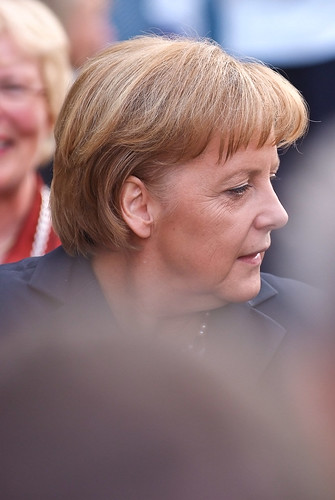
Merkel was going it alone in her unyielding objection to a bail-out for debt-ridden Greece, and she dug in her heels firmly. After much negotiation she relented and agreed to a bail-out, but on one condition – the American-controlled International Monetary Fund would have to be involved. European leaders are leaving Brussels today with a bailout plan in place, but only as an “emergency measure” to be triggered if Greece goes completely broke and cannot get any more credit.
Though it's stabilised the situation for the moment, the solution devised seems to have truly pleased no one. The euro rebounded from its long decline today in response to the news, but the markets did not reflect much confidence in the measure. Merkel is under tremendous pressure. The idea of a bail-out is extraordinarily unpopular in Germany, where many point out that such a bail-out is specifically forbiddon by the Maastricht Treaty. Many in Germany are saying that a core part of the eurozone agreement was that one state would never have to bail out another in the currency union. That, say some analysts, is why Merkel insisted on involving the IMF. Making the bail-out appear like an international effort will shield her from legal challenges that will surely be launched at home on the basis of the fund's violation of the Maastricht Treaty.
Wednesday, 24 March 2010
A Gallic Plot?
It was more of a tongue-in-cheek jest than an actual offer for assistance, but Ashton has taken him up on it and will be spending a month this summer in the south of France taking French lessons. But of course France’s offer wasn’t really about language. It reflects the increasing French dissatisfaction with Ashton as she creates the new EU diplomatic corps, which they fear is going to be dominated by the English.
Ashton speaks only rusty French, and she will only take questions at press conferences in English – a fact which has deeply irritated the French media. The fact that Ashton does not speak fluent French has been continually pointed out by those who think she is not qualified for the job. This is particularly true in France, where the phrase “the language of diplomacy” is not used with a smirk or as an old-timey throwback, but as their actual understanding of the world. Of course the reality is that French ceased to be the language of diplomacy 70 years ago, but don’t tell that to the French. Even within the EU, English has largely replaced French as the lingua franca since the accession of the Eastern European member states in 2004.
Tuesday, 23 March 2010
The US healthcare bill - what's in it?
I thought I'd write a brief entry on what this bill actually entails because I've found a lot of Europeans (and Americans, for that matter) are confused about what it contains. Many of my friends on the left seem to be under the impression that the bill has been watered down so much that it is almost meaningless and will do no good for anybody. People on the right still seem to believe that this is a government takeover of the healthcare system that mandates rationing of care. Neither is true.
Thursday, 18 March 2010
The case of the disappearing Brussels journos
Take a good look at the Brussels press corps, because in a few years it may have disappeared into thin air. That's at least the concern running through the EU capital at the moment, as the number of accredited journalists in the city plummets.Today I stopped by an extraordinary meeting of the International Press Association (API) that was called together to specifically address this question. I had come by because my company is dealing with a separate issue, the harassment of journalists working in the International Press Centre by the Belgian authorities. As it turns out though, these two issues are probably not unrelated.
In 2005 there were 1,300 accredited reporters in Brussels, more than the Washington press corps (a fact the EU was very proud of at the same time). Today, according to a blog this week by the Economist, the number is just 752. Well, 753 as of yesterday, when I received my accreditation. In the past year alone, almost 200 journalists have left Brussels.
The API meeting was called to approve a resolution demanding immediate action from the EU to stop the hemorrhaging of Brussels journalists. A noble aim to be sure. But during the meeting I couldn't help but feel perplexed by the remedies that API is demanding.
Tuesday, 16 March 2010
Brussels and London in finance face-off
Tomorrow the European Commission will tell the British government it must do more to cut its budget deficit, which is as large as that in Greece. Market watchers are growing increasingly concerned that once Greece has hit rock bottom speculators are going to turn to the UK's shaky financial system, hedging against the colossal debt. The UK is not part of the Eurozone therefor the EU has no power to exert control over the UK's plans or punish it, so the communication to come tomorrow could be considered more as "guidance". But it's very public "guidance" that will be humiliating for the Labour party.
Subscribe to:
Comments (Atom)