Monday, 29 November 2010

Is Switzerland becoming the black sheep of Europe?

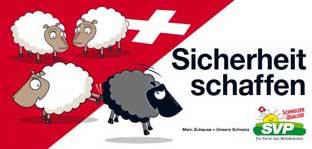
 The Swiss People's Party may have scored another victory yesterday in their campaign against the "black sheep" within Swiss society, but judging by the reaction of the European press today it may be the Swiss themselves who are becoming the real black sheep. In a referendum held Sunday, 53% of the Swiss endorsed a far-right initiative to automatically expel foreign residents who have committed a crime, following their time served in a Swiss prison.

According to the AFP, Austrian website news.at announced the news with the headline, "Switzerland is now the black sheep -- majority for tougher rules against foreigers." The headline is a reference to the notorious advertising used by the far-right Swiss People's Party (SVP) showing a group of white sheep kicking a black sheep out of Switzerland. The imagery, which helped propel the SVP to a huge election win in 2007, was again brought out in the SVP's campaign for the expulsion initiative (but this time with a new twist, one of the white sheep has been stabbed!). The Austrian press wasn't the only one criticising the referendum outcome. Belgian newspaper Le Soir noted today that the Swiss are increasingly choosing a "radical road". German newspaper Sueddeutsche Zeitung wrote that once again Switzerland is "sending a signal to the world that it doesn't care what others think of it." Many of the papers are noting that the vote comes exactly one year after the Swiss voted to ban minarets on mosques.

Friday, 26 November 2010

Putin suggests an EU-Russia union

Should Russia and the EU link up in a "common continental market?" Vladimir Putin thinks so. The Russian prime minister made the case for such a union in an editorial appearing in a German newspaper yesterday ahead of a two-day visit to Germany. But German Chancellor Angela Merkel quickly made her feelings on the subject known. Asked about Putin's editorial at a press conference yesterday she said she would have to "pour cold water" on the idea when she meets with Mr. Putin, though she said an EU-Russia free trade zone is a possibility.

The idea of a pan-European free trade zone, similar to the North American Free Trade Agreement (NAFTA) struck in the 1990's, has been floated for some time. But Putin's editorial seems to go further than this. "We propose the creation of a harmonious economic community stretching from Lisbon to Vladivostok," he wrote. "The result would be a unified continental market with a capacity worth trillions of euros." He said "the global economic crisis has revealed both Russia and the EU to be economically very vulnerable," adding that Russia is too dependent on its oil and gas exports while the EU is too dependant on imports, and the EU has lost its competitive edge because of de-industrialisation. Linking the two economies, Putin wrote, could solve problems on both sides.

Monday, 22 November 2010

Ireland in crisis

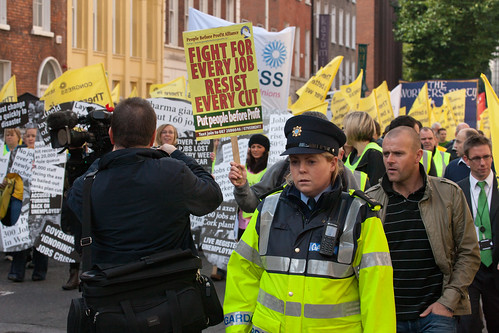
Today was a dramatic day in Dublin. First came the news that the government was giving in and accepting an EU bail-out, prompting angry demonstrators to swarm government buildings in protest of the decision. But as the day went on Ireland’s financial crisis morphed into a political one. The Green Party, a junior partner in the governing coalition, announced it was pulling its support - prompting a collapse of the government and a general election. The Irish government now appears to be in complete meltdown.

Since last week Ireland has been under pressure from the EU to accept the bail-out as it became clear that Ireland’s banks were in so much trouble that the Irish government was going to be unable to borrow money. Brussels was afraid this insolvency would spread to the other vulnerable so-called “PIGS” countries, causing the euro currency to collapse. If such a crisis were to spread to Spain, the eurozone's fourth largest economy, it could spell the end of the euro and as a consequence, some leaders have suggested, the end of the EU. After spending a week denying that they would take the money, today the Irish government accepted a rescue package worth up to €90 billion ($124bn).

So why the initial resistance, and why the protests today? Surely Ireland getting money is a good thing for Ireland right? Well the rescue package comes with a lot of strings attached, and they will be painful strings for the Irish population. In exchange for the aid, Ireland must make €4.5 billion in public spending cuts and €1.5 billion in tax increases. Overall, the country will have to save €15 billion by 2014. This will undoubtedly cause an increase to the unemployment rate, aleady high at nearly 15%. Essentially, it doesn’t matter who the Irish public elects in the general election that will likely be called in January (after the bail-out has been approved by the current parliament). The country will be governed by the International Monetary Fund and the European Central Bank for the next three years.

Friday, 19 November 2010

Today’s EU-US 'summit': progress or face-saving?

All this week I was inundated with press releases, previews and briefing notices leading up to the big EU-US summit taking place in Lisbon today, the first such summit since the Lisbon Treaty went into force a year ago. From the way the EU institutions were hyping it, you would think this was some kind of massive meeting of powers set to define the course of the next century. The reality? Barack Obama is taking two hours out of his busy schedule while at a NATO summit in Lisbon to meet with European Council President Herman Van Rompuy and European Commission President José Manuel Barroso on the sidelines.

Apparently this is all that US officials were willing to offer the new “EU president” even though the EU was originally thinking they could get a separate day with Obama while he was on the continent for the NATO gathering. But the EU grabbed the opportunity for even a two-hour meeting, eager to avoid another massive humiliation after Obama snubbed the union last May when he suddenly backed out of a planned EU-US summit in Madrid. The entire summit was cancelled after that last incident, and apparently EU officials didn’t want to have to go all of 2010 with the US president not meeting with his new EU counterpart.

Thursday, 18 November 2010

Will the ugly ducking CAP get a beauty makeover?

There's an episode of the 1970's sitcom The Brady Bunch where middle child Jan Brady decides she's sick of being overshadowed by her pretty, popular older sister Marcia and resolutely decides her problems will be solved by wearing a bizarre black wig at a friends birthday party. So she trots confidently down the stairs in her new 'do, announcing, "Look everyone, it's the new Jan Brady". But the wig looks so incongruous on her petite frame that the partygoers just look confused.

I started thinking about this scene (mocked hilariously in the Brady Bunch movie of the 1990's) as I sat in the European Commission press conference today unveiling its ideas for 'the new common agricultural policy (CAP)'. Agriculture commissioner Dacian Ciolos insisted that the function of CAP would have to be widened beyond just the simple mission of producing food and instead take on a climate change and biodiversity mission in order to gain legitimacy with the non-farming public. But as I listened to the raft of green measures that may be incorporated into the policy, I wondered if the CAP wasn't going to end up looking a little bit like poor Jan Brady, a 14 year old girl standing in the middle of the birthday party wearing a wig clearly designed for a 60 year old woman.

Tuesday, 16 November 2010

David Cameron's lucky day

It's been a good day for UK Prime Minister David Cameron. This morning Britain's Prince William announced he will wed his long-time girlfriend Kate Middleton in a lavish royal wedding next year. Cameron was reportedly ecstatic when he announced the engagement to his cabinet, and it's not hard to see why. A royal wedding is exactly the sort of thing the Tories need to lift the spirits of the British public, who are suffering so much from the economic crisis and the budget cuts. In fact the engagement announcement already started fulfilling its role as a much-needed distraction today as it completely drowned out the simultaneous announcement from 10 Downing Street of a raft of new cuts including, ironically, the scrapping of legal aid for poor people getting a divorce. So while the royal family celebrates an upcoming wedding, their subjects learn it will now be harder for them to obtain an equitable separation.

Meanwhile over in Brussels, word came this morning that Cameron may get his wish for a complete freeze in the EU budget after all. Talks between member states and the European Parliament over the 2011 EU budget broke down last night. With no agreement in sight, it will mean that the 2010 budget will have to be used next year. Freezing the EU budget at 2010 levels was exactly what Cameron wanted, though this is probably not the way he wanted to get it. But Brussels was in despair today over the failure to reach an agreement, which will have very serious consequences for the EU. Both the commission and the parliament seemed to be shocked by the deliberate sabotaging of the budget that appears to have been led by the UK with the aid of their Dutch and Danish eurosceptic allies.

It was particularly shocking considering that parliament had broken precedent and completely capitulated to member states' demand that the budget not be raised by more than 3% (the parliament had originally called for a 6% raise). What appears to have happened is that certain member states are using the budget negotiations as a power play, seeking to sideline an increasingly assertive European Parliament that has sought to use the new powers it was granted by the Lisbon Treaty. The irony of the situation was lost on no one in Brussels today. The British Conservatives, who are constantly whining about the "democratic deficit" in the EU, are seeking to marginalise the only directly elected EU institution. And they are willing to play a dangerous game to do so.